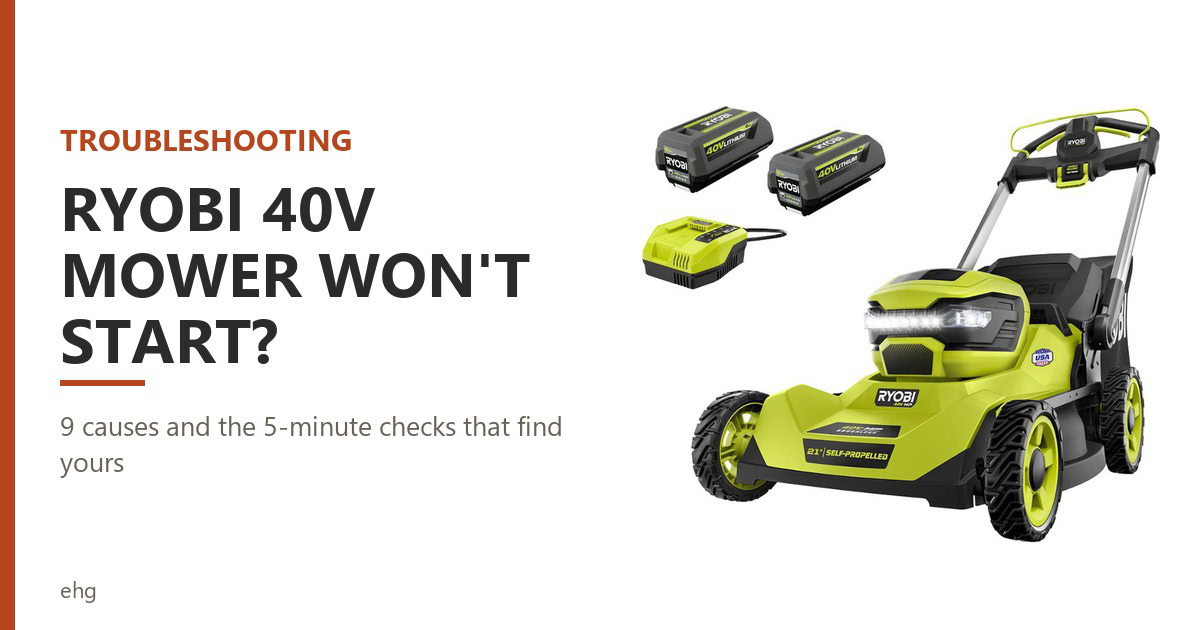
Is your Ryobi 40V lawn mower refusing to start, even with a battery that shows a full charge? Most of the time nothing is broken. The mower is waiting on one of its five start interlocks: a battery that hasn’t clicked home, a start key sitting proud of its slot, or a grass catcher that isn’t actually attached.
The good news: that means the fix is usually free and takes under five minutes. The frustrating part is that the mower gives you no error light to say which check failed.
This guide covers the RY401010 (18 in.), RY401110 (20 in. brushless) and the 40V HP 21 in. models, with the OP4026 through OP40752 battery packs. Every interlock and repair step below comes from Ryobi’s own operator manuals.
This post contains affiliate links. We may be paid a commission if you purchase through links, at no extra cost to you.
The Important Stuff
- The mower will not start without the battery seated, the start key installed, and the grass catcher or mulch plug attached. That is straight from Ryobi’s manual, and it catches most “dead” mowers.
- The start sequence matters: hold the start button, pull the bail, then release the button. Pulling the bail alone does nothing.
- A battery gauge showing four green lights does not mean the pack is healthy. The gauge reads voltage, not the pack’s ability to deliver current under load.
- Newer mowers have a tilt sensor. If the mower is tipped past 45 degrees, or stored vertically, it will refuse to start until it is flat.
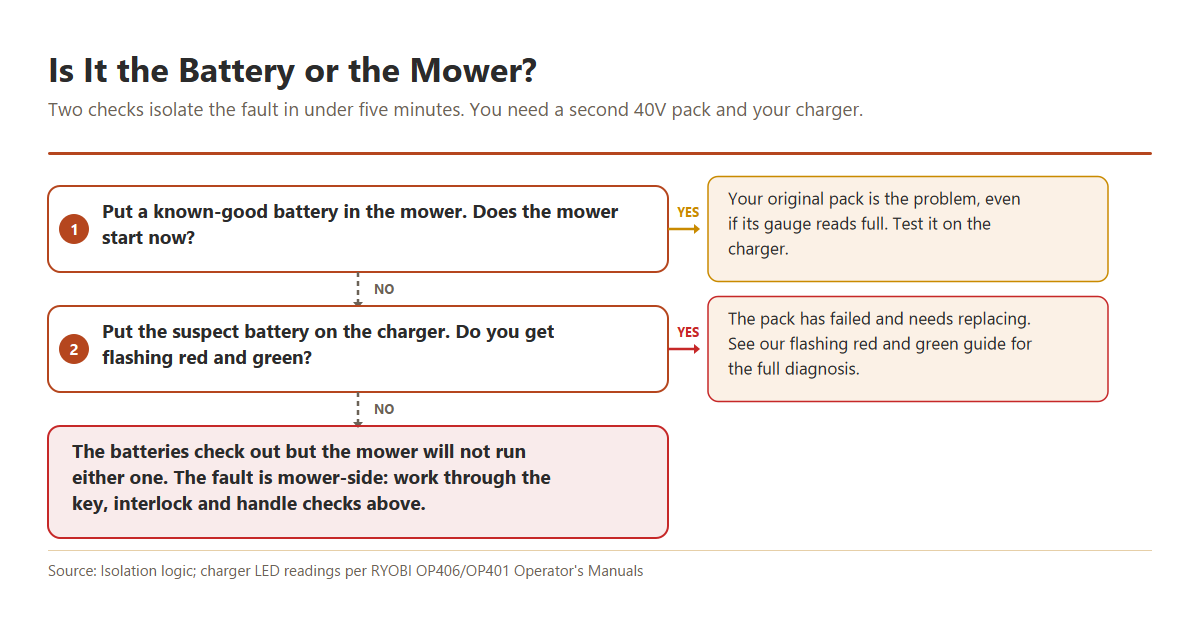
- If the mower runs a known-good battery but not yours, the battery is the problem. Our 40V battery problems guide takes it from there.
9 Reasons Your Ryobi 40V Mower Won’t Start & How to Fix It
Use this table to find your symptom, then read on for the full fix.
| Reason the mower won’t start | Solution |
|---|---|
| 1. Battery not fully seated | Reseat the pack until the latch clicks, then close the cover. |
| 2. Battery not actually charged | Charge it and read the charger lights, not the pack’s gauge. |
| 3. Start key missing or not fully inserted | Push the key all the way into its slot beside the battery port. |
| 4. Grass catcher or mulch plug not attached | Fit the catcher, mulch plug or side chute properly. The interlock blocks starting. |
| 5. Wrong start sequence | Hold the start button, pull the bail to the handle, release the button. |
| 6. Handle not locked in position | Unfold the handle fully and tighten both handle knobs. |
| 7. Tilt sensor tripped | Put the mower flat on the ground and try again. |
| 8. Deck packed with grass or blade jammed | Remove the key and battery, then clear the deck underside. |
| 9. Battery defective or in protection | Run the two-swap isolation test, then test the pack on the charger. |
1. The Battery Isn’t Fully Seated
This is the one readers report most, usually phrased as “I have to pull the battery out and put it back in to make it work.”
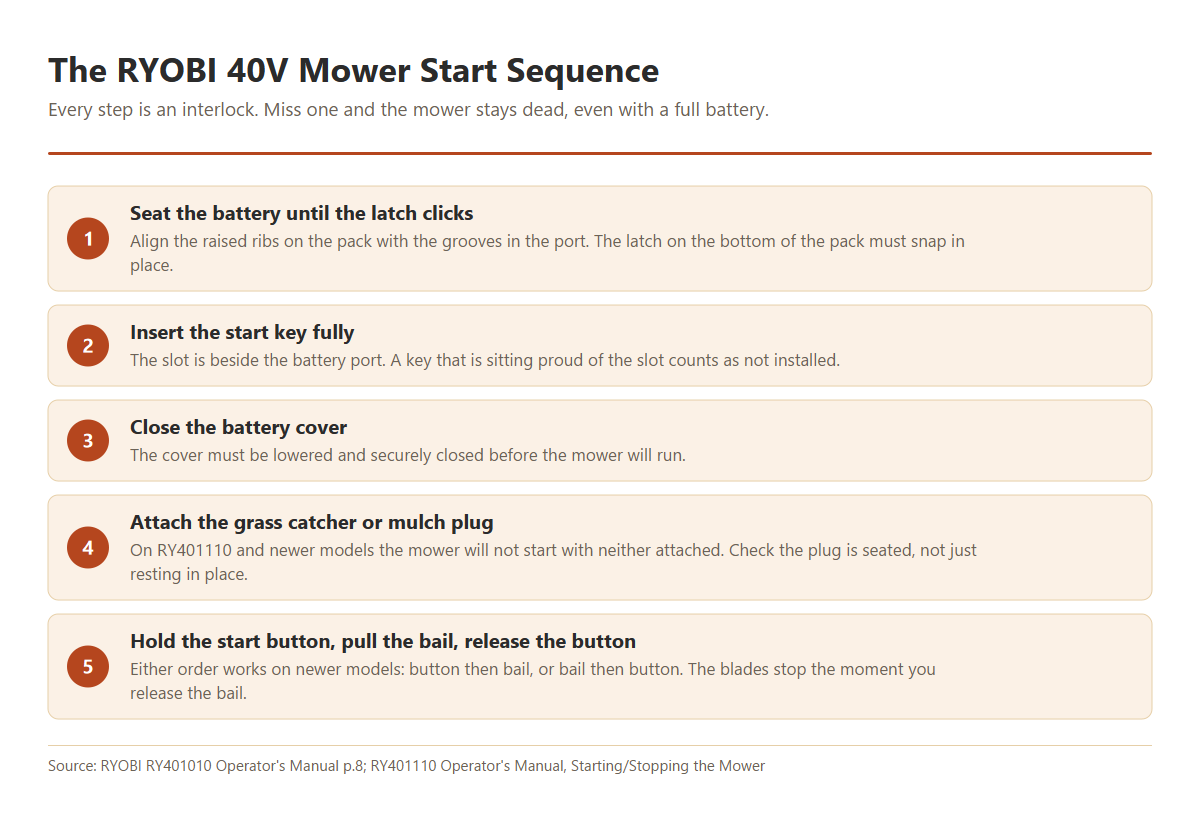
Ryobi’s manual is specific about what seated means. The raised ribs on the pack align with the grooves in the port, and the latch on the bottom of the pack must snap into place. A pack resting on its contacts without the latch engaged will power the mower intermittently or not at all.
How To Fix It
- Raise the battery cover and pull your pack out.
- Check the port for grass clippings and dirt, and brush them out.
- Look at the metal contacts on the pack and in the port. If they look dull or corroded, clean them with an electronics contact cleaner such as CRC QD contact cleaner, and let them dry.
- Slide your pack back in along the grooves and press until you hear the latch click.
- Close the battery cover firmly. On these mowers the cover must be securely closed before the mower will run.
If your mower dies over bumps or cuts out when you tip it, this is almost always the cause. A pack that falls out of the port entirely means the latch itself is damaged, and that is a battery problem rather than a mower problem.
2. The Battery Isn’t Actually Charged
Ryobi’s own troubleshooting table lists a low battery as the first cause of a mower not starting. The catch: the fuel gauge on your pack is not a reliable witness.
The gauge measures voltage. A worn pack can show full and still collapse the moment the mower asks it for real current. So don’t trust the four lights; trust the charger.
Put your pack on the charger and read the LEDs.
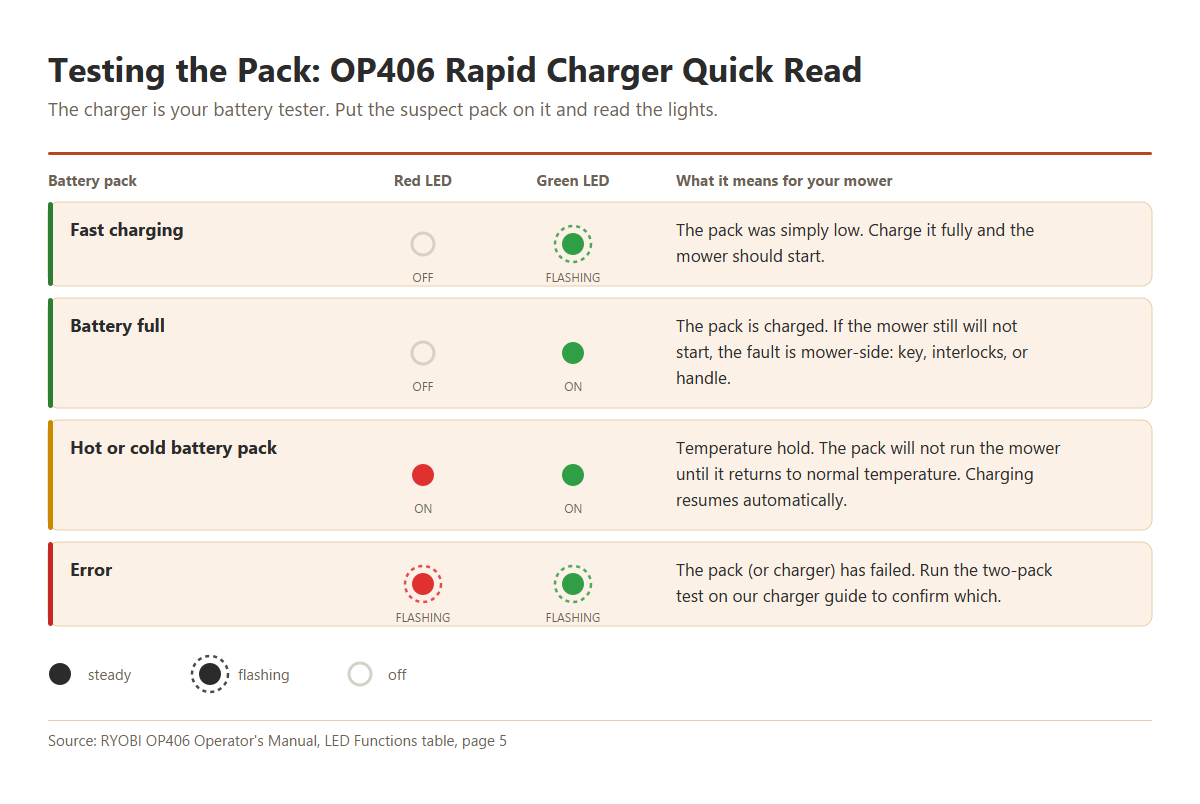
Green flashing means the pack genuinely was low. Charge it fully and the mower should start.
Flashing red and green together is Ryobi’s error state, and it means the pack or the charger has failed. Our charger problems guide has the full two-pack test, and the flashing red and green guide covers every cause of that one code.
No charger to test with?
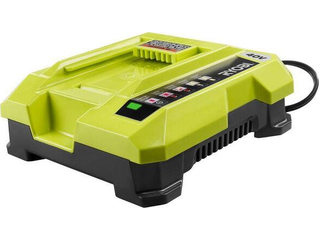
The charger is the only honest battery tester you own. If yours is missing or suspect, the rapid charger works with every 40V pack Ryobi makes.
3. The Start Key Isn’t Installed
The start key is the small plastic key that slots in beside the battery port, and the mower is completely dead without it.
Ryobi lists “start key not installed” as one of the two manual-documented causes of a mower not starting. This one is easy to hit after winter, because the manual tells you to remove the key for storage and most people do.
How To Fix It
- Raise the battery cover.
- Find the key slot beside your battery storage port.
- Push the key in until it’s fully home. A key sitting proud of the slot counts as not installed.
- Close the cover and try your start sequence again.
If you lost your key over winter, check the underside of the mower’s storage spot before buying anything. Replacement keys are model-specific, so order by your mower’s model number from the label on your deck.
4. The Grass Catcher or Mulch Plug Isn’t Attached
On the RY401110 and newer models, Ryobi’s manual states the mower will not start without the grass catcher or mulch plug attached. This is the interlock that catches people who just emptied the bag.
The discharge opening has a sensor or mechanical interlock behind it. A catcher hanging on the hooks but not seated, or a mulch plug pushed in at an angle, reads as missing.
How To Fix It
- Remove whichever attachment your mower has fitted: catcher, mulch plug or side discharge chute.
- Refit it firmly. Your mulch plug should sit flush, and your catcher should sit square on both mounting points with the rear door resting on it.
- Try the start sequence again.
If you switched attachments right before your mower went dead, this is your cause. Other guides often miss it, because it is not a fault at all.
5. You’re Fighting the Start Sequence
Your Ryobi 40V mower needs two controls pressed in the right pattern, and neither works alone.
The manual’s sequence: press and hold the start button, pull the bail (the blade control lever) back toward the handle, then release the button. On newer models like the RY401110 the reverse order also works, bail first and then the button.
Release the bail at any point and the motor stops instantly. That is the design, not a fault. If you get a brief click but no motor, hold the bail fully against the handle while you press the button; a half-pulled bail keeps the switch open.
6. The Handle Isn’t Locked in Position
Ryobi’s troubleshooting table opens with this one: handle not in position, handle knobs not tight.
Your mower’s start switch lives in the handle, and the folding sections have to be fully extended and locked for the circuit to close. There is a sneaky version of this fault too: the handle can creep down slightly with use and vibration, killing the mower mid-mow or blocking the next start.
How To Fix It
- Fold your handle fully down, then bring it back up to the operating position.
- Lock or tighten both sides. Depending on the model that means the upper and lower handle lock knobs, or the cam locks.
- Push and pull on the handle to confirm it has no play, then try starting.
7. The Tilt Sensor Has Tripped
Newer 40V mowers carry a tilt sensor that prevents starting when the mower is tipped more than 45 degrees or standing vertical.
That matters because these mowers are designed to store vertically. Take one down off the wall, start it before it’s sitting flat, and you will get nothing and assume the worst.
The fix is the whole fix: put all four of your mower’s wheels flat on the ground, wait a moment, and run the start sequence again. If you were tipping your mower to check the blade, remove the key and battery first anyway. That’s the manual’s rule for any work under the deck.
8. The Deck Is Packed With Grass
A blade that can’t spin freely reads like a mower that won’t start. The motor tries, the overload cuts it, and you hear a click or a brief hum.
Wet clippings are the usual culprit. They pack the underside of your deck after you mow damp grass, and Ryobi’s manual tells you to clean the deck underside after every use for exactly this reason.
How To Fix It
- Remove the start key and the battery pack. Never reach under the deck with either installed.
- Tip your mower on its side and scrape the packed clippings off the deck underside with a plastic scraper or stiff brush.
- Check your blade for wound-on string, wire or a stick jamming it, and clear anything you find.
- Never hose the mower down. Ryobi is explicit that water can short the electronics; use a dry cloth.
While you are under there, look at your blade edges. A blade that’s bent or badly worn causes vibration and overload cuts, and the manual’s answer is to replace it rather than straighten it.
9. The Battery Is Defective or in Protection
If every interlock checks out and your mower still won’t start, stop guessing and isolate the fault. This is the test readers ask for most, usually as “the battery shows fully charged but the mower won’t run.”
What you need: a second 40V battery, your charger, and optionally a digital multimeter if you want to see the voltage for yourself.
Two other protection states can make a good pack refuse to work.
A pack that has just come off a long mow in summer heat can be in thermal protection. Let it cool indoors for 30 to 60 minutes, then try again.
A pack that sat deeply discharged all winter can be in sleep mode, where the gauge shows nothing at all. Before you bin it, know this: our 40V battery problems guide covers the documented ways to wake one, and why a pack won’t hold charge explains the capacity fade behind short run times.
Pack failed the isolation test?
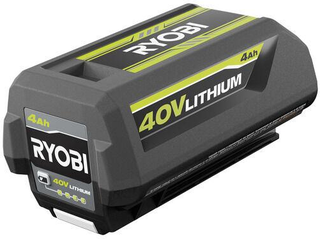
A pack that flashes red and green on the charger, or won’t run any tool, is done. The 6Ah high-capacity pack runs the same mowers with more runtime than the packs most kits shipped with.
The Mower Starts, Then Cuts Out Mid-Mow
Half the “won’t start” complaints we see are really “starts, runs a while, then quits.” If that is your pattern, start here, because it points at load or battery, not a broken mower.
Ryobi’s manual gives the first answer directly: a motor that stops while cutting means your cutting height is set too low. Thick or wet grass at a low height overloads your motor until the protection trips.
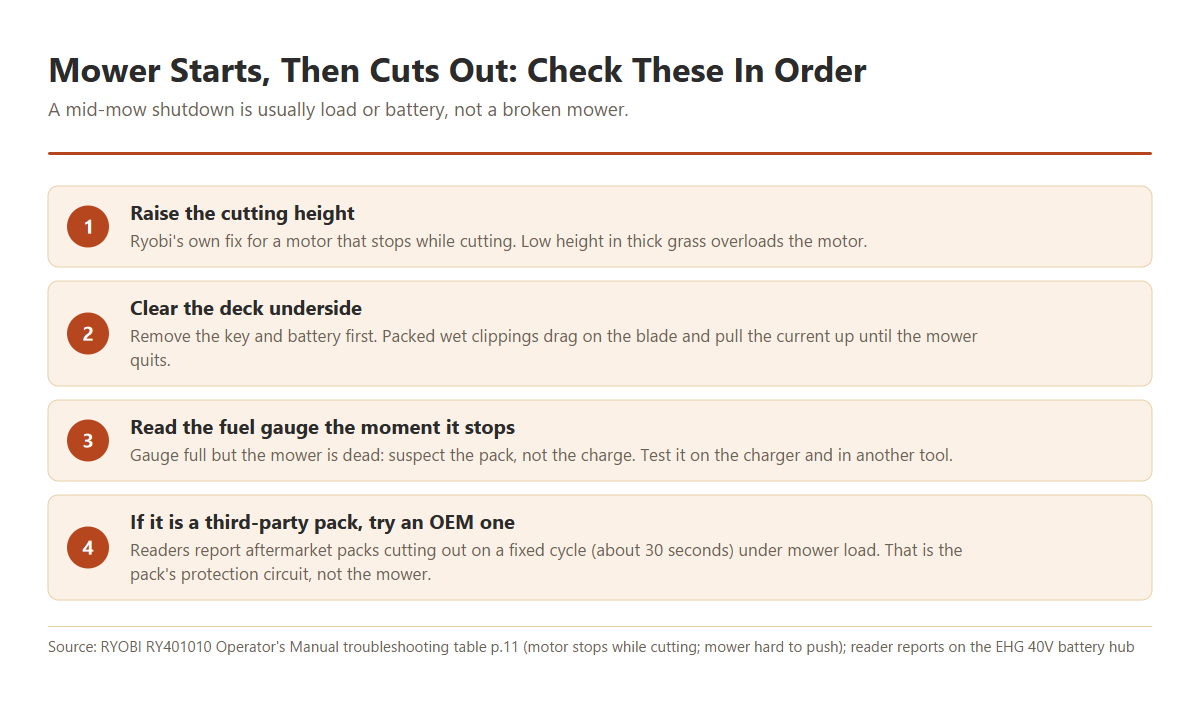
The battery version of this fault has a tell. If your mower quits and your pack’s gauge still shows most of a charge, your pack is collapsing under load. That is capacity fade in an older pack, and recharging it over and over will not cure it.
One more pattern from readers: an aftermarket pack that cuts out on a fixed cycle, around every 30 seconds, restarting fine each time. That is the third-party pack’s protection circuit tripping under mower load, not a mower fault. Swap in a genuine pack such as the RYOBI 40V 6Ah and the cycling stops.
Model-Specific Notes
RY401010 (18 in. push): the model whose manual this guide’s troubleshooting table comes from. Start key beside the battery port, blade control lever plus start button, no tilt sensor documented. Blade nut torque is 350 to 400 in-lbs with a 15 mm wrench if you’re refitting the blade.
RY401110 (20 in. brushless): adds the documented interlocks. It will not start without the catcher or mulch plug attached, has the 45-degree tilt sensor, and runs LED headlights whenever the motor runs. Pressing and releasing the bail lights the headlights for 60 seconds without starting the motor, which is normal and occasionally mistaken for a fault.
40V HP 21 in. (self-propelled): readers run these with the OP40752 7.5Ah pack and OP406 rapid charger. Dual battery ports mean a second seating latch to check. One documented reader case: the 7.5Ah pack showing a charger error that the 4Ah pack didn’t. The isolation test above sorts that in minutes.
Buying a Replacement 40V Battery
If your diagnosis landed on the pack, here is the honest read before you spend anything.
Check your warranty first. Ryobi’s 40V mowers carry a five-year limited warranty for home use, and the batteries carry their own coverage. A pack that failed inside its warranty window costs you a phone call to 1-800-860-4050, not money.
Out of warranty, you will choose between genuine and aftermarket. Aftermarket packs cost roughly half as much, and plenty of readers run them. The trade-offs are real though: reader reports of protection circuits cutting out under mower load, no Ryobi warranty, and capacity labels that don’t always match reality. For a high-draw tool like a mower, the genuine pack is the buy.
The RYOBI 40V 6Ah high-capacity battery fits every 40V mower in this guide and outlasts the 4Ah and 5Ah packs most kits shipped with. If your charger failed the two-pack test instead, the 40V rapid charger is the replacement.
The pick for 40V mowers
Genuine RYOBI 6Ah high-capacity pack. Full-power mowing, the fuel gauge on the pack, and it is covered by Ryobi’s battery warranty.
Related Ryobi Guides
- Ryobi 40V battery not charging: the hub guide, covering a pack the charger will not accept at all, including sleep-mode recovery.
- Ryobi 40V charger problems: what each charger light means on the rapid and standard chargers, and the two-pack test that finds the failed part.
- Ryobi battery flashing red and green: the error code readers hit most, and every cause of it.
- Ryobi 40V battery won’t hold a charge: the pack that reads full then dies in minutes, which is the usual reason a mower quits mid-lawn.
Frequently Asked Questions
Why won’t my Ryobi mower start when the battery shows fully charged?
Because the gauge measures voltage, not health, and because a charged battery does not clear your mower’s interlocks. First re-run the start checklist: pack latched, key fully in, cover closed, catcher or plug attached, handle locked.
If your interlocks pass, run the isolation test above. A pack can read full and still collapse the moment the mower loads it, and the charger’s lights will tell you the truth about it.
Why does my mower run 10 or 15 minutes and then stop?
If your gauge reads empty when it stops, that’s your real runtime and the pack has lost capacity, or it was never fully charged. If the gauge still shows charge, the pack is failing under load and it is time to test it on the charger.
Before you blame the battery, raise your cutting height and clear your deck. Thick, wet grass at a low height trips the overload protection well before the battery is empty.
Why do I have to take the battery out and put it back in to restart the mower?
That is the seating latch, not the battery. The pack is sitting on its contacts without the bottom latch snapped home, so any vibration breaks the connection until you reseat it.
Clean your battery port, reseat until you hear the click, and close the cover firmly. If your pack still won’t latch, the latch itself is damaged and the pack needs replacing.
Can I use a third-party battery in my Ryobi 40V mower?
They fit, and they do work for many readers. The documented downside on mowers specifically is protection-circuit cutouts under high load, including packs that quit about every 30 seconds while cutting and then restart.
There’s no Ryobi warranty on them, and using one won’t void the mower’s warranty by itself, but Ryobi won’t cover damage an aftermarket pack causes. For trimmers and blowers they’re a reasonable saving. For the mower, genuine is the safer buy.
Why is my charger flashing red and green after winter storage?
Flashing red and green together is Ryobi’s error state for a failed pack or charger, and winter is when it usually appears. A pack stored on the charger all winter, or stored empty, can drop below the voltage the charger accepts.
Run the two-pack test in our charger guide to confirm which part failed. If it’s the pack, the flashing red and green guide covers the recovery options before you buy anything.
How long do Ryobi 40V mower batteries last?
Ryobi doesn’t publish a cycle-count or lifespan spec for 40V packs. Ryobi’s own support has told a reader with 6-year-old packs that they were past their expected lifespan, which matches what we see in reader reports: roughly 3 to 6 seasons depending on storage and use.
Storage is the lever you control. Store your packs indoors at partial charge, off the charger, and never leave them flat all winter.
This post contains affiliate links. We may be paid a commission if you purchase through links, at no extra cost to you.
