Is your furnace blowing cold air when the heat is on? The most common cause is a thermostat fan set to ON instead of AUTO, which keeps the blower pushing room-temperature air between heating cycles.
That’s a ten-second fix. Most of the other causes are quick too, like a clogged filter or a furnace that has locked itself out and needs a reset. A few need a technician, and this guide tells you which ones.
We cover gas furnaces from Carrier, Bryant, Goodman, Lennox and Rheem, plus electric furnaces. Every timing, reset step and error code below comes from the manufacturers’ own manuals.
This post contains affiliate links. We may be paid a commission if you purchase through links, at no extra cost to you.
The Important Stuff:
- Set the thermostat to HEAT, the fan to AUTO, and the temperature a few degrees above the room. Fan ON is the top cause.
- A puff of cool air for the first minute is normal. The blower waits 20 to 45 seconds after the burners light so the heat exchanger can warm up.
- Warm air that turns cold while the blower keeps running usually means a dirty filter has tripped the high limit switch.
- Burners that light and then go out within seconds point to a dirty flame sensor.
- If you smell gas, leave the house and call your gas utility from outside. Don’t touch switches or the thermostat.
10 Reasons Your Furnace Is Blowing Cold Air & How to Fix It
Use this table for a quick summary of each cause and its fix. Read on for the full steps.
| Reason your furnace is blowing cold air | Solution |
|---|---|
| 1. Thermostat fan set to ON, or the wrong mode | Set the fan to AUTO, the mode to HEAT, and the setpoint above room temperature. |
| 2. The furnace is still warming up | Wait about a minute after the burners light. The blower delay is normal. |
| 3. Dirty filter or blocked vents | Replace the filter and open every supply and return vent. |
| 4. Dirty flame sensor | Clean the sensor rod with fine steel wool, or replace it. |
| 5. Ignition failure and lockout | Read the error code, then reset the furnace once. |
| 6. Gas supply off | Check the furnace gas valve and your other gas appliances. |
| 7. Clogged condensate drain or blocked vent pipe | Clear snow, ice or debris from the outside pipes and check the drain line. |
| 8. Leaky or disconnected ducts | Reconnect and seal accessible ducts with mastic or foil tape. |
| 9. Flame rollout switch tripped | Don’t keep resetting it. Call an HVAC technician. |
| 10. Electric furnace breaker tripped | Reset the furnace’s own breakers and the panel breakers once. |
Furnace Blowing Cold Air? Find Your Cause
Three questions. Stand near the furnace while you answer them.
Turn on JavaScript to use the diagnosis tool, or use the summary table above.
1. The Thermostat Fan Is Set to ON
Carrier names this the most common reason a furnace blows cold air. With the fan set to ON, the blower runs all the time, including between heating cycles when the burners are off.
So you get warm air while the furnace is heating, then room-temperature air the rest of the time. It feels like your furnace is blowing cold air, but it’s working normally.
How To Fix It
- Set the fan switch on your thermostat to AUTO. The blower will then run only while the furnace is heating.
- Check the mode is set to HEAT, not COOL or OFF.
- Set the temperature a few degrees above the current room temperature.
- Check the program schedule. A schedule can quietly drop the setpoint at night or while you’re out.
- Replace the batteries if the display is blank or faded.
If your thermostat is old, blank with fresh batteries, or you can’t tell which mode it is in, it may be time for a replacement. A programmable model also lets you set the right cycle rate for a gas furnace, which helps with short cycling.

Thermostat on its last legs?
The Honeywell T6 Pro is a plain programmable thermostat with clear HEAT, COOL and fan settings. Its installer menu also lets you set the cycle rate for your furnace type.
Prefer a smart thermostat? The ecobee Smart Thermostat Enhanced shows the mode and fan setting on your phone, so a wrong setting is easy to spot.
2. The Furnace Is Still Warming Up
A modern gas furnace does not start the blower the moment your burners light. It waits so the heat exchanger can warm up first, otherwise you’d get a blast of cold air every time the heat came on.
How long it waits depends on the brand. Carrier tells homeowners to expect warm air about 30 to 60 seconds after the burners ignite. The installation manuals put the blower delay at 30 seconds on Goodman and Lennox, about 20 seconds on Rheem, and 25 to 45 seconds on Carrier two-stage furnaces.
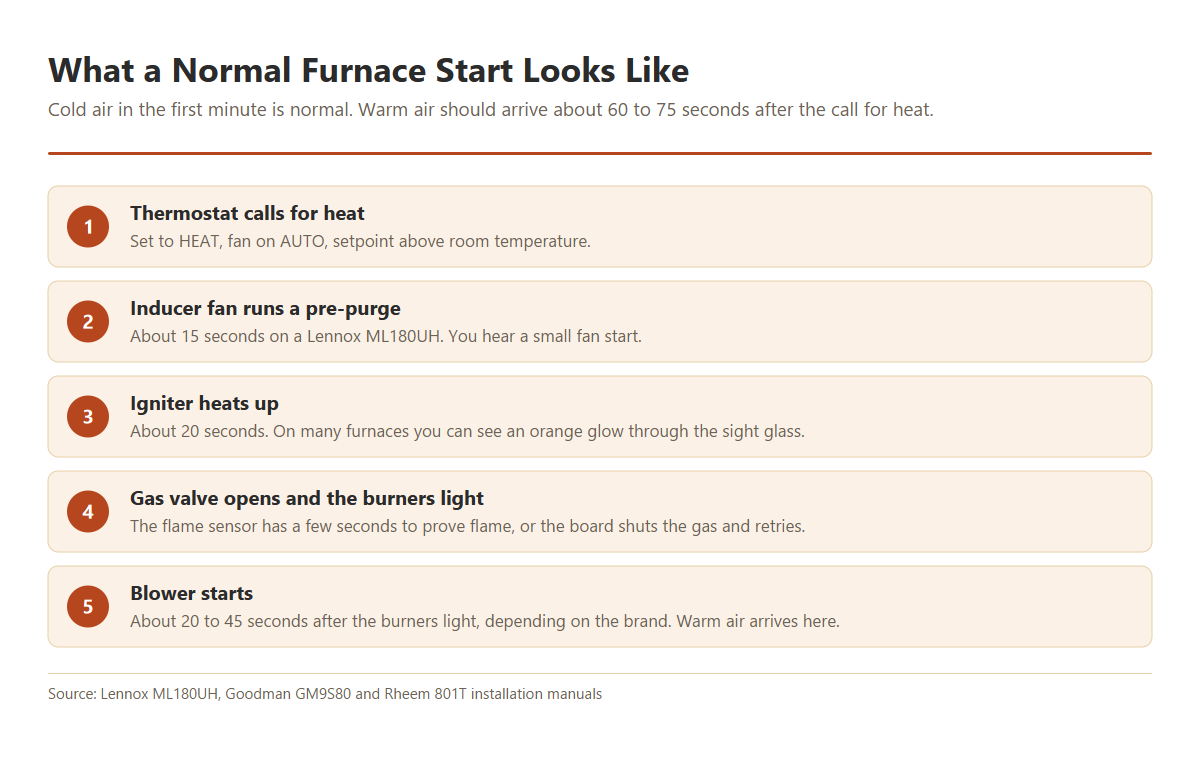
The blower also keeps running for 90 to 180 seconds after your burners shut off, to pull the last heat out of your furnace. That tail end of air can feel cool, and it’s normal too.
How To Fix It
- Wait two to three minutes after you hear the burners light before you judge the air.
- Feel the air at the register nearest the furnace, not one at the far end of the house.
- If the air is still cold after a few minutes of burner operation, move on to the causes below.
Want to be sure? A cheap kitchen thermometer settles it. Your furnace’s rating plate lists a temperature rise range, and the supply air should be that much warmer than the return air.
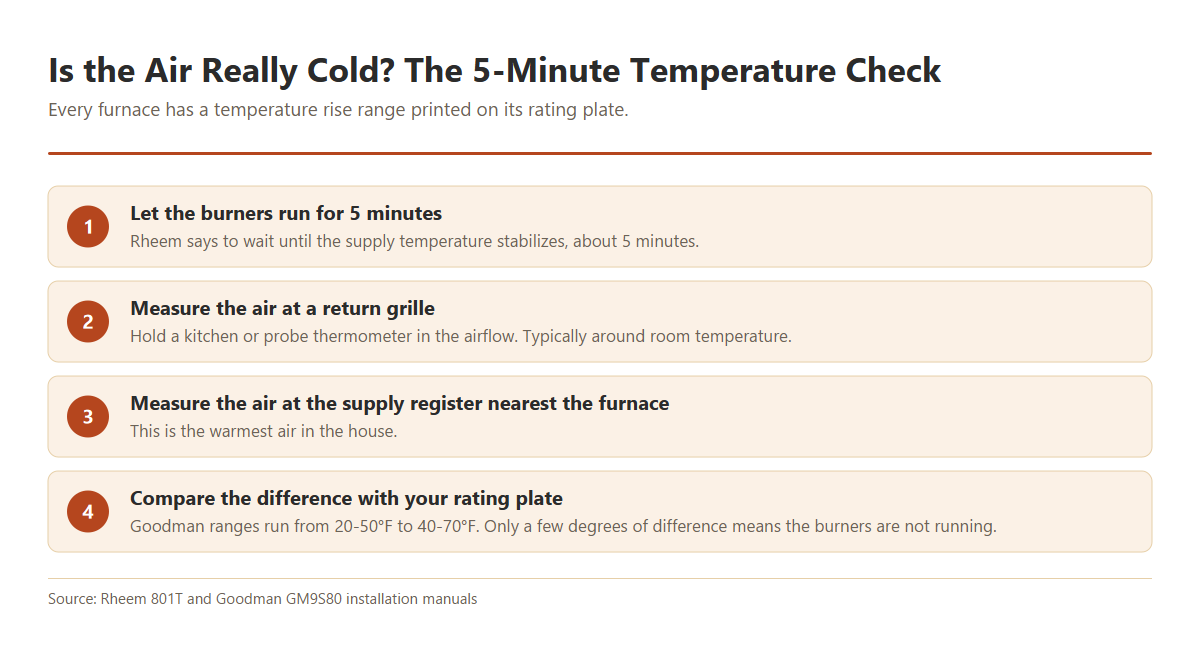
With return air around 68°F and a typical 35 to 65°F rise, the supply air should land somewhere around 100 to 130°F. If it is only a few degrees warmer than the room after five minutes, your burners aren’t running.
3. A Dirty Filter or Blocked Vents
This is the cause behind the “it blew hot for a while, then went cold” complaint. A clogged filter starves your furnace of airflow, so the heat exchanger overheats.
The high limit switch then shuts off the gas to protect the furnace, but the blower keeps running to cool it down. Carrier’s troubleshooting guide says the blower runs for at least four minutes, or until the switch resets. That is four minutes of cold air, and the cycle repeats.
Goodman’s manual calls a blocked or dirty filter one of the most common causes of furnace problems, and tells you to inspect it monthly.
How To Fix It
- Turn the thermostat to OFF.
- Pull out the filter and hold it up to a light. If you can’t see light through it, replace it.
- Fit the new filter with the airflow arrow pointing toward your furnace.
- Open every supply register in the house. Closing vents in unused rooms raises the pressure in the ducts and makes the limit trip.
- Move furniture, rugs and boxes off the return grilles.
- Turn the heat back on and watch for a full cycle.
ENERGY STAR says to check your filter every month and change it at least every three months. If your furnace has been tripping the limit, a lower-restriction MERV 8 filter is the safer choice.

Filter clogged? Swap it today.
Nordic Pure MERV 8 filters trap dust without choking airflow, which matters on a furnace that keeps tripping its limit switch. Match the size printed on your old filter’s frame.
If you want finer filtration, Filtrete MPR 1000 MERV 11 filters are a popular choice. Change them on schedule, because a denser filter clogs faster.
If the limit keeps tripping with a clean filter and open vents, the problem is deeper: a weak blower motor, a wrong blower speed, or undersized ducts. That’s a job for an HVAC technician. Our guide to weak airflow from vents covers the duct side.
4. A Dirty Flame Sensor
The flame sensor is a thin metal rod that sits in the burner flame. Its job is to prove to the control board that the gas is actually burning.
Over time, it builds up a dull coating that stops it reading the flame. The board then shuts off the gas within seconds, even though your burners lit fine. The blower runs on, blowing cool air, and the furnace retries.
Carrier’s troubleshooting guide lists oxide buildup on the flame sensor as a cause of failed ignition, and says to clean it with fine steel wool. After a few failed tries, most furnaces lock out completely (see cause 5).
⚠ Essential Safety Warning: Working Inside a Gas Furnace
- Turn off the power at the furnace service switch and close the gas valve before you remove any panel.
- Never touch the hot surface igniter beside the sensor. It’s brittle and cracks easily.
- Never try to light the burners by hand on a furnace with an automatic igniter.
- Goodman labels flame sensor cleaning as a job for a qualified servicer. If your manual says the same, or you’re not comfortable working inside the furnace, call a technician.
If you can’t meet these conditions, leave the flame sensor to an HVAC technician. It’s a short service call.
How To Fix It
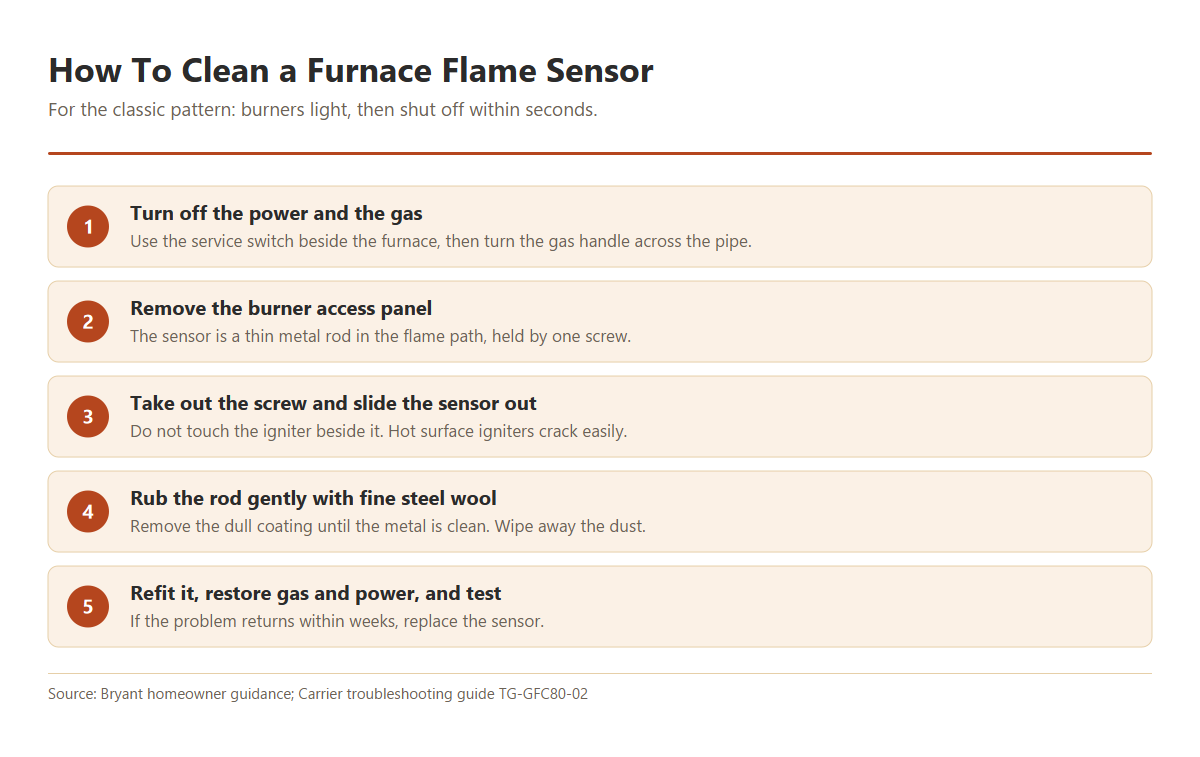
- Turn off the power at the service switch and close the gas valve.
- Remove the burner access panel and find the sensor, a thin rod held by one screw.
- Remove the screw and slide the sensor out.
- Rub the rod gently with fine steel wool until the metal is clean, then wipe it.
- Refit the sensor, replace the panel, and restore gas and power.
If the problem comes back within a few weeks, replace the sensor. Match the part number on your old one. A 0130F00010 flame sensor fits many Goodman and Amana furnaces, and a PFS401 universal flame sensor replaces the common White-Rodgers 760-401 used on Carrier units.
5. Ignition Failure and Lockout
If the burners never light at all, your furnace may have tried and failed to ignite several times, then locked itself out. While it’s locked out, it won’t try to heat.
Every brand does this a little differently. Goodman retries three times before locking out. Rheem tries four times, then locks out for an hour. Lennox tries five times before a 60-minute lockout, and Carrier boards reset themselves after three hours.
Common causes are a cracked hot surface igniter, a dirty flame sensor, or no gas. On an older furnace with a standing pilot, the pilot light may simply have gone out. Our guide to a furnace igniter that’s not working walks through the full ignition sequence.
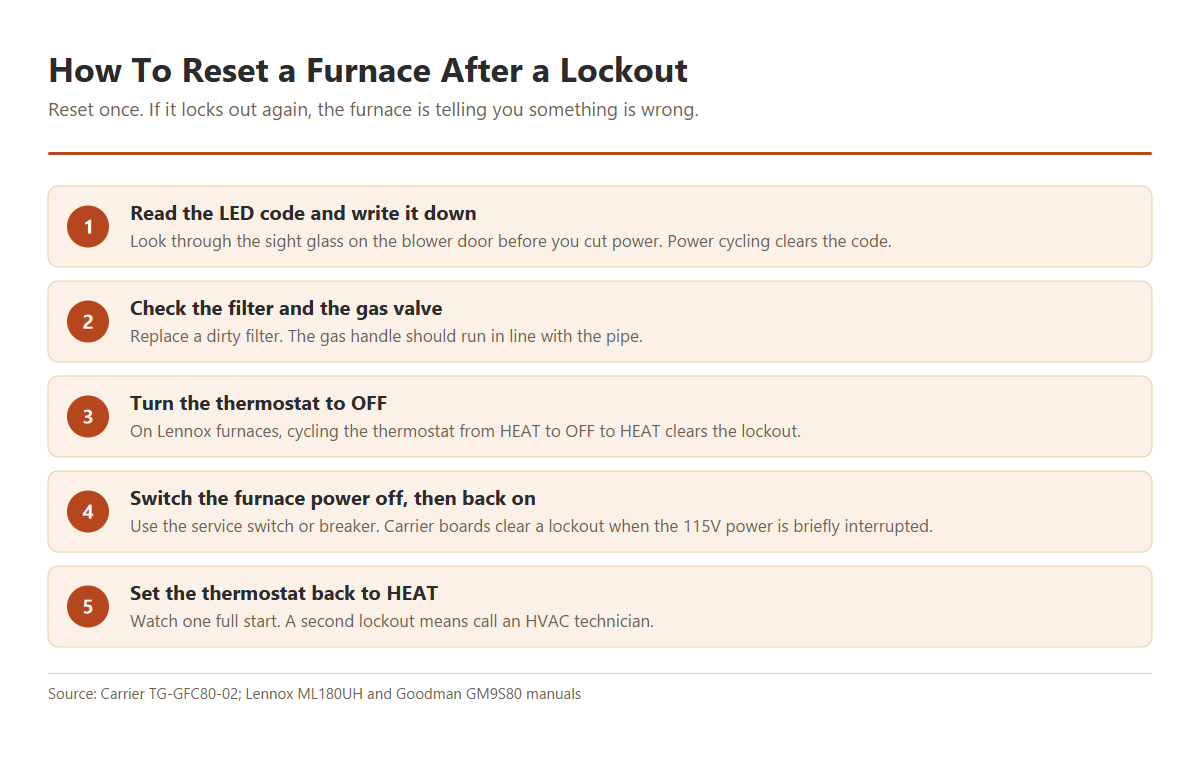
How To Fix It
- Look through the window on the blower door and write down the flashing LED code before you touch anything. Cutting the power clears it.
- Check your filter, and check that the gas valve handle runs in line with the pipe.
- Turn the thermostat to OFF, switch your furnace power off at the service switch, then back on.
- Set the thermostat back to HEAT and watch one full start.
- On a standing-pilot furnace, relight the pilot only by following the instructions on the label inside the furnace door.
Reset once. If your furnace locks out again, don’t keep resetting it. Something is stopping it from lighting safely, and a technician needs to find out what. Don’t buy parts until you know the code.
6. The Gas Supply Is Off
No gas means no flame, and the furnace will run its blower on failed attempts before locking out. Carrier’s troubleshooting guide lists a shut manual valve and low gas pressure among the causes of failed ignition.
How To Fix It
- Check whether your other gas appliances work, such as the stove or water heater.
- Find the gas valve on the pipe going into your furnace. The handle should run in line with the pipe. Across the pipe means it is off.
- If you heat with propane, check the tank level.
- If nothing gas-fired works, call your gas utility.
If you smell gas, stop. Don’t light anything, don’t touch switches, and don’t use your phone inside. Leave the house and call your gas supplier from outside, as every furnace manual instructs.
7. A Clogged Condensate Drain or Blocked Vent Pipe
This one only applies to high-efficiency furnaces, the ones with white plastic vent pipes running outside. These furnaces make water as they burn gas, and it drains away through a trap and a hose.
If the drain clogs, water backs up into the inducer or the pressure switch tube. The pressure switch then will not confirm a safe draft, so the furnace won’t light. Goodman’s manual lists a blocked flue, intake pipe or drain system as causes of an open pressure switch. A pipe blocked by snow, ice or a bird’s nest does the same.
How To Fix It
- Go outside and find the two plastic pipes where they leave the house.
- Clear any snow, ice, leaves or nests from the pipe openings by hand. Don’t push anything inside the pipes.
- Check the drain hose from your furnace isn’t kinked and runs freely to the floor drain or pump.
- If your furnace drains into a condensate pump, check the pump’s tank is not full and the pump runs.
- Reset the furnace once (cause 5) and watch it start.
If your pump has failed, a replacement like the Little Giant VCMA-15ULS condensate pump has an overflow switch that stops your furnace before water spills. Flushing the trap or replacing a pressure switch is a technician’s job.
8. Leaky or Disconnected Ducts
If the air is warm at the furnace but cool at some registers, your ducts may be losing the heat before it arrives. ENERGY STAR says about 20 to 30 percent of the air moving through a typical duct system is lost to leaks, holes and poorly connected ducts.
Ducts in an attic, crawlspace or garage are the worst for it, because any leak there dumps heat into a cold space. A disconnected return duct can also pull cold air from the attic straight into your furnace.
How To Fix It
- Check every duct you can reach in the basement, attic or crawlspace for joints that have pulled apart.
- Push loose sections back together and fasten them.
- Seal the joints with duct mastic or foil tape. ENERGY STAR notes that ordinary duct tape does not last.
- Feel along the seams for escaping air while the blower runs.
Ducts you can’t reach, or ducts that are crushed or badly undersized, need an HVAC contractor.
9. The Flame Rollout Switch Has Tripped
A rollout switch is a safety device near your burners. It trips if flames roll out of the burner area instead of going up through the heat exchanger, usually because of a blocked vent or heat exchanger.
When it trips, the furnace will not light, and the blower may still run. Carrier and Lennox both describe it as a manual-reset switch. That is deliberate: a trip means combustion gases went somewhere they shouldn’t.
⚠ Essential Safety Warning: Rollout Switch Trips
- Don’t keep resetting a rollout switch. Each trip means flame or flue gas escaped the burner area.
- Look for soot or scorch marks around the burners. Either one means stop using the furnace.
- Check your carbon monoxide alarm works. The CPSC recommends one on every level of the home and outside sleeping areas.
- Call an HVAC technician to find the blockage before the furnace runs again.
This is never a DIY fix. A technician needs to inspect the vent and heat exchanger.
If you do not have a carbon monoxide alarm near your furnace, fix that today. It’s the cheapest safety upgrade in the house.

No CO alarm near your furnace?
The First Alert CO605 plugs into a standard outlet and has a battery backup, so it keeps working through a power cut.
10. The Breaker Has Tripped on an Electric Furnace
Electric furnaces heat with large elements instead of burners. Bigger units have their own circuit breakers inside the cabinet, and some are fed by two separate circuits from your panel.
So the blower can have power while the heating elements don’t. You get a fan blowing room-temperature air, which looks just like a gas furnace that won’t light.
How To Fix It
- Check the breakers on your furnace itself are all in the ON position.
- Check the furnace breakers in your main panel. There may be two.
- Reset a tripped breaker once.
- Check the filter. Electric furnaces have limit switches too, and a clogged filter trips them.
If a breaker trips again, stop. Electric furnaces run on 240 volts, and the Nordyne owner’s manual warns there are no user-serviceable parts inside the control panel. Elements, sequencers and limits need an HVAC technician or electrician.
Furnace Error Codes That Mean Cold Air
Most furnaces made in the last 20 years flash a diagnostic code through a small window in the blower door. Read it before you call for service. It can save the technician time and you money.
Codes vary between models, even within one brand. Always check the code label inside your own furnace door. These examples come from each manufacturer’s manuals.
Carrier and Bryant (troubleshooting guide TG-GFC80-02). Short flashes give the first digit and long flashes the second.
| Code | What it means |
|---|---|
| 13 | Limit circuit lockout. Resets itself after 3 hours. |
| 14 | Ignition lockout. Resets itself after 3 hours. |
| 32 | Pressure switch did not close. Check the vent and drain. |
| 33 | Limit circuit fault. Check for a dirty filter or restricted ducts. |
| 34 | Ignition proving failure, including a dirty flame sensor. |
Goodman and Amana (GM9S80 manual, display codes).
| Code | What it means |
|---|---|
| EE0 | Lockout from too many ignition retries |
| EE2 | Pressure switch open |
| EE3 | High limit switch open |
| EE6 | Low flame signal |
| E11 | Rollout switch open |
Rheem and Ruud (801T manual, display codes).
| Code | What it means |
|---|---|
| 10 | One-hour lockout |
| 11 | Failed ignition |
| 12 | Low flame sense |
| 13 | Flame lost |
| 22 | Main limit open |
| 33 | Manual-reset rollout limit open |
| 57 | Pressure switch stuck open |
Lennox (ML180UH manual, flash codes).
| Flashes | What it means |
|---|---|
| 3 | Pressure switch open with the inducer running |
| 4 | Primary limit switch open |
| 5 | Rollout switch open |
| 7 | Lockout: burners failed to light |
| 8 | Lockout: burners lost flame too many times |
When To Call an HVAC Technician
Some of these fixes are yours, and some aren’t. Call a licensed HVAC technician if:
- The furnace locks out again after one reset.
- The limit keeps tripping with a clean filter and every vent open.
- The rollout switch has tripped, or you see soot or scorch marks.
- You smell gas, or your carbon monoxide alarm sounds.
- An electric furnace keeps tripping its breaker.
- The fix involves the gas valve, control board, inducer, pressure switch or heat exchanger.
Carrier’s own advice is not to repair or replace a control board yourself. We can connect you with a local HVAC technician for a free repair quote.
Waiting on a repair visit? A portable heater keeps one room warm in the meantime. Our pick of the quietest space heaters has options that will not keep you up at night.
Buying Replacement Furnace Parts
For anything you replace yourself, match the part number on the old part. Furnace parts look alike across brands but aren’t interchangeable. A flame sensor or igniter that’s the wrong length or voltage won’t work, and can damage the control board.
Third-party parts are common for flame sensors and filters, and they work well when the part number matches. For control boards, gas valves and inducers, stick with the original manufacturer’s part and have a technician fit it.
Here’s what’s worth keeping on hand:
- Filters: a stack of the right size saves a cold night. Nordic Pure MERV 8 for furnaces that run hot, or Filtrete MERV 11 for better dust capture.
- A flame sensor: the 0130F00010 for Goodman and Amana, or the PFS401 universal for Carrier-type furnaces.
- A carbon monoxide alarm: the First Alert CO605 plugs in near your furnace.
Frequently Asked Questions
Should I turn my furnace off if it’s blowing cold air?
Set the fan to AUTO first. If the furnace still blows cold air with the fan on AUTO and the mode on HEAT, turn the thermostat to OFF while you troubleshoot.
Running the blower without heat will not hurt your furnace, but it cools the house and runs up your power bill. If you smell gas or see soot, turn it off and call a technician.
Is it dangerous if my furnace is blowing cold air?
Usually not. Carrier says it’s not normally an immediate danger, but it does mean something isn’t working.
The exceptions are a gas smell, soot or scorch marks, a tripped rollout switch, or a carbon monoxide alarm. Any of those means stop using the furnace and call a technician.
Where is the reset button on a furnace?
Most modern gas furnaces don’t have a single reset button. You reset them by turning the thermostat to OFF and switching your furnace power off and back on at the service switch.
Some furnaces have a manual-reset rollout switch near the burners. Don’t press it repeatedly. A trip means the furnace needs inspecting first.
Why is my furnace running but not producing heat?
If the blower runs but your burners do not light, your furnace has either failed to ignite or locked out. Check the gas valve, your filter and the error code.
If the burners light and then go out, clean the flame sensor. If the air is warm at first and then cold, the high limit is tripping, usually from a dirty filter.
Why does my furnace blow cold air after I changed the filter?
Check the filter’s airflow arrow points toward the furnace, and that your filter fits its slot without gaps. A filter that’s too restrictive for your system can also trip the high limit.
If you switched to a high-MERV filter, try a MERV 8 and see whether the problem goes away.
Why does my furnace blow cold air at night?
The most likely cause is a thermostat schedule lowering the setpoint overnight, with the fan set to ON. The blower keeps running while your furnace is not heating.
Set the fan to AUTO and check the schedule. If it is a heat pump, see our guide to a heat pump that’s not heating, because defrost cycles can blow cool air too.
How many years does a furnace usually last?
It depends on the model, how hard it works, and how well it’s maintained. Age alone isn’t a reason to replace a furnace that still runs safely.
Repeated lockouts, a cracked heat exchanger or rising repair bills are better signs it is time. A technician can tell you whether a repair is worth it.
This post contains affiliate links. We may be paid a commission if you purchase through links, at no extra cost to you.
