Is your heat pump not heating, or blowing cold air even though it’s set to heat? Often, nothing is broken. Your heat pump is running a defrost cycle, or it’s making normal heat pump air, which is a lot cooler than the blast you’d get from a gas furnace.
When it really isn’t heating, the cause is usually something you can check in minutes: the thermostat setting, a dirty filter, or a tripped breaker. Carrier names those three as the most common causes.
This guide covers ducted heat pumps from Carrier, Trane, Lennox, Goodman and Rheem, plus ductless mini-splits. It shows you how to tell normal from broken, what you can fix yourself, and which jobs need a technician.
This post contains affiliate links. We may be paid a commission if you purchase through links, at no extra cost to you.
The Important Stuff:
- Heat pump air is normally about 85 to 100°F at the vent, versus 120 to 140°F from a gas furnace (Carrier). It can feel cool and still be heating your home.
- A few minutes of cool air with steam from the outdoor unit is a normal defrost cycle.
- Set the thermostat to HEAT, the fan to AUTO, and the temperature 5°F above the room.
- Cold air in Heat and warm air in Cool after a thermostat swap means the O/B setting is reversed.
- Ice thicker than 1/4 inch, a silent outdoor fan or a hissing sound need a technician. Switch to emergency heat in the meantime.
12 Reasons Your Heat Pump Is Blowing Cold Air & How to Fix It
Use this table as a summary of each cause and its fix. Read on for the details.
| Reason your heat pump isn’t heating | Solution |
|---|---|
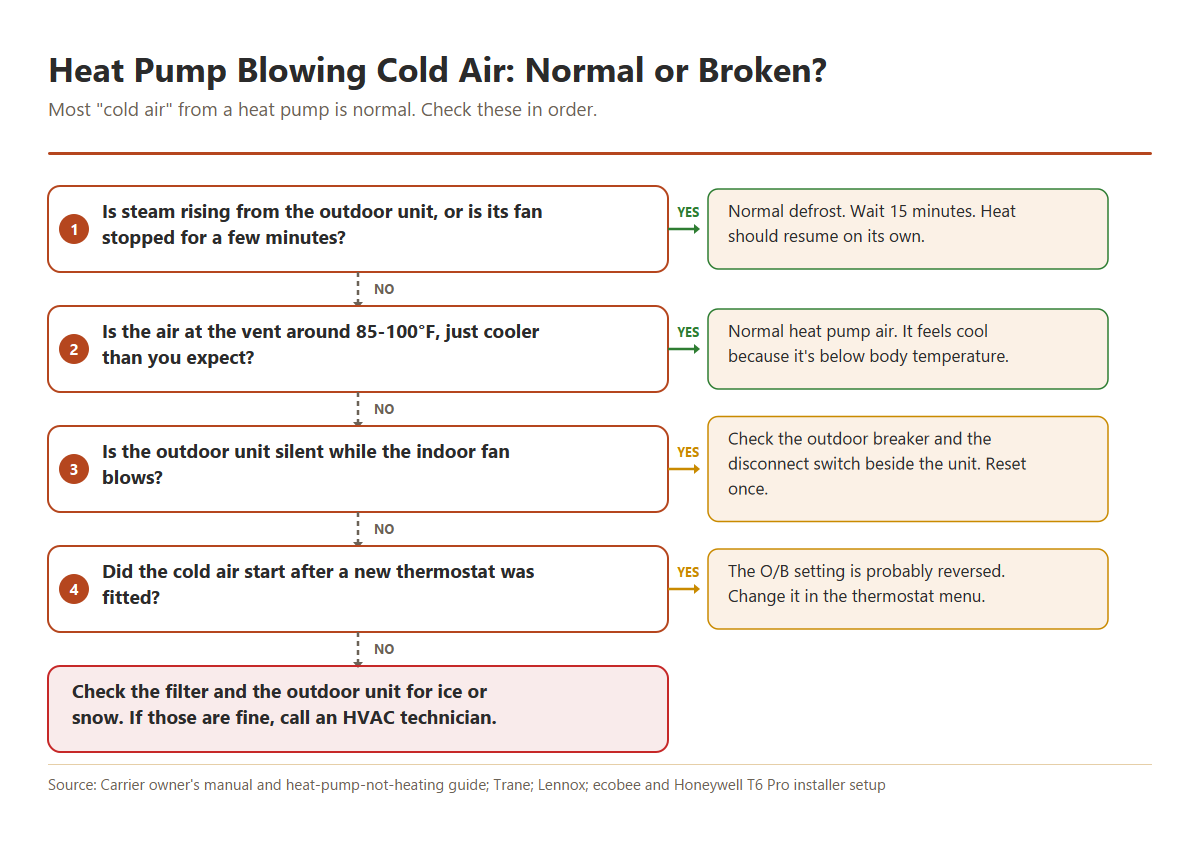
| 1. It’s running a defrost cycle | Wait 15 minutes. Heat resumes on its own. |
| 2. Heat pump air just feels cooler | Measure the vent air. 85-100°F is normal. |
| 3. Thermostat on COOL, or fan on ON | Set HEAT, fan AUTO, setpoint above room temperature. |
| 4. O/B setting reversed | Switch the O/B setting in the thermostat’s installer menu. |
| 5. Dirty filter or blocked vents | Replace the filter and open every vent. |
| 6. Breaker tripped or disconnect off | Check both breakers and the outdoor disconnect. Reset once. |
| 7. Outdoor unit blocked by snow or leaves | Clear the top, sides and 2 feet around it. |
| 8. Too cold outside for the heat pump alone | Let auxiliary heat help. Check the aux heat is working. |
| 9. Defrost failure and a frozen coil | Switch to emergency heat and call a technician. |
| 10. Low refrigerant | Call a technician to find and fix the leak. |
| 11. Stuck reversing valve | Call a technician to repair the valve or solenoid. |
| 12. Failed outdoor fan or capacitor | Turn the system off and call a technician. |
Heat Pump Blowing Cold Air? Find Your Cause
Go outside and look at the outdoor unit while you answer.
Turn on JavaScript to use the diagnosis tool, or use the summary table above.
1. It’s Running a Defrost Cycle
In cold, damp weather, frost builds up on your outdoor unit’s coil. The heat pump melts it by briefly running in reverse, which is called a defrost cycle.
During defrost, your vents can blow cooler air for a few minutes. Many systems switch on backup electric heat to cover it, so your thermostat may show “AUX”. Trane says homes without backup heat may notice cool air, and that’s normal.
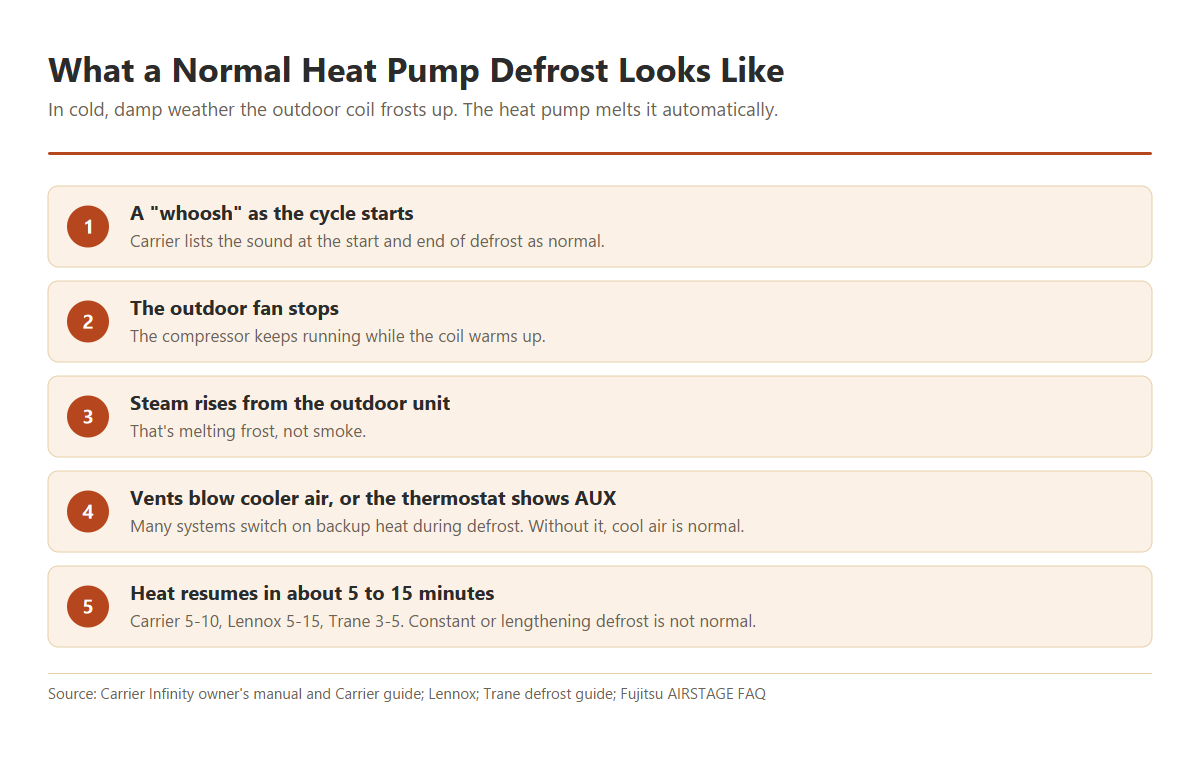
How long it lasts depends on the brand. Carrier says a typical defrost lasts about 5 to 10 minutes, Lennox says 5 to 15, and Trane’s demand defrost typically runs 3 to 5 minutes.
How To Fix It
- Go outside and look for steam rising from the outdoor unit, or a fan that has stopped.
- Wait 15 minutes.
- Check the vents again. Warm air should be back once defrost ends.
Defrost is a problem only when it seems constant, when the cycles keep getting longer, or when ice keeps building up anyway. Trane lists all three as signs to call a technician. See cause 9.
2. Heat Pump Air Just Feels Cooler
This surprises a lot of people who’ve switched from gas. A heat pump moves heat from outside rather than burning fuel, so its air comes out much cooler than a furnace’s.
Carrier puts heat pump supply air at about 85 to 100°F, against roughly 120 to 140°F from a gas furnace. Trane says it is usually between 85 and 93°F. That air feels cool on your hand because it’s below your body temperature of 98.6°F, even while it’s warming the room.
How To Fix It
- Hold a kitchen thermometer in the airflow at the vent nearest the indoor unit for a few minutes.
- Compare it with the ranges above.
- Check the house is actually holding the temperature you set.
If the vent air is in range and the house stays warm, your heat pump is working. Heat pumps run longer, gentler cycles than furnaces, so expect it to run for long stretches in cold weather.
3. The Thermostat Is on COOL, or the Fan Is on ON
Carrier, Trane and Lennox all list the thermostat as a top cause. If the mode is COOL or AUTO, the heat pump may not be heating at all.
If the fan is set to ON, the indoor blower runs nonstop, including between heating cycles. That pushes room-temperature air through your vents, which feels cold.
How To Fix It
- Set the mode to HEAT.
- Set the fan to AUTO.
- Raise the setpoint about 5°F above the room temperature, as Trane suggests.
- Replace the batteries if your thermostat uses them and the display is faded.
- Check that your thermostat is not stuck on EMERGENCY HEAT unless you meant it to be.
Your thermostat needs to support heat pumps properly, including the O/B setting and auxiliary heat. The ecobee Smart Thermostat Enhanced supports most heat pumps and shows “AUX” on screen, so you can see when backup heat is running.

See what your heat pump is really doing
The ecobee Smart Thermostat Enhanced works with most heat pumps, has an O/B setting in its equipment menu, and shows when auxiliary heat kicks in.
Prefer a simpler programmable model? The Honeywell T6 Pro supports heat pumps with backup heat and sets O/B in its installer menu.
4. The O/B Setting Is Reversed
This is the classic “cold air in Heat, warm air in Cool” problem, and it usually starts right after a new thermostat is installed. Every heat pump has a reversing valve that switches it between heating and cooling.
The thermostat controls that valve through a wire labeled O or B. ecobee explains that most heat pumps energize the reversing valve in cooling (the O setting). If the setting is wrong, you get heat when you call for cooling and cooling when you call for heat.
How To Fix It
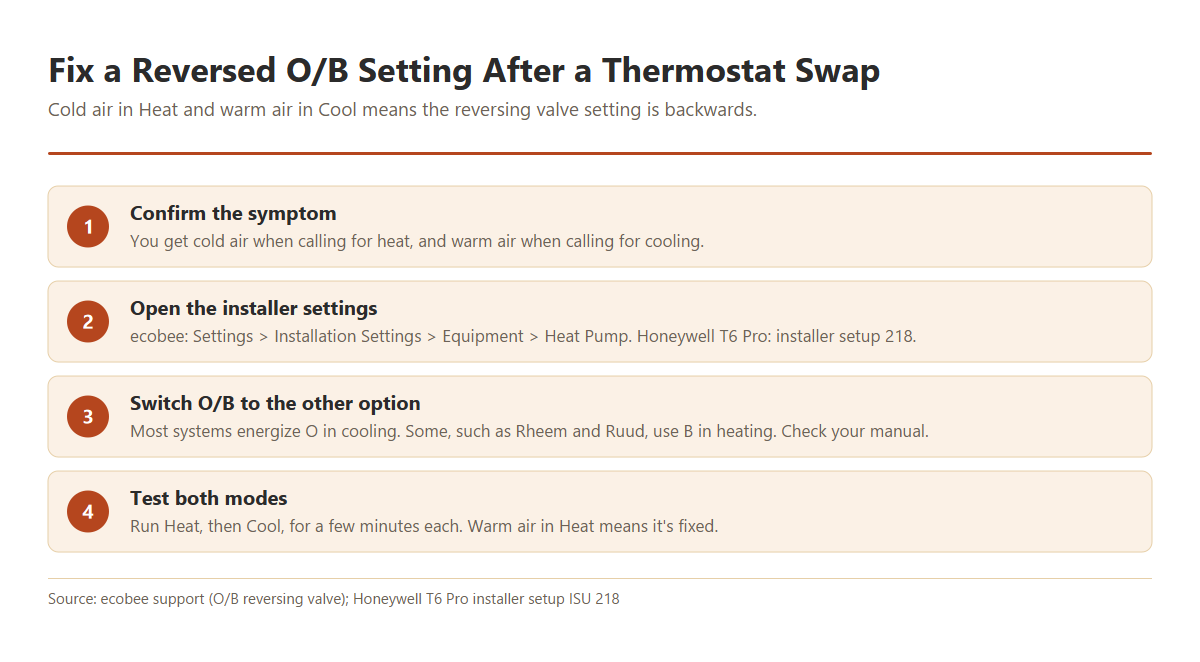
- Confirm the symptom: cold air in Heat and warm air in Cool.
- Open your thermostat’s installer settings. On an ecobee, that’s Settings, then Installation Settings, Equipment, Heat Pump. On a Honeywell T6 Pro, it is installer setup 218.
- Change the O/B setting to the other option.
- Test Heat, then Cool, for a few minutes each.
Some brands, such as Rheem and Ruud, energize the valve in heating instead. Check your equipment manual rather than guessing from the brand. If switching the setting doesn’t fix it, a technician should check the wiring and the valve (cause 11).
5. A Dirty Filter or Blocked Vents
A clogged filter chokes the airflow through your indoor unit. You get weak, lukewarm air, and the system can shut itself off.
Carrier says to check the filter every 60 to 90 days. Trane says every one to three months, and Lennox says to replace it if light can’t pass through it.
How To Fix It
- Turn the system off at the thermostat.
- Pull out the filter and hold it up to a light. Replace it if it’s clogged.
- Fit the new filter with the airflow arrow pointing toward the indoor unit.
- Open every supply vent in the house.
- Move furniture and rugs off the return grilles.
Match the size printed on your old filter’s frame. A pack like the Filtrete MPR 1000 MERV 11 six-pack covers a year or more of changes.
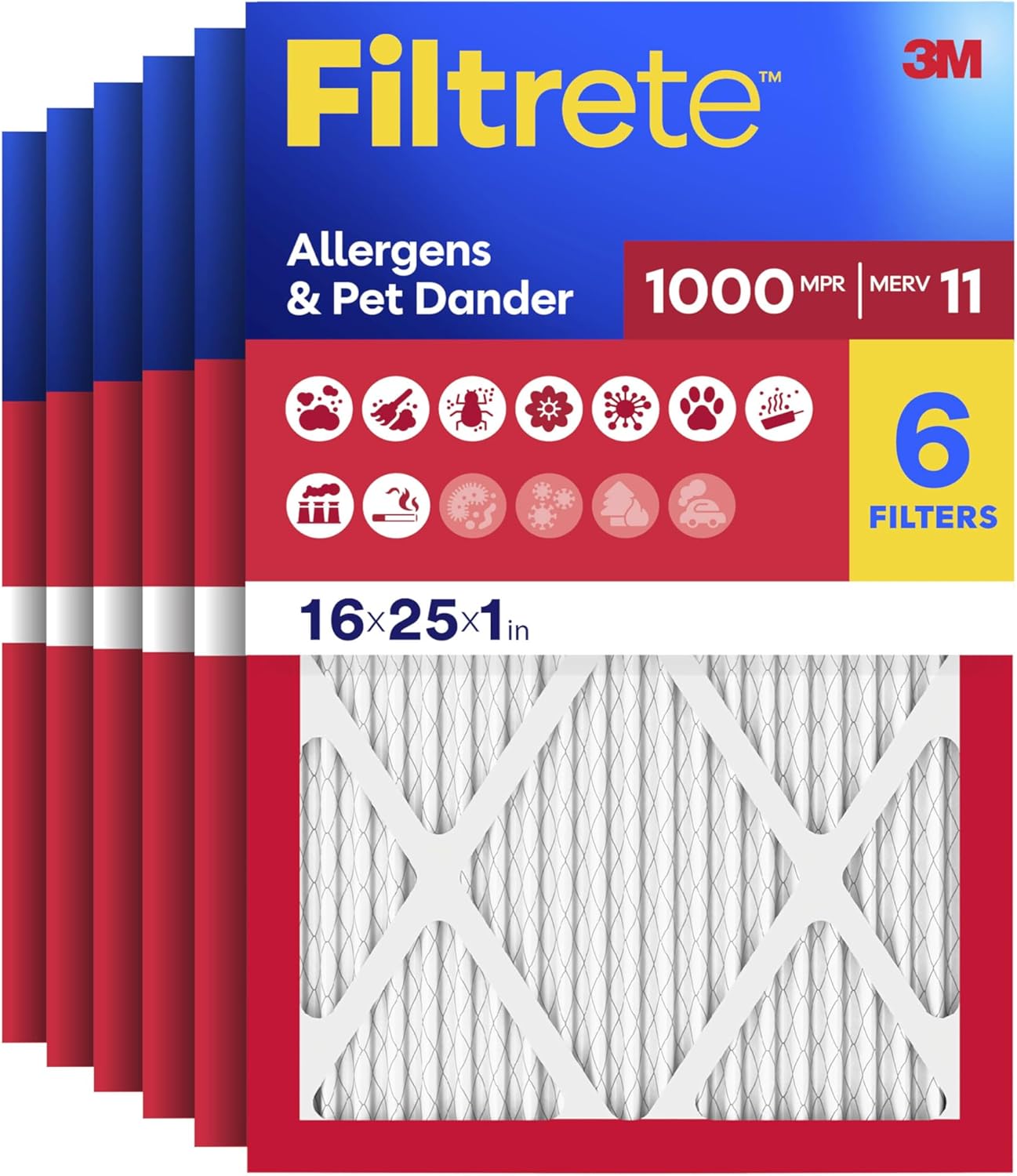
Stock up on the right filter
A six-pack of Filtrete MPR 1000 filters means you always have a fresh one on hand. Check your size first: it’s printed on the old filter’s frame.
If airflow stays weak with a clean filter, a technician should check the blower and ductwork.
6. A Breaker Has Tripped or the Disconnect Is Off
Your heat pump has two halves, and each usually has its own breaker. The outdoor unit runs on 240 volts and also has a disconnect switch on the wall beside it.
If the outdoor breaker trips, the indoor fan keeps blowing but the outdoor unit sits silent. All you get is room-temperature air.
How To Fix It
- Check the main panel for tripped breakers marked for your heat pump, air handler or condenser.
- Check the disconnect box on the wall next to your outdoor unit is switched ON.
- Reset a tripped breaker once.
- Wait a few minutes, then listen for the outdoor unit to start.
If the breaker trips again, leave it off and call a technician. Repeated trips point to an electrical fault in the unit.
7. The Outdoor Unit Is Blocked by Snow or Leaves
Your heat pump pulls heat out of the outdoor air through its outdoor coil. If snow, leaves or ice block that coil, it can’t take in enough heat, and the air indoors cools off.
Carrier says to keep at least 24 inches clear around the outdoor unit, and Lennox says 2 feet on all sides. Don’t cover the unit while it’s in use. Carrier and Trane both warn against it.
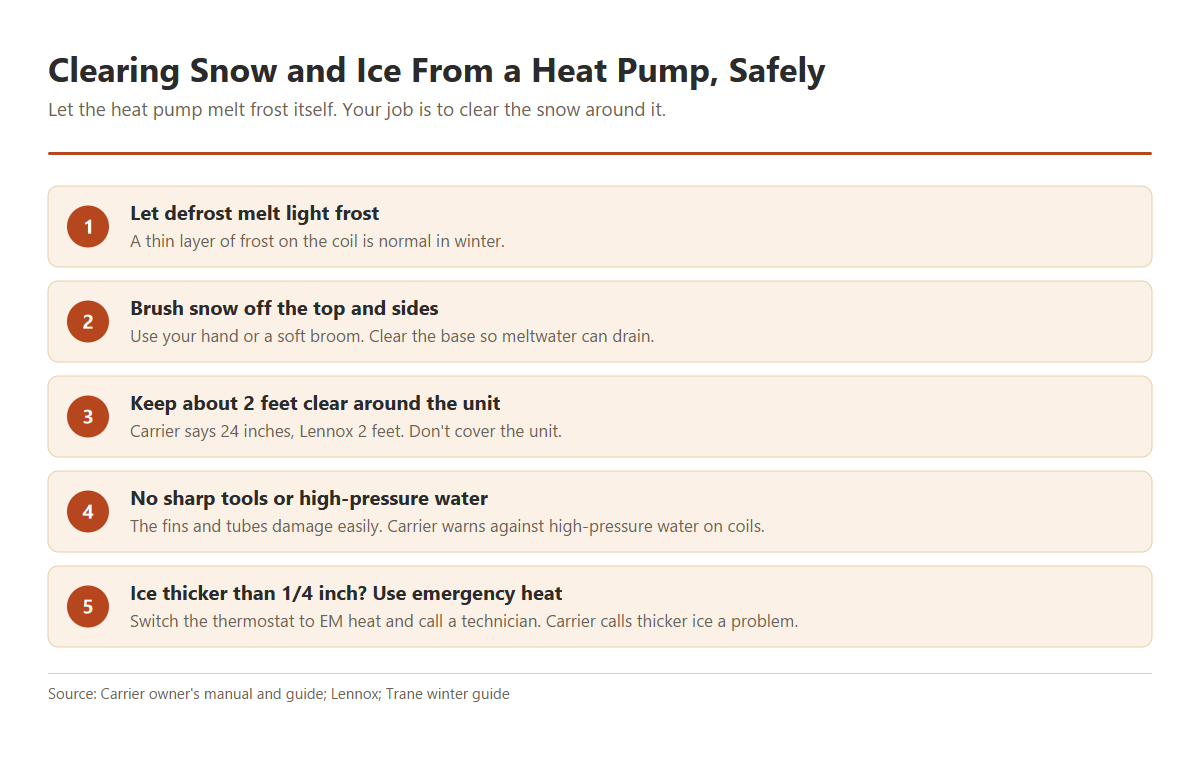
How To Fix It
- Brush snow off the top and sides with your hand or a soft broom.
- Clear snow, leaves and debris from the base so meltwater can drain.
- Cut back shrubs and grass to keep about 2 feet clear.
- Leave light frost alone. The defrost cycle handles it.
- Never chip at ice with a tool or spray the coil with high-pressure water. Carrier warns against high-pressure water on coils.
In a heavy snow or ice storm, Carrier says it may be best to turn the heat pump off and run on auxiliary heat until the snow and ice clear. If your unit sits low and keeps getting buried, ask your installer about raising it on heat pump risers. Lifting a unit with refrigerant lines attached is an installer’s job.
8. It’s Too Cold Outside for the Heat Pump Alone
A heat pump’s output falls as the outdoor temperature drops. Lennox says standard heat pumps struggle below freezing, typically around 25 to 30°F, while cold-climate models keep working below zero.
That’s what backup heat is for. Most ducted heat pumps have electric heat strips or a furnace that switches on automatically as auxiliary heat when your heat pump can’t keep up.
How To Fix It
- Look for “AUX” on your thermostat during very cold weather. That’s normal.
- If the house won’t reach temperature and AUX never shows, the backup heat may not be working. Check the breaker for your air handler, which may be separate from your outdoor unit.
- Avoid big temperature setbacks at night. Recovering from a deep setback can force your system onto expensive backup heat.
- If the house drifts down every cold snap, ask a contractor whether the heat pump is sized for your climate.
ENERGY STAR’s cold-climate rating requires a heat pump to deliver at least 70 percent of its rated heating capacity at 5°F. If you’re replacing a unit in a cold region, look for that rating.
9. A Failed Defrost Control Has Frozen the Coil
If your outdoor coil is encased in solid ice that keeps getting thicker, the defrost system isn’t doing its job. Goodman’s troubleshooting chart lists a faulty defrost control and a faulty defrost thermostat as causes.
Carrier says ice thicker than about 1/4 inch indicates a problem. A frozen coil can’t pull heat from the air, so your home gets cool air or none.
How To Fix It
- Switch your thermostat to EMERGENCY HEAT. Lennox recommends it when the outdoor unit is frozen or damaged.
- Clear snow from around the unit, but don’t chip at the ice.
- Call an HVAC technician to test the defrost control and sensor.
Emergency heat runs only your backup heat, and it is expensive. Lennox warns your bill can climb quickly if it runs for days or weeks, so treat it as a stopgap.
10. Low Refrigerant
Refrigerant is what carries heat from outside into your home. Trane points out that the only cause of low refrigerant is a leak, so topping it up without fixing the leak only buys time.
Signs include lukewarm air, a frozen coil, a hissing sound, or oily residue on the refrigerant lines.
How To Fix It
- Note what you see and hear: hissing, ice on the lines, oily spots.
- Turn the system off if the coil is frosting badly.
- Call a licensed HVAC technician.
This one is not DIY. The EPA restricts sales of refrigerant for home systems to technicians certified under Section 608.
11. A Stuck Reversing Valve
If your heat pump cools fine in summer but blows cool air in heat mode, and you’ve already checked the O/B setting, the reversing valve may be stuck in the cooling position. Trane and Lennox both list it as a cause.
How To Fix It
- Double-check the O/B setting first (cause 4). It’s the free fix and the more common one after a thermostat change.
- If the setting is right, call a technician.
Goodman’s troubleshooting chart lists replacing the valve or its solenoid as the repair. It involves the refrigerant circuit, so it’s a technician’s job.
12. A Failed Outdoor Fan Motor or Capacitor
If the outdoor unit hums or clicks but the fan on top isn’t spinning, the fan motor or its capacitor has likely failed. Running the compressor without the fan can overheat it.
⚠ Essential Safety Warning: Heat Pump Electrical Parts
- The outdoor unit runs on 240 volts. Carrier notes there may be more than one disconnect switch, so turn off power at the thermostat, the outdoor disconnect and the breaker before touching anything beyond the filter.
- Capacitors hold a high-voltage charge even after the power is off. Trane describes them as high-voltage components. Never open the outdoor unit’s electrical panel.
- The fins and panel edges are sharp. Wear gloves near the unit.
- Never poke anything into a running fan.
If the fan isn’t spinning, turn the system off at the thermostat and call a technician. Trane puts a typical capacitor replacement at $100 to $400.
How To Fix It
- Turn the system off at the thermostat to protect the compressor.
- Look, without touching, to confirm the fan is not turning.
- Switch to emergency heat if you need warmth while you wait.
- Call a licensed HVAC technician.
Normal Heat Pump Numbers, by Brand
Use these to judge whether your system is behaving normally. They come from each manufacturer’s own guidance.
| Brand | Normal supply air (heating) | Typical defrost length |
|---|---|---|
| Carrier | 85-100°F (95-105°F on variable-speed Infinity) | 5-10 minutes |
| Trane | 85-93°F | 3-5 minutes (demand defrost) |
| Lennox | Cooler than a furnace | 5-15 minutes |
| Fujitsu (mini-split) | Fan runs very low at start-up while it warms | 7-15 minutes, OPERATION lamp flashes |
Mini-splits behave a little differently. Fujitsu says that when heating starts, the indoor fan runs very slowly at first so the internal parts can warm up, which can look like it isn’t working. During defrost the indoor unit stops heating, its OPERATION lamp flashes, and the outdoor fan may stop with steam rising.
Newer units with R-454B refrigerant have a leak detection system. Carrier’s manual explains that if it detects a leak, it can shut off your outdoor unit and supplementary heat and run the blower. That looks like a fan blowing with no heat, so call your dealer if it happens.
When To Call an HVAC Technician
Call a licensed technician if:
- Ice on the outdoor coil is thicker than 1/4 inch, or doesn’t clear after defrost.
- Defrost seems constant, or the cycles keep getting longer.
- The outdoor fan is not spinning, the unit hums, or you smell burning.
- You hear hissing or see oily spots on the refrigerant lines.
- It cools fine but won’t heat, and the O/B setting is correct.
- A breaker trips again after one reset.
- The house won’t reach temperature in mild weather.
We can connect you with a local HVAC technician for a free repair quote. While you wait, emergency heat or a quiet space heater keeps you warm.
Have a gas furnace instead? See our guides to a furnace blowing cold air and a furnace igniter that’s not working. If your system turns on and off every few minutes, read our short cycling guide.
Buying a Replacement Thermostat or Filters
Most heat pump parts that fail, like capacitors, fan motors, defrost boards and valves, are technician jobs. What you can buy and fit yourself is your thermostat and the filter.
The main risk with a new thermostat is compatibility. A heat pump needs a thermostat that supports heat pumps, has an O/B setting, and handles auxiliary heat. Plenty of cheap thermostats don’t, and some smart thermostats only support one stage of auxiliary heat.
Check your system’s wiring and stages before you buy. Then set the O/B option correctly on day one (cause 4).
- Smart: the ecobee Smart Thermostat Enhanced supports most heat pumps and shows when AUX heat runs.
- Programmable: the Honeywell T6 Pro supports heat pumps with backup heat.
- Filters: Filtrete MERV 11 or lower-restriction Nordic Pure MERV 8 in your size.
Frequently Asked Questions
Why is my heat pump blowing cold air when it’s on heat?
The most common reasons are a defrost cycle, normal heat pump air that’s cooler than you expect, or a thermostat with the fan set to ON. Check for steam outside, and set the fan to AUTO.
If it started after a new thermostat, the O/B setting is probably reversed. If none of those fit, check the filter and the outdoor unit for ice or snow.
What outside temperature is too cold for a heat pump?
There’s no single cut-off. Lennox says standard heat pumps start to struggle around 25 to 30°F, while cold-climate models keep heating below zero.
Below that range, your backup heat does more of the work. That’s normal, and the thermostat will often show “AUX”.
How do you reset your heat pump?
Most heat pumps don’t have a homeowner reset button. Turn the system off at the thermostat, then check the breakers and the outdoor disconnect switch.
Reset a tripped breaker once, then turn the heat back on and wait a few minutes. If it trips again, call a technician.
Why is my heat pump running but not heating?
If the outdoor unit runs but the air is cool, check for defrost, ice on the coil, a dirty filter, or a reversed O/B setting.
If your outdoor unit is silent, check its breaker and disconnect. If it hums without the fan spinning, turn it off and call a technician.
Should I use emergency heat?
Only as a stopgap. Lennox says to use it when a technician tells you to, when your heat pump has completely failed, or when the outdoor unit is frozen or damaged.
Emergency heat runs only your backup heat, so it costs much more to run. Switch back to HEAT once the problem is fixed.
Is it normal for a heat pump to run constantly in cold weather?
Yes, to a point. Heat pumps run longer, gentler cycles than furnaces, and Carrier notes the system runs longer as it gets colder.
It is a problem if the house can’t reach your setpoint in mild weather, or if the backup heat runs all the time. Either one is worth a service visit.
This post contains affiliate links. We may be paid a commission if you purchase through links, at no extra cost to you.
