Is your furnace igniter not working, or your furnace won’t turn on at all? Often, the igniter itself is fine. The furnace is stuck at an earlier step: no power, no call for heat from the thermostat, or a safety switch that will not let the igniter fire.
That’s good news, because most of those checks are free and take minutes. When your igniter really has failed, it’s a common part you can test with a multimeter and replace for far less than a new furnace.
This guide follows the ignition sequence step by step, so you can see exactly where your furnace stops. It covers hot surface igniters on Carrier, Bryant, Goodman, Amana and Lennox furnaces, using each manufacturer’s own manuals and error codes.
This post contains affiliate links. We may be paid a commission if you purchase through links, at no extra cost to you.
The Important Stuff:
- A furnace lights in a fixed order: thermostat, inducer fan, pressure switch, igniter, gas valve, flame sensor, blower. Where it stops tells you what’s wrong.
- If you hear nothing at all, it’s a power or thermostat problem, not the igniter.
- If the inducer runs but the igniter never glows, check the pressure switch and vent before blaming the igniter.
- A healthy carbide igniter reads about 40 to 70 ohms cold. An open reading or a visible crack means replace it.
- Burners that light and go out within seconds point to the flame sensor, not the igniter.
10 Reasons Your Furnace Igniter Isn’t Working & How to Fix It
Use this table to find your symptom, then read on for the full fix.
| Reason your furnace won’t light | Solution |
|---|---|
| 1. Thermostat not calling for heat | Set it to HEAT above room temperature and replace the batteries. |
| 2. Power off at the switch or breaker | Turn on the service switch and reset the breaker once. |
| 3. Blower door not seated | Refit the door so it presses the safety switch. |
| 4. Blown 3A control board fuse | Find the short, then replace the fuse with the same rating. |
| 5. Gas supply off | Open the gas valve and check your other gas appliances. |
| 6. Dirty filter tripping the limit | Replace the filter and open every vent. |
| 7. Pressure switch, blocked vent or drain | Clear the outside vent pipes and check the drain line. |
| 8. Cracked or worn hot surface igniter | Inspect it, test it with a multimeter, and replace it if it fails. |
| 9. Dirty flame sensor | Clean the sensor rod with fine steel wool, or replace it. |
| 10. Control board lockout | Read the code, then reset the furnace once. |
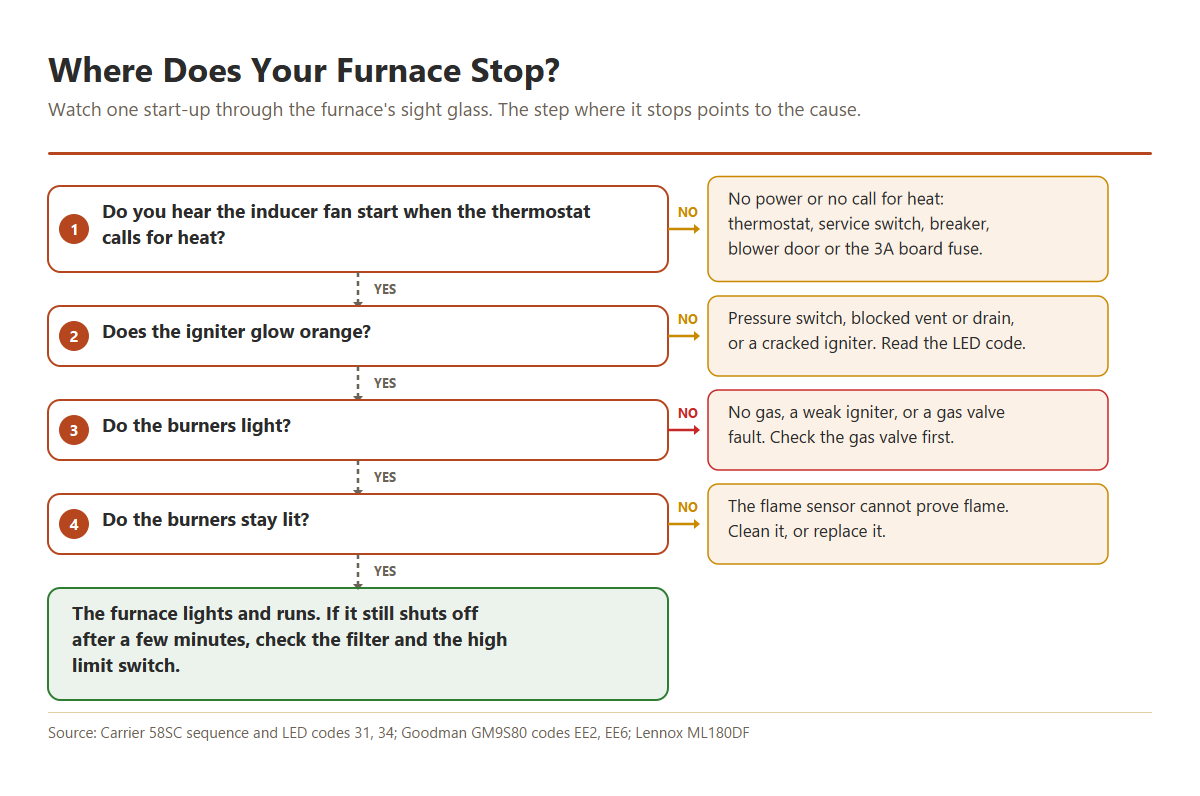
Furnace Won't Light? Find Where It Stops
Turn the thermostat up, then watch the furnace through its sight glass.
Turn on JavaScript to use the diagnosis tool, or use the summary table above.
How Your Furnace Lights (and Where It Can Stop)
Every gas furnace with a hot surface igniter follows the same basic sequence. Knowing it turns “my furnace won’t turn on” into a specific, fixable problem.
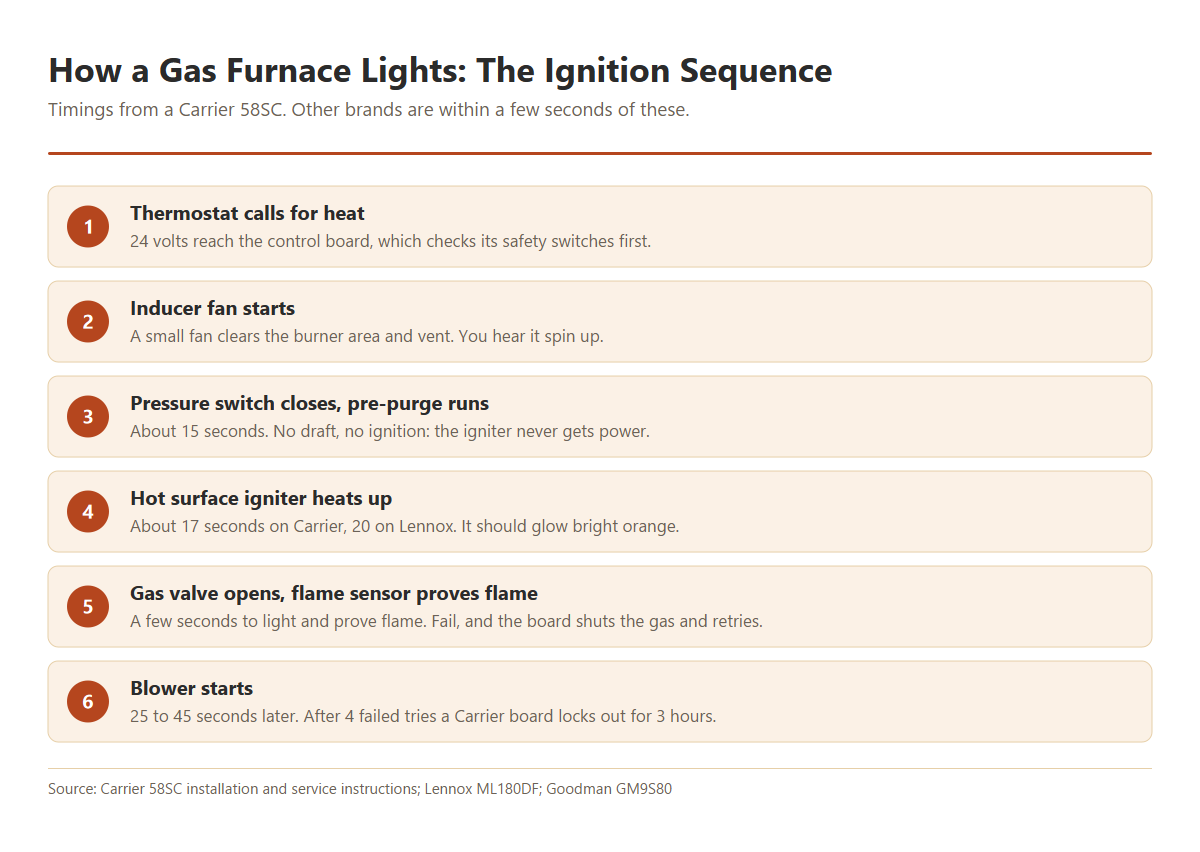
The key point: the board will not power the igniter until the inducer has run and the pressure switch has closed. So an igniter that never glows isn’t always a bad igniter. The furnace may never have asked it to glow.
If the burners fail to light or stay lit, the board shuts the gas and tries again. A Carrier board allows four attempts, then locks out for three hours. Lennox allows five before a 60-minute lockout, and Goodman locks out after three retries.
1. The Thermostat Isn’t Calling for Heat
Bryant, Trane and Carrier all start their “furnace not turning on” checklists with the thermostat. If it is not sending a call for heat, nothing else in the sequence happens.
How To Fix It
- Set the mode to HEAT.
- Raise the setpoint several degrees above the room temperature.
- Replace the batteries if the screen is blank or faded.
- Check the program schedule isn’t holding a low temperature.
- Listen at the furnace. Within a few seconds you should hear the inducer fan start.
If the screen stays blank with fresh batteries, the thermostat may get its power from your furnace. In that case a blown fuse on the furnace board (cause 4) can make a working thermostat look dead.
A worn-out thermostat is worth replacing. The Honeywell T6 Pro is a reliable programmable model with simple HEAT, COOL and fan settings.
2. The Power Is Off at the Switch or Breaker
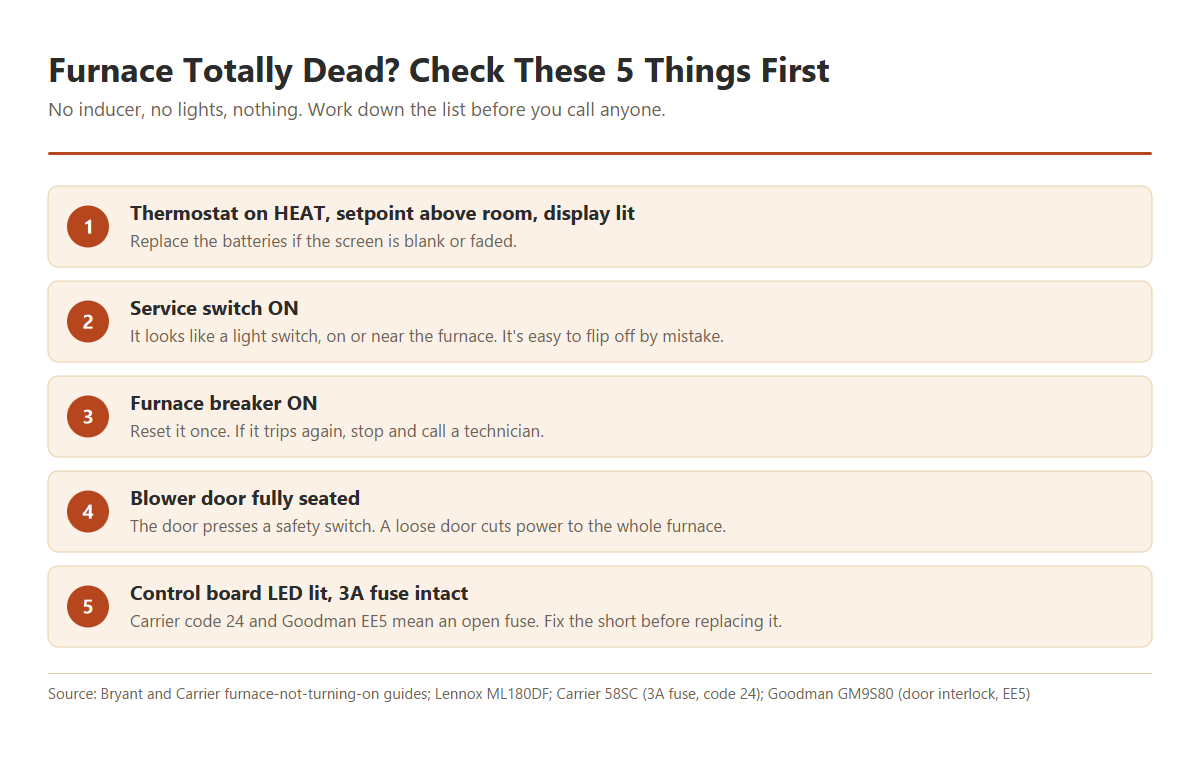
Your furnace has its own power switch, usually on the side of your furnace or on a nearby wall. It looks exactly like a light switch, and it’s easy to flip off by mistake.
If the switch or breaker is off, the furnace is completely dead: no inducer, no lights on the control board, nothing.
How To Fix It
- Find the service switch on or near your furnace and turn it ON.
- Check your furnace breaker in your main panel.
- Reset a tripped breaker once.
- Turn the thermostat up and listen for the inducer.
If the breaker trips again, stop. A breaker that won’t hold means a short or a failed motor, and that needs an HVAC technician.
3. The Blower Door Isn’t Seated
This one often appears right after a filter change. Behind the lower door of your furnace is a small push-button safety switch, and the door presses it in when it is closed properly.
If the door is loose or crooked, the switch cuts the power to the whole furnace. Goodman’s manual is clear that you should never defeat this switch.
How To Fix It
- Remove the blower door and look for the small switch on the frame.
- Refit the door so it sits flat and presses the switch in.
- Tighten any screws or latches that hold it.
- Turn the thermostat up and listen for the inducer.
Never tape the switch down or bypass it. It’s there so the blower can’t start while your hands are inside.
4. A Blown 3A Control Board Fuse
Most furnace control boards have a small automotive-style blade fuse protecting the 24-volt thermostat circuit. Carrier specifies a 3-amp fuse and flashes code 24 when it’s open. Goodman shows EE5, “open fuse”.
It usually blows because a thermostat wire touched metal, often during a thermostat swap. With the fuse open, the board has power but never hears the thermostat calling for heat.
How To Fix It
- Turn off the power at the service switch.
- Find the fuse on the control board and pull it out.
- Look for a broken strip inside. If it’s blown, find the cause first: check the thermostat wires at both ends for bare copper touching metal.
- Replace it with a fuse of exactly the same rating and size printed on the board. Carrier says to use only a 3-amp fuse.
- Restore power and test.
A pack of 3-amp blade fuses costs a few dollars and is worth keeping beside the furnace. If the new fuse blows straight away, there’s still a short, and a technician should trace it.
5. The Gas Supply Is Off
If the igniter glows but the burners never light, the gas may simply be off. Carrier’s troubleshooting chart lists a gas valve turned off and a closed manual shutoff valve as causes of ignition failure.
How To Fix It
- Find the shutoff valve on the gas pipe beside your furnace. The handle should run in line with the pipe.
- Check the ON/OFF switch or knob on your furnace’s gas valve itself.
- Check whether your other gas appliances work.
- If you use propane, check the tank.
- Reset the furnace once (cause 10) and watch a start.
If you smell gas, don’t try any of this. Leave the house without touching switches, and call your gas company from outside.
6. A Dirty Filter Is Tripping the Limit
If your furnace lights, runs a few minutes, then shuts the burners off while the blower keeps going, the problem is not ignition. A clogged filter has starved your furnace of air, and the high limit switch has shut it down.
After repeated trips, some boards lock out entirely. Carrier shows code 13 for a limit lockout and code 33 for a limit fault. Goodman shows EE3, and Lennox flashes 4 times.
How To Fix It
- Turn the thermostat off and pull the filter.
- Replace it if you can’t see light through it.
- Open every supply vent and clear the return grilles.
- Reset the furnace once and let it run.
ENERGY STAR says to check the filter monthly and change it at least every three months. For a furnace that has been overheating, a lower-restriction MERV 8 pleated filter is a sensible choice. Our guide to a furnace blowing cold air covers limit trips in more detail.
7. The Pressure Switch, a Blocked Vent or a Clogged Drain
The pressure switch confirms that the inducer is pulling flue gases out through the vent. Until it closes, the board will not power your igniter. That’s the “inducer runs, igniter never glows” pattern.
On high-efficiency furnaces with white plastic vent pipes, the usual culprits are an outside pipe blocked by snow, ice or a nest, or a clogged condensate drain backing water into the switch tube. Carrier shows code 31, Goodman EE2 and Lennox 3 flashes.
How To Fix It
- Go outside and clear snow, ice, leaves or nests from the vent pipe openings by hand.
- Don’t push anything into the pipes.
- Check the condensate drain hose from your furnace isn’t kinked or clogged.
- Reset the furnace once and watch the start.
If the code comes back, a technician needs to check the inducer, the switch, the tubing and the condensate trap. Our short cycling guide covers the pressure switch and condensate trap as a cause of on-off cycling too.
8. A Cracked or Worn Hot Surface Igniter
The hot surface igniter is a small ceramic element that glows bright orange and lights the gas. White-Rodgers, one of the biggest igniter makers, notes that older silicon carbide igniters may need routine replacement.
Newer silicon nitride igniters are tougher and last much longer. Bryant’s guide lists the warning signs of a failing igniter: your furnace clicks repeatedly without starting, ignition is delayed, or you can see a crack or a white blister on the element.
⚠ Essential Safety Warning: Testing and Replacing an Igniter
- Turn off the power at the service switch and close the gas valve before removing any panel.
- Let the igniter cool. White-Rodgers rates them at 1,200°F or more.
- Never touch the glowing element with bare fingers. Goodman warns that skin contact or rough handling causes early failure.
- Match the voltage. White-Rodgers says 80-volt and 120-volt igniters are not interchangeable, so the wrong one can fail or damage the board.
- Goodman labels igniter work as a job for a qualified servicer. If you’re not confident with power and gas off, call one.
If you can’t meet these conditions, have a technician replace the igniter. Bryant puts a professional replacement at about $150 to $400.
How To Fix It
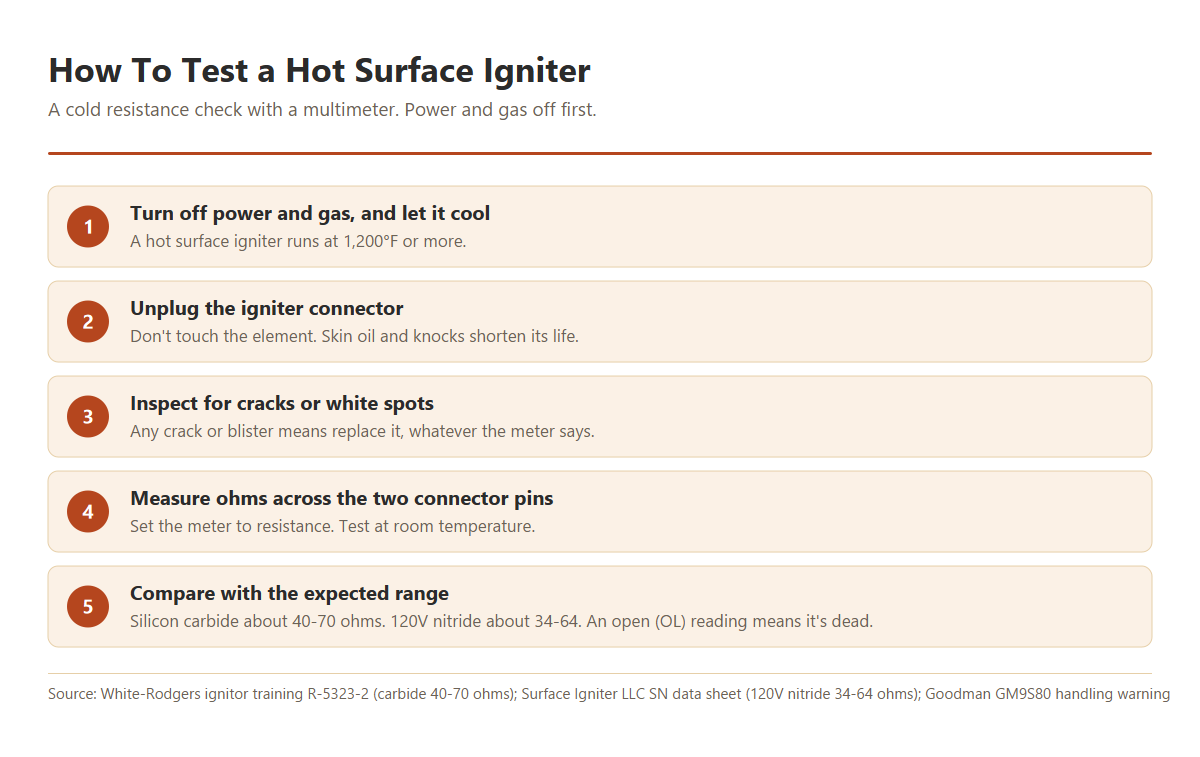
- Turn off the power and the gas, and let the igniter cool.
- Remove the burner door and unplug the igniter’s wire connector.
- Remove the single bracket screw and slide your igniter out, holding it by its base.
- Look for cracks or white spots. Any visible damage means replace it.
- Set a multimeter to ohms and measure across the two pins of the igniter’s plug.
- Compare the reading. White-Rodgers puts a silicon carbide igniter at 40 to 70 ohms cold. A 120-volt nitride igniter maker lists 34 to 64 ohms. An open (OL) reading means the igniter is dead.
- Fit the replacement in exactly the same position, refit the door, and restore gas and power.
Any basic meter does this test. The Klein Tools MM325 measures resistance and voltage, and it is useful well beyond the furnace.

Test before you buy a part
A multimeter tells you whether the igniter is really dead, so you don’t replace a good part. The Klein MM325 handles resistance, AC voltage and continuity.
Buy the right igniter. Find the part number on your old igniter or in your furnace’s parts list, and match it. White-Rodgers publishes direct replacements:
- Goodman and Amana part 0130F008 is replaced by the White-Rodgers 789A-707A1 (120V nitride).
- Lennox and Rheem part 41K5601 is replaced by the White-Rodgers 768A-844 (80V nitride).
- Carrier, Bryant and Payne part LH33ZG001 is replaced by White-Rodgers 789A-751A1. Check the listing names that part number before you buy.
If your igniter tests fine but never glows, the board may not be sending it power. Goodman shows EEL for an igniter relay fault. That’s a technician’s job.
9. A Dirty Flame Sensor
If your igniter glows and the burners light, then go out within a few seconds, the igniter has done its job. The flame sensor can’t prove the flame, so the board shuts the gas.
Carrier’s chart lists oxide buildup on the flame sensor as a cause, with a normal flame signal of 4.0 to 6.0 microamps. It recommends cleaning the rod with fine steel wool. Goodman shows EE6 for a low flame signal, and Lennox flashes 8 times once the burners have lost flame too often.
How To Fix It
- Turn off the power and close the gas valve.
- Remove the screw holding the flame sensor, a thin rod in the burner flame.
- Rub the rod gently with fine steel wool until it’s clean, then wipe it.
- Refit it, restore gas and power, and test.
If it comes back within weeks, replace the sensor. Match your old part number: the OEM Goodman 0130F00010 flame sensor fits many Goodman, Janitrol and Amana furnaces, and the PFS401 universal sensor replaces the White-Rodgers 760-401 used on Carrier units. Goodman labels sensor cleaning as a qualified-servicer job, so call one if you’re unsure.
10. The Control Board Has Locked Out
After too many failed attempts, your control board stops trying and waits. While it’s locked out, nothing happens when you turn the thermostat up, which looks exactly like a dead furnace.
Carrier boards reset themselves after three hours and Lennox after 60 minutes. You can clear a lockout sooner, but only after you’ve written down the code.
How To Fix It
- Look through the sight glass and write down the LED code before you cut power. A power cycle clears it.
- Fix what the code points to: filter, gas, vent or flame sensor.
- Turn the thermostat to OFF.
- Switch your furnace off at the service switch, then back on. Carrier says a brief power interruption clears the lockout. On Lennox, cycling the thermostat from HEAT to OFF to HEAT does it.
- Set the thermostat back to HEAT and watch one full start.
Reset once. Lennox’s manual says to call a service technician if the furnace locks out again, because something is stopping it from lighting safely.
⚠ Essential Safety Warning: Lockouts, Gas and Carbon Monoxide
- If you smell gas, stop. Leave the house without touching switches and call your gas company from outside.
- Don’t reset a lockout over and over. Each reset sends more gas trials to a furnace that isn’t lighting properly.
- Never bypass a safety switch: the door switch, limit switch, pressure switch or rollout switch.
- A tripped rollout switch (Carrier code 33 or 13, Lennox 5 flashes, Goodman E11) means flame or flue gas escaped the burner area. Lennox says to call a technician.
- Keep a working carbon monoxide alarm near the furnace and outside bedrooms.
If any of these apply, turn the furnace off and call a licensed HVAC technician.
No CO alarm near your furnace? The First Alert CO605 plugs into an outlet and has a battery backup.
Furnace Codes for Ignition Problems
Codes differ between furnace models, even within a brand, so check the label inside your blower door. These come straight from each manufacturer’s manual.
Carrier and Bryant (58SC manual). Short flashes are the first digit and long flashes the second.
| Code | What it means |
|---|---|
| 13 | Limit circuit lockout. Resets after 3 hours. |
| 14 | Ignition lockout: failed to light in 4 attempts. Resets after 3 hours. |
| 24 | 24-volt fuse open (3A) |
| 31 | Pressure switch did not close |
| 33 | Limit circuit fault. A rollout switch needs a manual reset. |
| 34 | Ignition proving failure: gas, igniter or flame sensor |
| 45 | Control lockout. Resets after 1 hour. Replace the board if it repeats. |
Goodman and Amana (GM9S80 manual).
| Code | What it means |
|---|---|
| EE0 | Lockout after 3 failed tries |
| EE2 | Pressure switch open |
| EE3 | High limit open |
| EE5 | Open fuse |
| EE6 | Low flame signal |
| EEL | Igniter relay fault |
| EEn | Igniter open |
| E11 | Rollout switch open |
Lennox (ML180DF manual, flash count).
| Flashes | What it means |
|---|---|
| 3 | Pressure switch open with the inducer running |
| 4 | Primary limit switch open |
| 5 | Rollout switch open |
| 6 | Pressure switch cycle lockout |
| 7 | Lockout: burners failed to light |
| 8 | Lockout: burners lost flame too many times |
When To Call an HVAC Technician
Call a licensed technician if:
- You smell gas at any point.
- The breaker or the 3A fuse trips again after you reset or replace it.
- The furnace locks out again after one reset.
- The rollout switch has tripped.
- The igniter tests fine but gets no power, or glows but the gas never flows.
- The pressure switch code comes back after you’ve cleared the vent.
We can connect you with a local HVAC technician for a free repair quote. If you’re waiting on a visit, one of our quietest space heaters will keep a bedroom warm.
Have a heat pump rather than a gas furnace? See our guide to a heat pump that’s not heating instead.
Buying a Replacement Igniter
The biggest risk with igniters is buying the wrong one. Lookalike “universal” igniters are everywhere, and an igniter with the wrong voltage or shape either won’t light the gas or burns out fast.
So start with the part number. It is printed on the igniter’s base or in the parts list inside your furnace door. Then buy the OEM part, or the White-Rodgers direct replacement for that number.
Universal kits exist and work, but they come with brackets and wire nuts you have to fit yourself. A direct replacement drops into the same bracket with the same plug.
- Goodman and Amana (0130F008): White-Rodgers 789A-707A1
- Lennox and Rheem (41K5601, 80V): White-Rodgers 768A-844
- Test it first: a basic multimeter confirms the old one is really dead.
Frequently Asked Questions
How do I tell if my furnace igniter is bad?
Watch it during a start. If the inducer runs and the pressure switch code is clear, but your igniter never glows, it is likely bad. Look for cracks or white spots too.
For a definite answer, test it with a multimeter. An open reading, or a reading far outside the expected range, means replace it.
How do I reset my furnace igniter?
You don’t reset the igniter itself. You reset your furnace’s control board, which controls it.
Turn the thermostat off, switch the furnace off at the service switch and back on, then turn the heat back up. If it locks out again, the igniter or another part needs attention.
Is there a reset button on my furnace?
Most modern furnaces do not have one. You reset them by cycling the power at the service switch, or on Lennox furnaces by cycling the thermostat from HEAT to OFF to HEAT.
The exception is a manual-reset rollout switch near the burners. Don’t press it without finding out why it tripped.
What is the average cost to replace a furnace igniter?
Bryant puts a professional igniter replacement at about $150 to $400. The part on its own costs much less.
If you replace it yourself, the main cost is getting the right part. Match the part number and voltage on your old igniter.
How long does a furnace igniter last?
Bryant gives different figures on its own guide, from 3 to 10 years. Older silicon carbide igniters tend to fail sooner.
Silicon nitride igniters are tougher. Bryant says they can last as long as your furnace itself.
Why does my furnace turn on but not heat even though the fan is running?
If the blower runs but the burners don’t light, the furnace has failed to ignite or has locked out. Check the gas valve, read the LED code, and work through the sequence above.
If the fan is set to ON at the thermostat, it will also run without heat between cycles. Set it to AUTO.
What fails first on a furnace?
There’s no official ranking, but igniters, flame sensors and filters are the parts that wear in normal use. White-Rodgers notes that carbide igniters may need routine replacement.
A clogged filter causes more shutdowns than almost anything else, so change it on schedule.
This post contains affiliate links. We may be paid a commission if you purchase through links, at no extra cost to you.
