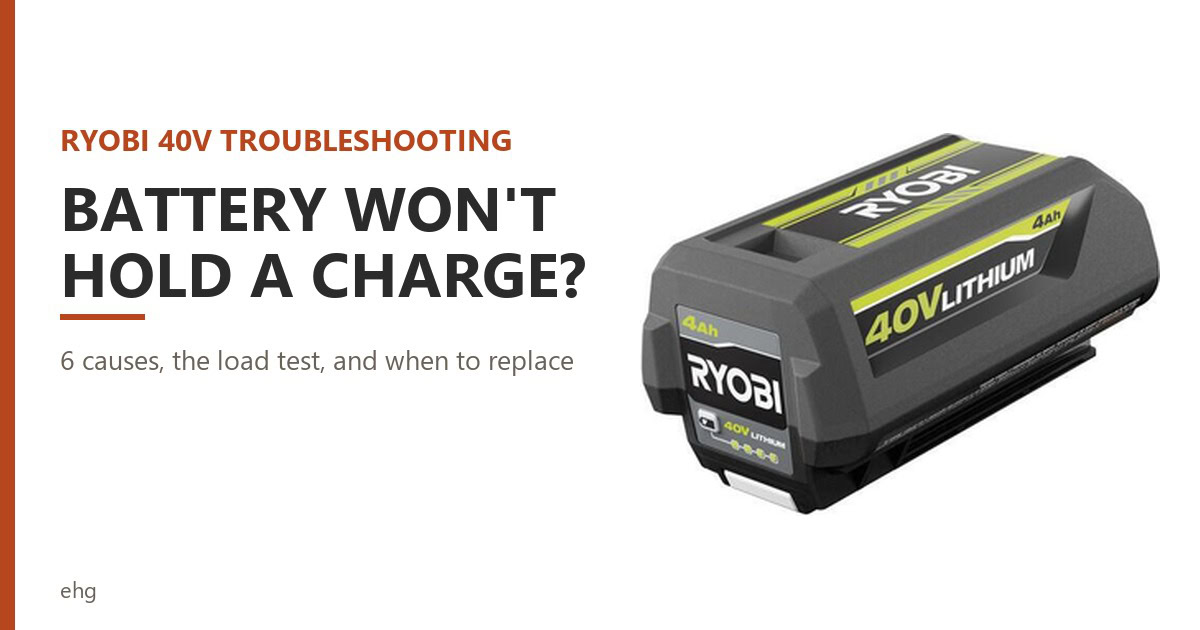
Your Ryobi 40V battery charges all the way to four green lights, and then it dies after ten minutes of work. The most likely answer is the simplest one: the cells are worn out, and the fuel gauge has no way of telling you that.
That gauge reports how charged the pack is, not how much life is left in it. A pack that has lost most of its capacity still charges to the top of its remaining range and still shows you four lights.
The good news is that this is easy to confirm, and a couple of the causes below cost nothing to fix. The bad news is that worn cells can’t be revived, whatever you may have read.
This guide covers the OP4015, OP4026, OP4030, OP4050 and OP40752 packs, and it deals with one specific problem: a battery that charges fine but doesn’t keep the charge. If your pack won’t charge at all, that’s a different fault and we cover it in our Ryobi 40V battery guide.
This post contains affiliate links. We may be paid a commission if you purchase through links, at no extra cost to you.
The Important Stuff
- Four lights does not mean a healthy battery. Ryobi’s fuel gauge shows state of charge, not state of health. This one fact explains most of what you’re seeing.
- Ryobi publishes no charge-cycle rating for its 40V packs. Any specific number you find quoted for them did not come from Ryobi. More on that below.
- The warranty is three years on a battery for household use, and it covers defects rather than wear. A pack that faded gradually is not a claim.
- A pack that’s flat every time you pick it up usually has a storage problem, not a dead cell. Ryobi says store at 30 to 50% and recharge every six months.
- Do not run the pack flat to reset it. Deep discharge is how lithium packs get killed, not how they get fixed.
6 Reasons Your Ryobi 40V Battery Won’t Hold a Charge & How to Fix It
Use this table for a summary, then read on for the detail on yours.
| Why it won’t hold a charge | What to do |
|---|---|
| 1. The cells have worn out | The most common cause by a distance. Confirm with a load test, then replace the pack. |
| 2. It cuts out before the pack is empty | One weak cell is tripping the protection circuit early. Replace the pack. |
| 3. Voltage collapses under load | Healthy at rest, crashes the moment you pull the trigger. The pack has failed. |
| 4. It goes flat sitting in storage | A storage habit rather than a fault. Ryobi’s own routine fixes it. |
| 5. Heat has aged it early | Charging hot and working hot cost you capacity permanently. Change the habit. |
| 6. It’s the tool or the contacts | Clean the terminals and try a second pack before you condemn anything. |
What “Won’t Hold a Charge” Actually Means
Start here, because the phrase covers four genuinely different faults and they don’t share a fix.
The thing that confuses almost everybody is the fuel gauge. Press the button on your pack and you get up to four green lights, and it feels like a health report. It isn’t one.
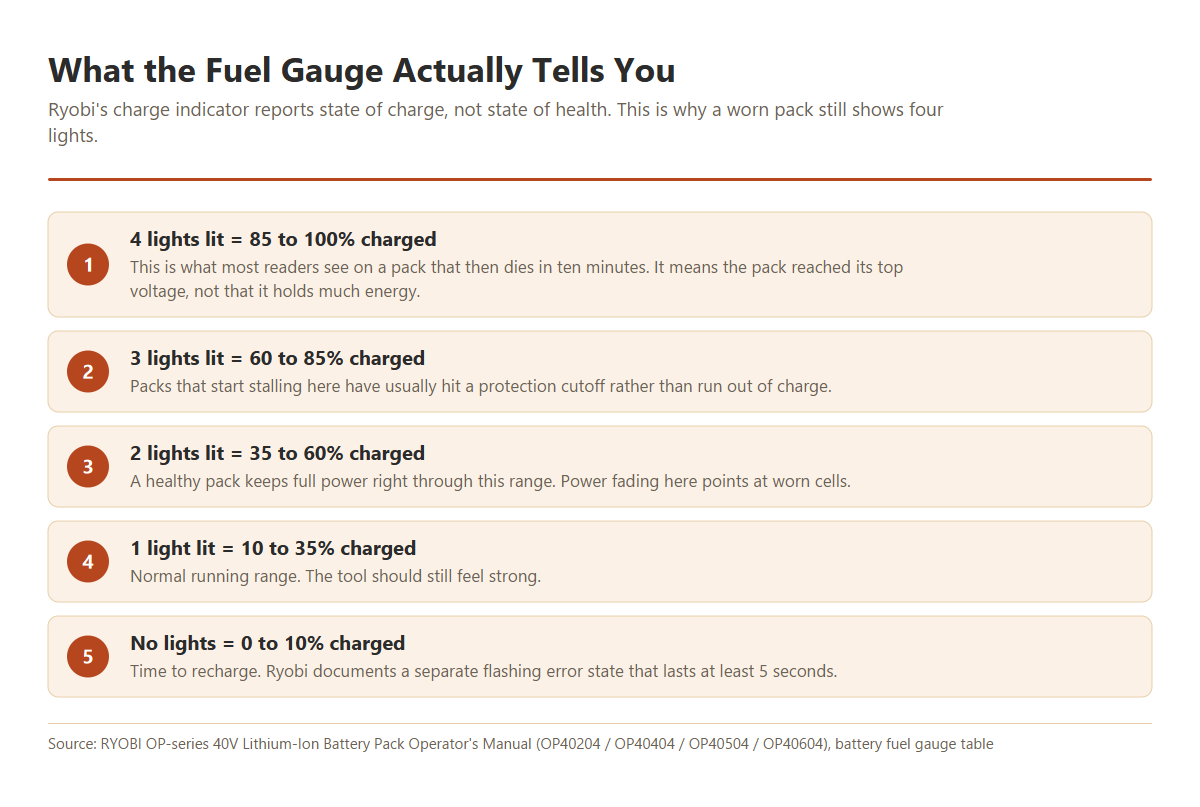
Ryobi’s manual defines those lights purely as state of charge. Four lights means 85 to 100% of whatever capacity the pack still has.
So a five-year-old pack that has lost two thirds of its capacity charges up, reaches the top of its shrunken range, and lights all four. The gauge is working exactly as designed. It just isn’t measuring what you want to know.
Now work out which version of the problem you have.
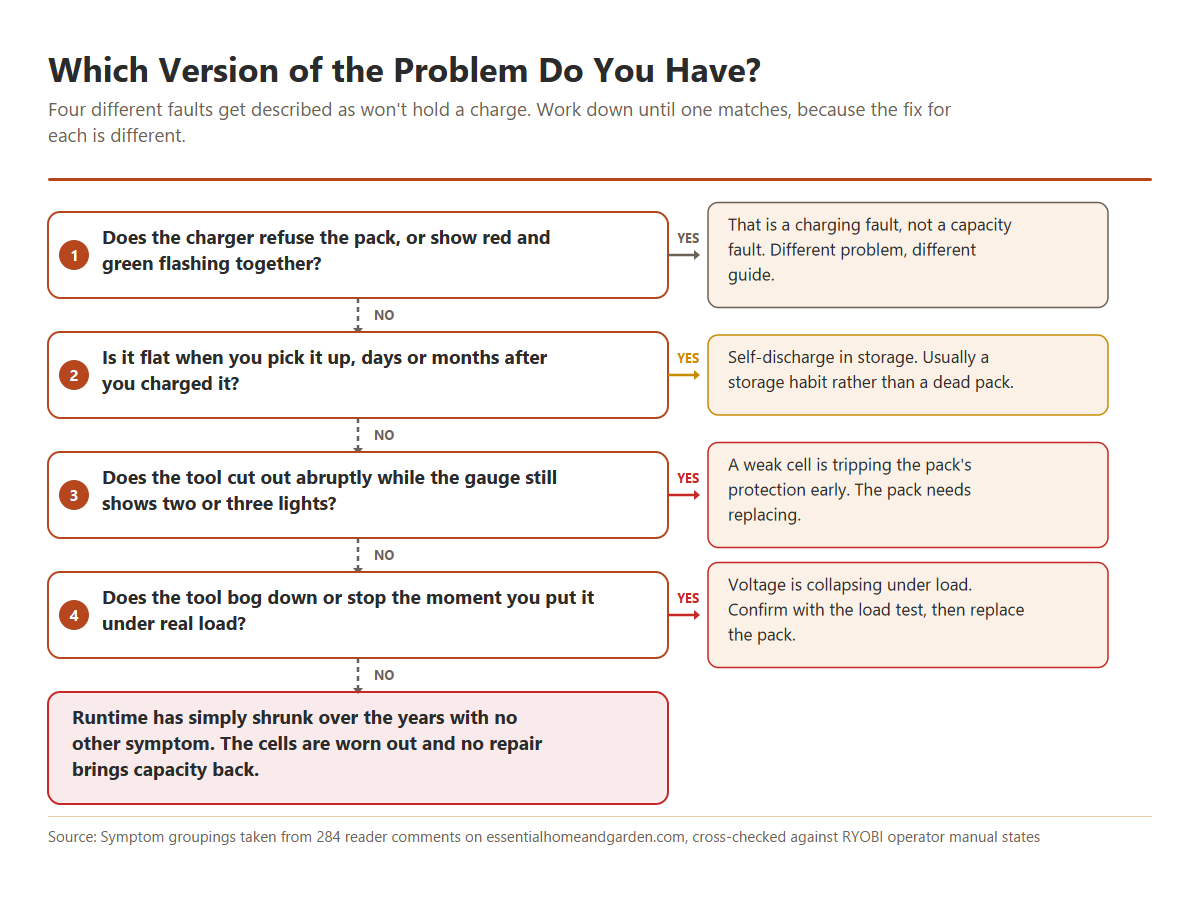
One quick note on what you’ll find elsewhere. Search this problem and you’ll be told to try mini-charging, jump-starting from a good pack, or feeding the battery from a bench power supply.
Those methods exist to wake a pack the charger refuses to accept. Your pack charges to four lights, so it isn’t in that state and none of them apply to you. We cover them properly on the hub guide, where they belong.
1. The Cells Have Worn Out
This is the answer for most people reading this, and it’s worth accepting early rather than spending a weekend on it.
Lithium cells lose capacity every year whether you use them or not. Your pack still charges, still reports full, and still delivers its rated power. There is simply less energy in it than there used to be.
The signature is a runtime that has shrunk steadily over seasons rather than dropped off a cliff. Your trimmer used to do the whole yard and now it does the front. Nothing else about your pack seems wrong.
How To Fix It
There is no fix you can apply. Capacity loss is chemical and permanent, and no reset procedure, deep discharge or charging trick brings it back.
- Check the age of the pack. Ryobi packs carry a date code, and the tool it came with is usually a good guide.
- Compare it against a second pack if you have one. Run both on the same tool and time them.
- If the old pack does a fraction of the runtime, you have your answer.
An OP4026 is the pack that comes up most often in reader reports, and those shipped with trimmers and blowers well over a decade ago. At that age, worn cells are simply expected.
Recycle your old pack rather than binning it. Home Depot and Lowe’s both run collection bins, and Call2Recycle lists drop-off points.
Runtime shrinking every season?
Worn cells don’t come back. A genuine pack drops straight into every 40V tool you already own.
2. It Cuts Out Before the Pack Is Empty
This one has a different feel to it, and readers describe it precisely. Your tool runs normally, your gauge drops to three lights or two, and then the tool stops dead.
Plenty of people report the same thing in slightly different words: the pack quits at around 60 to 70% discharged, or a hedge trimmer starts stalling out the moment it hits three green lights.
That is not your pack running out of charge. That is the protection circuit inside it shutting things down.
Your pack contains several cells wired in series, and they age unevenly. Once a single weak cell drops below its safe minimum voltage, the pack cuts power to protect itself, even though the others still hold plenty.
How To Fix It
The diagnosis is worth doing, because it tells you the pack is finished rather than the tool.
- Note the gauge reading at the moment it cuts out, and whether it’s repeatable.
- Release the trigger and wait a few seconds. Ryobi documents that releasing the trigger resets the protection so you can resume.
- If the tool runs briefly then cuts again at the same point, one cell is dragging the pack down.
- Try the pack in a lower-draw tool. Cutting out under a mower but running a drill fine fits the same picture.
Do not try to “bleed it down to zero” to reset it. Readers ask about this often, and it’s the one action that reliably makes things worse. Deep discharge damages lithium cells and can push a pack below the voltage a charger will accept.
There’s no repair path here either. A pack with one failed cell needs replacing.
Cutting out at three lights?
One weak cell is tripping the whole pack. The other cells being fine doesn’t help you.
3. Voltage Collapses the Moment You Pull the Trigger
Here’s the version that catches people who own a multimeter. The pack reads a healthy voltage sitting on the bench, so it looks fine, and then it can’t drive anything.
One reader put numbers on it perfectly: their charged pack read about 38 volts at rest, and dropped below 10 volts as soon as the leaf blower was running.
That gap is your whole diagnosis. As your cells age their internal resistance climbs, and resistance only shows itself when current flows. At rest your pack looks healthy because almost no current is moving.
How To Fix It
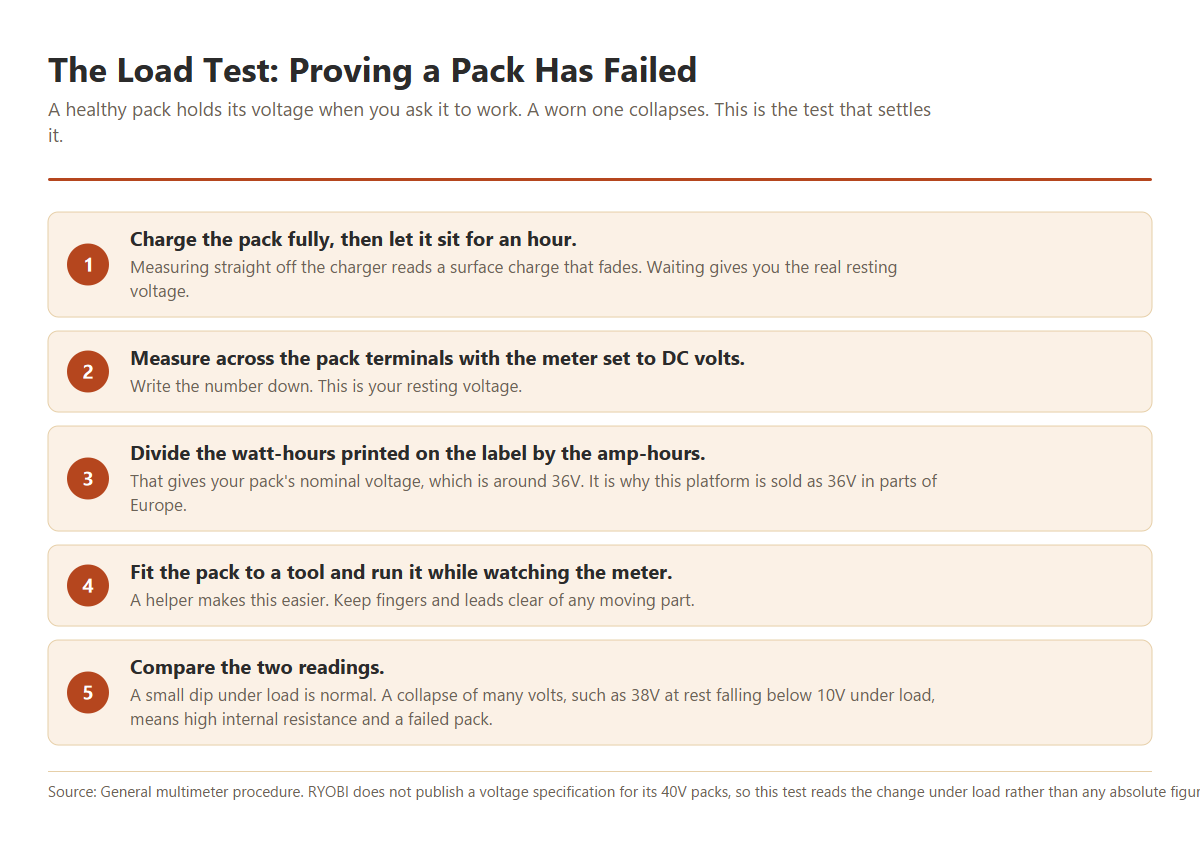
What you need: a basic digital multimeter set to DC volts. Anything that measures up to 50V will do.
A useful trick while you’re there: divide the watt-hours printed on your pack’s label by the amp-hours. That gives you the nominal voltage, which lands around 36V. It’s the reason this same platform is sold as 36V in parts of Europe.
Ryobi doesn’t publish a voltage specification for these packs, so don’t chase an exact target number. What matters is the change between the resting reading and the loaded one.
A small dip under load is completely normal. A collapse of twenty or thirty volts is a pack with failed cells, and it won’t recover.
Voltage crashing under load?
That’s the clearest failure signal there is. High internal resistance can’t be cleaned, charged or reset away.
4. It Goes Flat Sitting in Storage
This is the one that’s genuinely fixable, so pay attention if it sounds like yours.
The complaint is always the same shape. Your drill is dead every time you reach for it, no matter how recently you charged it. Or the mower went away working in autumn and the pack is flat in spring.
Every lithium pack self-discharges slowly on its own, including yours. What turns that from harmless into a problem is where you keep it and what state you leave it in.
Your unheated garage or shed spends months outside the temperature range Ryobi specifies. Cold storage accelerates the drain, and a pack left sitting at full charge ages faster than one stored part-charged.
How To Fix It
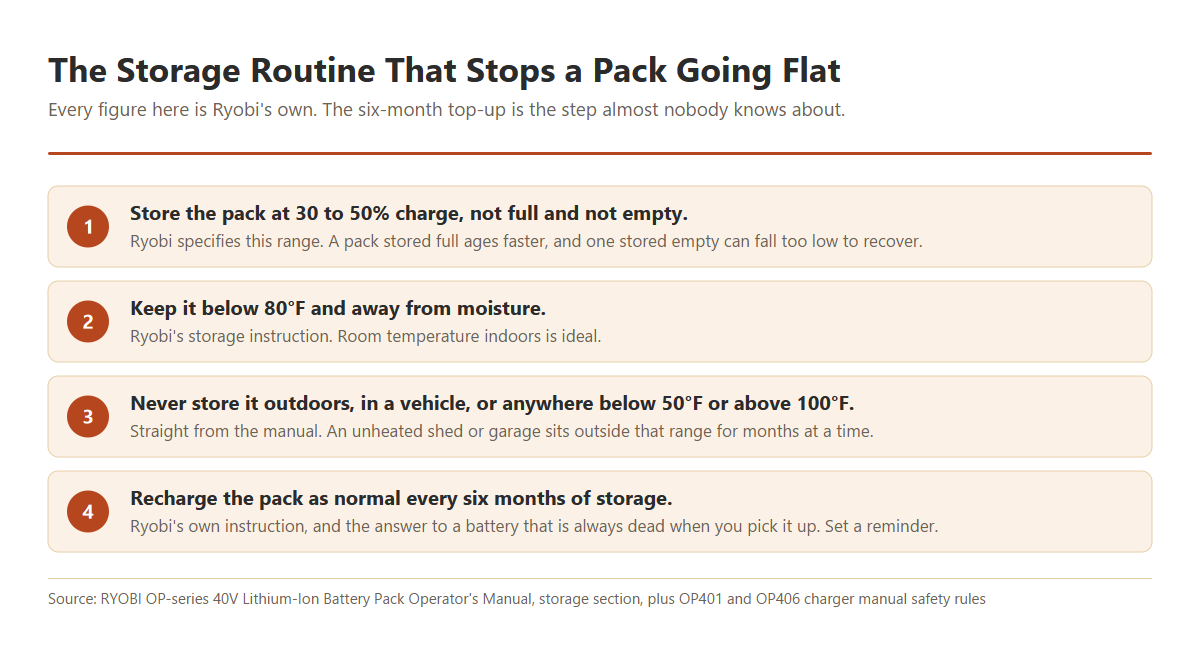
Every figure there is Ryobi’s own, out of the battery manual. The last step is the one almost nobody knows about: recharge the pack as normal every six months of storage.
Set a calendar reminder for it. That single habit is the difference between a pack that lasts and a pack that’s dead every spring.
If your pack has already been through several winters in a cold shed, some of the damage is done and won’t reverse. Storing it properly from now on protects what’s left.
5. Heat Has Aged It Early
Heat is the quietest killer of lithium packs, and the damage is cumulative and permanent.
Two habits do most of the harm, and you may recognise both. Dropping your pack straight onto the charger after mowing on a hot afternoon, and leaving batteries in a car, a truck bed or a sun-facing shed.
How To Fix It
- Let a hot pack rest 30 to 60 minutes before charging it. It holds heat far longer than it feels like it should.
- Keep packs out of vehicles. Ryobi says so explicitly, and a parked car easily exceeds the 100°F limit.
- Store below 80°F, and never below 50°F or above 100°F.
- Take a second pack to the job instead of pushing one pack through back-to-back charges.
A pack becoming slightly warm while charging is normal and Ryobi says so. A pack too hot to hold comfortably is not, and it’s telling you something.
None of this recovers lost capacity. It just stops you losing the next pack the same way.
6. It’s the Tool or the Contacts, Not the Pack
Worth ruling out before you spend anything, because the symptoms overlap and the fix is nearly free.
Dirty or corroded terminals cause intermittent power delivery that feels to you exactly like a failing battery. Your tool cuts out, restarts when you wiggle the pack, and works fine some days.
The tell you are looking for is inconsistency. Genuine cell failure is repeatable, while a contact fault comes and goes and often responds to you pressing down on the pack.
How To Fix It
- Take the pack off and look at both sets of terminals for dullness, corrosion or debris.
- Blow the tool’s battery well out with compressed air or a dry brush.
- Clean the contacts with an electronics-safe cleaner, and let them dry fully.
- Refit until the latches snap, then test again.
What you need: an electronics-safe contact cleaner that dries without residue. Water, WD-40 and general degreasers all belong nowhere near battery terminals.
Then swap in a second known-good pack. If that one behaves the same way in the same tool, your battery was never the problem and the tool needs looking at.
How Long Should a Ryobi 40V Battery Last?
This is the question behind everything above, and it deserves a straight answer rather than a confident number.
Ryobi does not publish a charge-cycle rating for its 40V batteries. We checked the operator’s manuals for the OP-series packs, the OP40602 family and the OP4050A, both charger manuals, and the official warranty statement. None of them contains one.
So if you’ve seen a specific cycle figure quoted for Ryobi packs, it didn’t come from Ryobi. The number you will usually find traces back to Battery University, which says manufacturers specify the life of lithium-ion in most consumer products at 300 to 500 discharge cycles. That’s a general industry figure for consumer electronics, not a power tool spec, and certainly not a Ryobi one.
Treat it as a rough estimate and nothing firmer. Battery University itself cautions that counting cycles isn’t conclusive, because “there is no standard definition as to what constitutes a discharge cycle.”
What a “charge cycle” actually means
This trips people up, and it matters, because the usual reading inflates your own count badly.
A cycle is not one trip to the charger. It’s one full battery’s worth of use, however you accumulate it. Apple explains the convention clearly: use 75% of a pack one day and 25% the next, and that’s one cycle between them, not two.
Cycle ratings are also quoted to a point where the pack still holds a useful fraction of its original capacity, not to the point it dies. Apple rates to 80% of original capacity, Battery University’s tables use 70%. Different yardsticks, different numbers, which is another reason to hold any cycle figure loosely.
What that means in seasons
Here’s the useful translation, and it’s an estimate rather than a spec.
Mow weekly through a 30-week growing season, using roughly one full pack per mow, and you’re using about 30 cycles a year. Against a 300 to 500 cycle band, that’s on the order of a decade of mowing.
Which tells you something important: for a homeowner, packs almost always die of age rather than use. Calendar ageing gets there first. Run a landscaping business through several packs a day and you’ll reach the same band in a couple of seasons, which is exactly why Ryobi’s commercial warranty is so much shorter.
The one number Ryobi does commit to
The warranty is the only lifespan promise you actually get from Ryobi, and it is more useful to you than any cycle count.
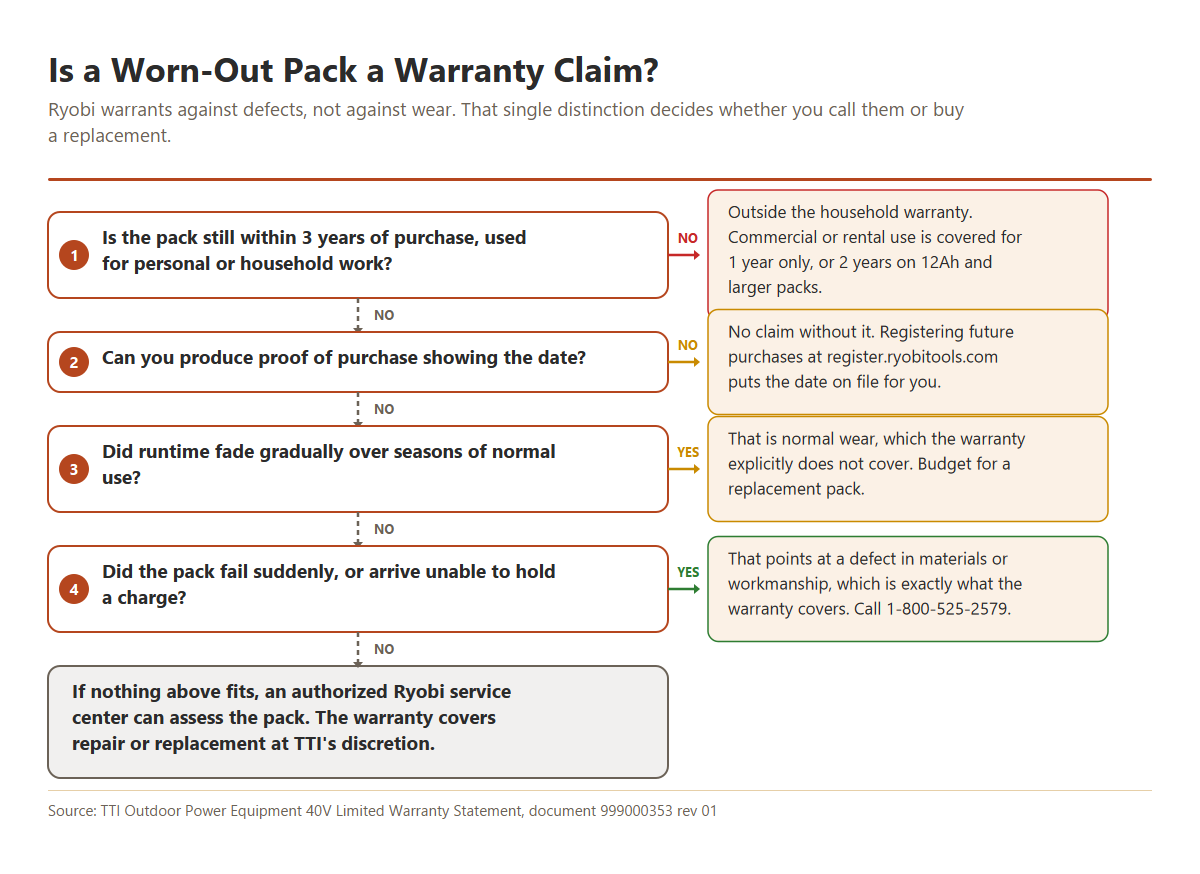
For household use, a 40V battery carries a three-year limited warranty, with five years on the tool and three on the charger. Used commercially or for rental, that drops to one year on the battery, or two years on packs of 12Ah and above.
Read the exclusion carefully, because it decides your case. The warranty covers defects in materials and workmanship, and it states that it “does not extend to repairs made necessary by normal wear.”
Gradual capacity loss over several seasons is normal wear. That is not a warranty claim, however annoying it is. A pack that fails abruptly inside three years, or one that never held a charge properly from new, is a much better case, and you’ll need dated proof of purchase either way.
Ryobi’s service centre line is 1-800-525-2579, and registering at register.ryobitools.com keeps your purchase dates on file.
Out of warranty and worn out?
Normal wear isn’t a claim, so a replacement is the realistic route. Genuine packs work with every 40V tool you own.
Model-Specific Notes
OP4026 and the older packs
The OP4026 turns up more than any other model in reader reports, and it’s simply old. These shipped with trimmers and blowers over a decade ago.
If yours still charges to four lights and runs for ten minutes, nothing is broken in the sense that you could fix it. Those cells have reached the end of their service life.
The same goes for OP4015, OP4030 and OP400-era packs. If yours is one of these, age is your diagnosis, and a current-generation 40V pack drops straight into the same tools.
If your pack says 36V
Ryobi’s 40V outdoor range is sold as 36V in parts of Europe and elsewhere. Same platform, different market naming, same behaviour on everything covered here.
That figure is the nominal voltage rather than the peak, which is why a healthy charged pack reads higher than 36V on a meter.
If your part number starts with P
P104 and P117 aren’t 40V parts. They belong to Ryobi’s 18V ONE+ system, where P104 is a battery and P117 is a dual-chemistry charger.
The platforms do not interchange, so if that is what you have, none of the guidance here applies to your pack.
Buying a Replacement Battery
Once the load test has told you the pack has failed, the decision is which replacement, not whether.
The aftermarket is where your real risk sits. Third-party 40V packs are where most fake-capacity complaints come from, and a pack advertised as 6Ah that behaves like a 3Ah one puts you straight back where you started. One reader bought a generic pack and had a mower that ran 30 seconds before shutting off.
There is a warranty angle for you too. Ryobi’s cover excludes damage caused by parts that are incompatible with the product, so a cheap pack that harms your tool can cost you more than it saved.
A genuine RYOBI 40V lithium-ion pack is the straightforward swap and works with every 40V tool you already own.
On capacity, buy up rather than like-for-like. A higher-capacity pack gives you longer runtime, not more power, so a 6Ah in place of a worn 4Ah means fewer interruptions rather than a faster mower. The trade is weight and price.
If you keep a spare, you also get to rotate them, which is easier on both your packs than running one into the ground every session.
Ready to replace it?
Buy genuine, store it at 30 to 50% over winter, and you won’t be reading this page again next season.
Still not sure the pack is the culprit? Our guides to Ryobi 40V charger problems and a charger flashing red and green cover the charger side of the system.
Related Ryobi Guides
- Ryobi 40V battery not charging: the hub guide, covering a pack the charger will not accept at all, including sleep-mode recovery.
- Ryobi 40V charger problems: six causes covering no lights, lights that never progress, dirty contacts and a charger that says full when it is not.
- Ryobi battery flashing red and green: what the error code means, and the two-minute test that shows whether the pack or the charger failed.
- Ryobi 18V ONE+ battery problems: the other platform: what the three charger lights mean, why flashing red is not a fault, and the protection circuit that stops your tool.
- Ryobi 40V lawn mower won’t start: the five start interlocks that stop a mower dead even with a fully charged pack, plus the test that separates a battery fault from a mower fault.
Frequently Asked Questions
My battery shows fully charged but only runs the tool for a few minutes. What’s wrong?
Your cells have lost most of their capacity. Your fuel gauge reports state of charge, not state of health, so a worn pack still charges to four lights.
Four lights means 85 to 100% of whatever capacity remains. On an old pack, that isn’t much.
Why does my Ryobi battery stop working when it still shows three lights?
That is your protection circuit working, not an empty battery. When one cell in your pack drops below its safe voltage, the pack shuts down to protect itself even though the others still hold charge.
Release the trigger and it will reset, but it will cut out again at the same point. A pack doing this needs replacing.
Can a Ryobi 40V battery that won’t hold a charge be fixed?
Not if the cells are worn. Capacity loss is a chemical change, and no reset, deep discharge or charging trick reverses it.
The exception is a pack that only goes flat in storage. That’s usually a storage habit and it responds to Ryobi’s 30 to 50% rule and a six-monthly top-up.
How long should a Ryobi 40V battery last?
Ryobi doesn’t publish a cycle rating, so there’s no official answer. The general industry figure for consumer lithium-ion is 300 to 500 cycles, per Battery University, and that’s an estimate rather than a Ryobi spec.
For a homeowner mowing weekly, that’s roughly 30 cycles a year, so age usually finishes a pack before cycle count does. Ryobi’s three-year household warranty is the only commitment it actually makes.
My charged battery reads 38 volts but drops below 10 volts under load. What does that mean?
Your pack has failed. That collapse is high internal resistance, which builds up as cells age and only shows itself when current flows.
At rest almost no current moves, which is why your pack looks healthy on the bench. No cleaning or charging routine fixes it.
Should I run the battery all the way down to reset it?
No. Deep discharging a lithium pack damages it, and it can push the voltage low enough that the charger refuses to accept it afterwards.
Ryobi’s guidance points the other way, storing packs at 30 to 50% charge. There’s no reset procedure that recovers lost capacity.
Why is my battery always dead when I pick it up, even though I charged it?
That is self-discharge, and where you store your pack usually explains it. Ryobi says not to store batteries outdoors, in vehicles, or anywhere below 50°F or above 100°F.
An unheated garage sits outside that range for months. Store it indoors at 30 to 50% charge and recharge it every six months.
Is a battery that won’t hold a charge covered under warranty?
It depends entirely on how it failed. Ryobi’s 40V battery warranty runs three years for household use and one year for commercial use, and it covers defects in materials and workmanship.
It states that it does not cover repairs made necessary by normal wear. Gradual capacity loss is wear, so it isn’t a claim, while a sudden failure inside the period may well be.
My batteries are six years old and still show fully charged. Can I use another brand?
At six years, four lights tells you your pack charges, not that it holds useful energy. Age alone explains what you are seeing.
Stick with genuine Ryobi 40V packs. Third-party batteries are the source of most capacity complaints, and Ryobi’s warranty excludes damage from incompatible parts.
Does leaving the battery on the charger damage it?
Ryobi’s instruction is to disconnect the charger from the power supply when it isn’t in use. Long-term storage on a charger isn’t the intended use.
For anything longer than a few days, take the pack off and store it at 30 to 50% charge instead.
Why does a fairly new battery only work until it’s half discharged?
Cutting out at half charge on a newer pack points at a defective cell rather than wear, so your battery is very likely faulty. Healthy packs deliver full power right down to the last light.
That’s a strong warranty case if you’re inside three years and have proof of purchase. Call 1-800-525-2579 before you buy a replacement.
The Short Version
A Ryobi 40V pack that charges to four lights and then dies has almost always worn out, and the fuel gauge was never able to tell you that. The load test settles it in about five minutes.
If it only goes flat in storage, that one is fixable, and Ryobi’s six-month top-up rule is the step to take from here.
Comments are open below if your symptom isn’t covered. Reader questions are where most of these guides come from.
Sources: RYOBI OP-series 40V Lithium-Ion Battery Pack Operator’s Manual, RYOBI OP401 and OP406 charger manuals, and the TTI Outdoor Power Equipment 40V Limited Warranty Statement (document 999000353). Cycle-life figures attributed to Battery University, which is not a Ryobi source.
We may be paid a commission if you purchase through links on this page, at no extra cost to you.
