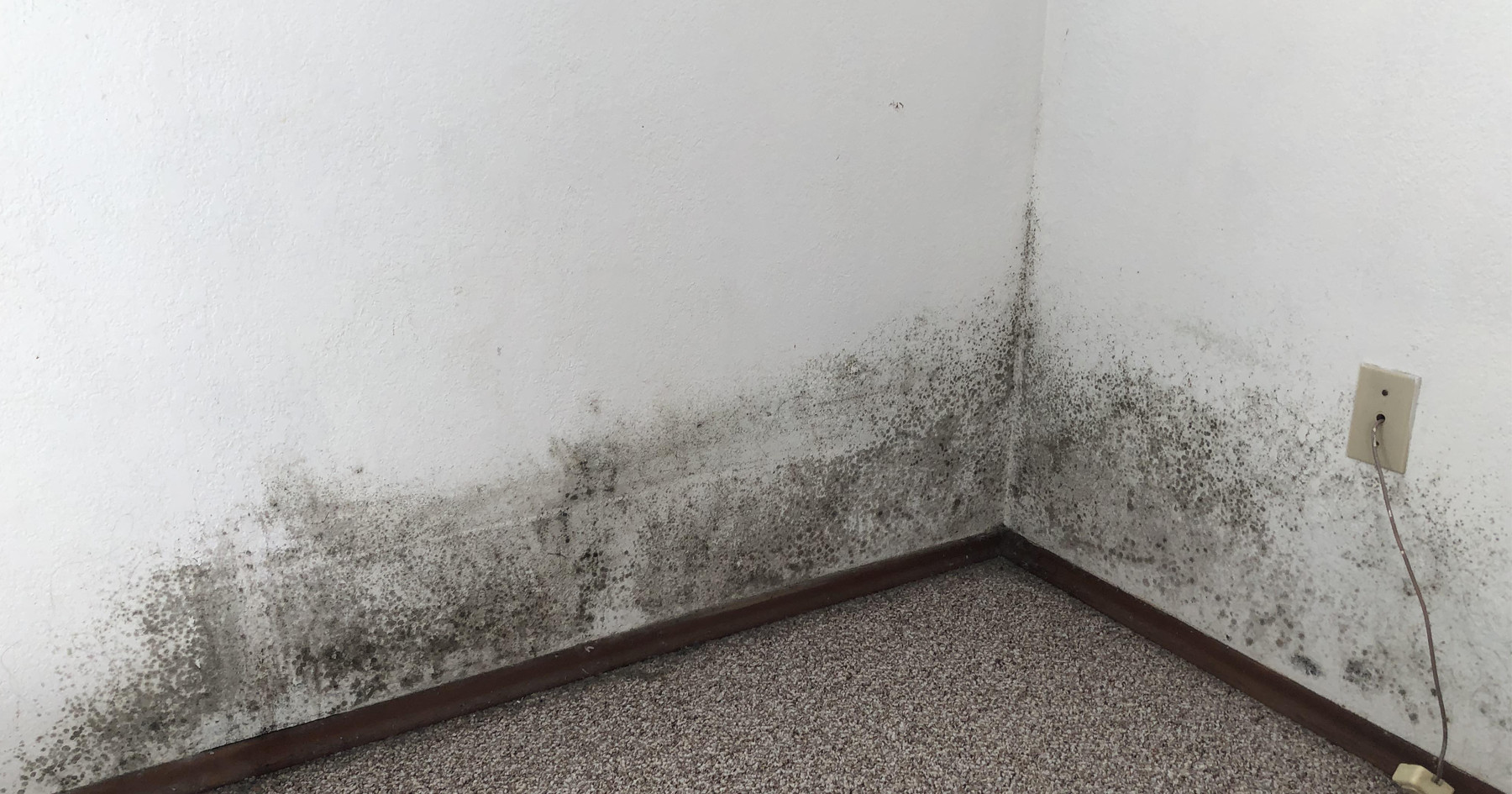
To remove mold from drywall, first fix the moisture that caused it. Then decide between two jobs: clean it, or cut it out.
A small patch on painted drywall that still feels firm can be cleaned: HEPA vacuum it, scrub it, and dry the wall within 48 hours.
Drywall that is unpainted, soft, soaked or moldy on both sides has to be cut out and replaced, because drywall is porous and mold grows into it.
If the mold covers more than about 10 square feet, the EPA says that is a job for a professional.
Updated October 2026 against current EPA and CDC mold guidance.
- Mold can cause health problems, especially for people with asthma or allergies, so remove it as soon as it’s spotted.
- Fix any moisture sources like leaks that allow mold to grow before starting removal.
- Protect yourself with gloves, masks, goggles when removing mold.
- Clean small patches on firm, painted drywall with a HEPA vacuum, a scrub and a cleaning solution.
- Cut out and replace drywall that is unpainted, soft, soaked or moldy right through.
- Call a professional if the moldy area is larger than about 10 square feet.
- Dry areas quickly and prevent future growth with fans, dehumidifiers and mold-resistant paint.
Clean It or Cut It Out?
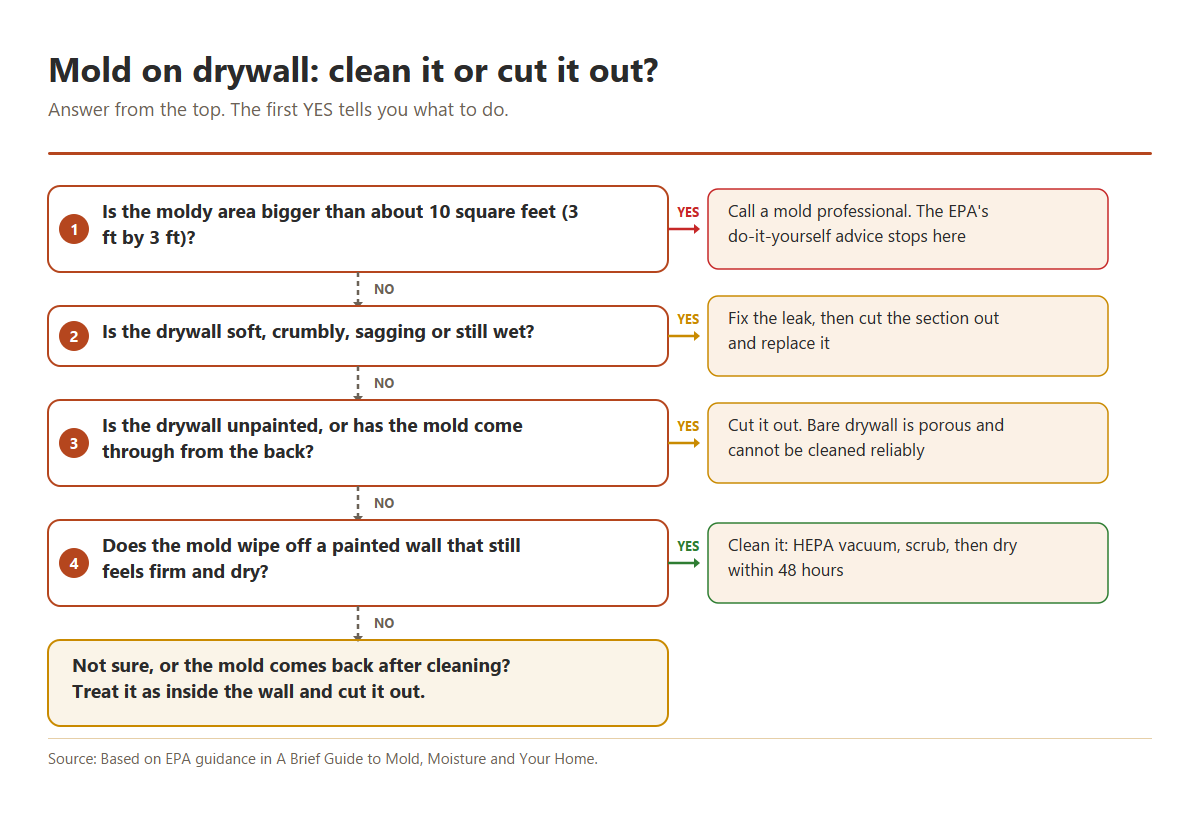
This is the decision that matters most. Work down the chart from the top.
Painted vs Unpainted Drywall
Paint makes the difference. A painted wall has a sealed surface, so mold that started on the paint can often be cleaned off before it reaches the paper underneath.
Unpainted drywall is bare paper over gypsum, and both soak up water. The EPA notes that mold grows into the empty spaces of porous materials, so it may be difficult or impossible to remove completely.
So if the drywall is unpainted, or the mold has come through from the back of the wall, plan to replace it.
| Your drywall | What to do |
|---|---|
| Painted, firm and dry, with a small patch of surface mold | Clean it (see Cleaning Surface Mold on Drywall) |
| Unpainted or bare paper | Cut it out and replace it |
| Soft, crumbly, sagging or still wet | Fix the leak, then cut it out and replace it |
| Mold on both sides, or coming back after cleaning | Cut it out and replace it |
| More than about 10 square feet of mold | Call a mold professional |
How to Remove Black Mold From Drywall
The same way as any other mold. The color does not change the job.
The CDC says you do not need to know what type of mold you have, and it does not recommend testing. Whatever the type, you need to remove it.
So use the chart above. What matters is the size of the patch and the condition of the drywall, not whether the mold is black, green or gray.
Assess the Mold Damage
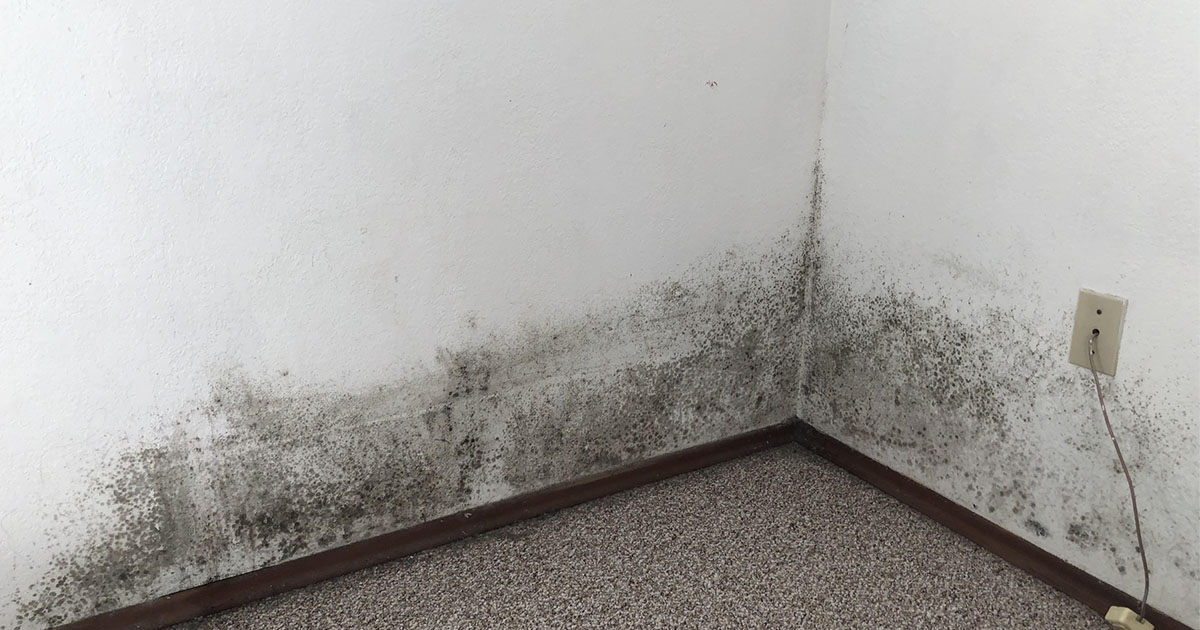
Before you start cleaning, take time to assess the extent of the mold problem. This will determine the removal approach.
1. Inspect and Evaluate the Moldy Areas
Thoroughly inspecting the mold damage on your drywall will guide your removal approach.
Follow these tips:
- Note the location of the mold. Is it concentrated in one area like near a pipe or window? Or spread out in patches? Location points to the moisture source.
- Estimate the size of the affected area. A few square feet may just need surface cleaning. Over about 10 square feet (roughly 3 feet by 3 feet), the EPA advises bringing in a professional.
- Observe the texture and color of the mold. Fuzzy gray, black, green or brown spots indicate typical mold. White or bright colors may be mildew which can also be harmful.
- Check if the surface mold rubs off easily with a gloved finger or brush. Mold that scrubs off may just be surface growth, while mold that’s difficult to scrub needs disinfecting.
- Determine if the drywall feels very soft, soggy or crumbly. Press gently with a tool. Soft areas indicate moisture has soaked deep into material.
- Assess if any areas feel slimy or damp. Wet spots mean there’s an active moisture source that needs to be fixed before cleaning.
- See if mold has grown in spots on just one side of drywall or went all the way through. One-sided mold has a better chance of being cleaned.
- Look for signs like warped corners or sagging sections that point to structural damage from moisture. This requires drywall replacement.
Carefully evaluating the mold damage guides the removal plan.
Minor surface mold can be scrubbed away, while extensive colonization or signs of deep penetration into drywall requires replacing the sections affected.
Fix all leaks before cleaning the mold away!
2. Address the Moisture Source
Mold needs moisture to grow. Solve any underlying issues before cleanup:
- Fix plumbing leaks, clear rain gutter clogs, improve ventilation.
- Use dehumidifiers and fans to lower interior humidity under 50%.
- The EPA says to keep indoor humidity below 60%, and ideally between 30% and 50%. A humidity meter shows whether you are there.
- Dry anything that gets wet within 24 to 48 hours. That is the window the EPA gives for preventing mold growth.
- Pull out and replace wet insulation rather than trying to dry it. The EPA’s water damage table says wet fiberglass and cellulose insulation should be discarded and replaced.
3. Protect Yourself and Your Home
Safe mold removal means guarding your lungs and your belongings:
- Wear an N95 respirator, long gloves that reach mid-forearm, and goggles without ventilation holes. This is the gear the EPA lists.
- If you have asthma, allergies or a weakened immune system, talk to a doctor before doing the cleanup yourself.
- Isolate the workspace by sealing vents/doors and laying plastic sheets.
- Remove furniture, rugs, drapes from the area and cover floors.
Now that you’ve assessed the situation and prepared your workspace, we can move on to killing and removing the mold from surfaces.
Cleaning Surface Mold on Drywall
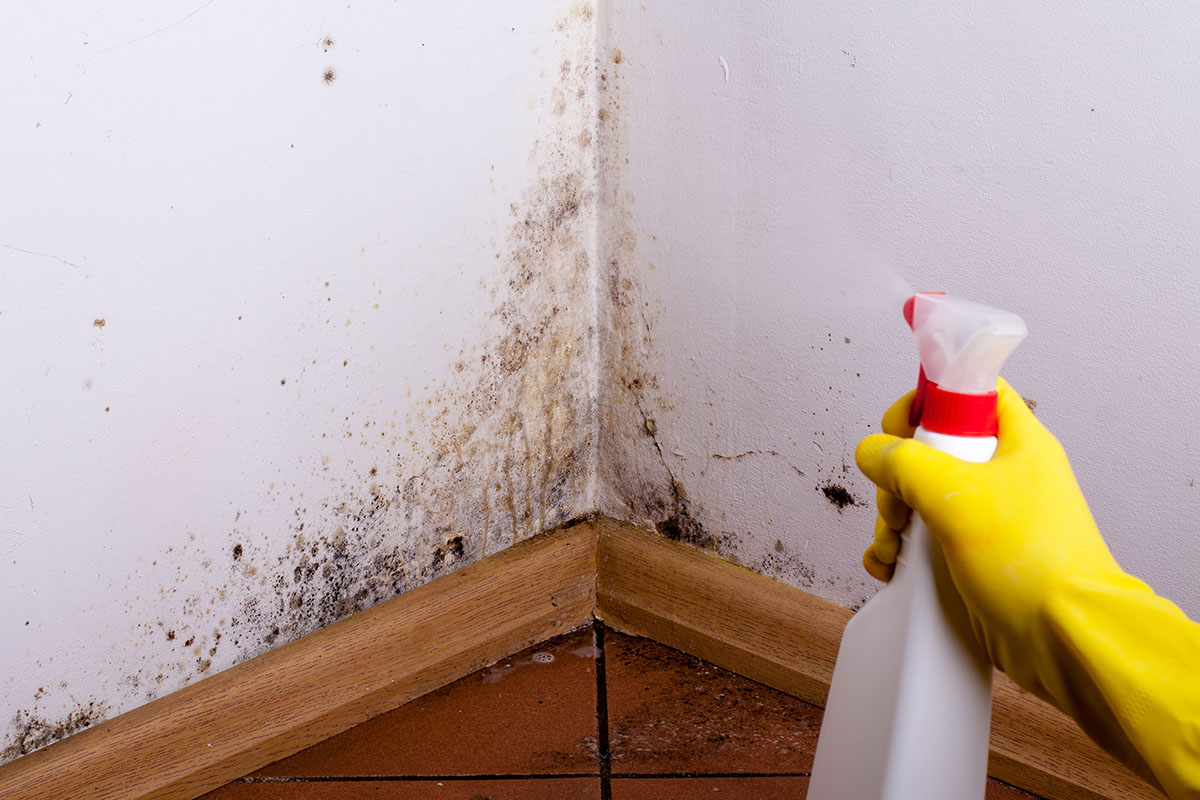
If you’re dealing with small patches of mold on painted drywall, you can clean the mold away without replacing drywall.
If the mold has penetrated deeply into the drywall, then continue on to the next section where we discuss replacing damaged drywall.
Here are tips for safe, effective surface mold removal.
1. Vacuum the Mold
Use a vacuum with a high-efficiency particulate (HEPA) filter to remove loose spores and reduce airborne mold.
Slowly vacuum the entire area, especially around edges and crevices where mold hides.
2. Scrub Away Mold
Use a cleaning solution like Concrobium or white vinegar and spray it over the moldy spots. Do not soak the wall: drywall that gets wet grows more mold.
Let it sit for 10-15 minutes. Use a stiff nylon brush or sponge to scrub the area, rinsing the brush often, until all visible mold is gone.
What Kills Mold on Drywall?
Killing the mold is not enough on its own. The EPA points out that dead mold can still cause allergic reactions, so it has to be physically removed.
The EPA also does not recommend bleach or other biocides as a routine part of mold cleanup. Scrubbing, removing and drying do the real work.

Concrobium Mold Control, 1 Gallon
- EPA-registered mold cleaner that contains no bleach
- Odorless, and leaves a barrier that helps prevent regrowth as it dries
- One gallon covers 800 to 1,600 sq ft, per the maker
We may earn a commission if you buy through this link. It costs you nothing extra.
⚠ Use one cleaner, and never mix them
- Pick one solution from the list below. Do not combine them or use one straight after another.
- Never mix bleach with ammonia or any other cleaner. The CDC warns this produces a poisonous gas.
- If you do use bleach, the CDC’s limit is 1 cup of household bleach per gallon of water.
- Open windows and doors so fresh air moves through while you work.
Here are some common antimicrobial solutions that can be used for mold removal:
- Bleach – A bleach and water solution disinfects hard surfaces. The CDC says to use no more than 1 cup of bleach per gallon of water. It is not the best choice on porous drywall, and the EPA does not recommend it for routine mold cleanup.
- Borax – Borax is a natural mineral salt that kills mold. Mix 1 cup borax with 1 gallon hot water. Wipe on moldy surfaces and let sit for 1 hour before rinsing.
- White Vinegar – The high acetic acid content in white vinegar kills mold spores. Mix equal parts vinegar and water in a spray bottle. Spray on mold and let sit before scrubbing and rinsing.
- Baking Soda – Create a paste with baking soda and water. Apply to moldy areas, let sit for 15 minutes, then scrub and rinse away. Baking soda changes pH levels to inhibit mold growth.
- Hydrogen Peroxide – Hydrogen peroxide at 3% concentration can remove mold on non-porous surfaces like tile or metal. Spray on mold and let bubble for 10 minutes before wiping away.
- Concrobium Mold Control – This EPA-registered solution uses sodium carbonate to kill mold and form a protective barrier. Spray on moldy surfaces as directed.
- Tea Tree Oil – The antifungal properties in tea tree oil make it effective at killing mold naturally. Add 20 drops oil to 32 oz spray bottle filled with water. Shake and spray on affected areas.
- Grapefruit Seed Extract – This citrus-based antifungal extract destroys mold, mildew and bacteria. Use 5-10 drops per cup of water in a spray bottle. Shake and spray on mold growth.
3. Speed Dry with Fans
Use fans and dehumidifiers to completely dry out the cleaned area.
Mold flourishes in dampness, so quick drying prevents regrowth.
Aim fans at the wall and have it fully dry within 48 hours.
4. Seal and Paint
Paint only after the mold is gone and the wall is completely dry. The EPA warns against painting over moldy surfaces, because the paint is likely to peel.
Then apply a mold inhibitor primer and a topcoat rated for bathrooms and kitchens. Allow each coat to dry fully.
Repeat as Needed
Check the area regularly the first month after cleaning. Re-clean small spots that reappear before they spread.
If the mold keeps coming back in the same place, it is growing inside the wall. Cut that section out.
For more extensive mold colonization inside drywall, continue to the next part of our guide on cutting out and replacing moldy sections.
Removing Moldy Drywall Sections
If mold has penetrated deep into the drywall, or the drywall is unpainted, soft or was soaked, replacing the damaged section is the reliable fix.
Past about 10 square feet of mold, or if the water came from sewage, the EPA says to bring in a professional instead.
Here are the steps:
1. Outline the Affected Area
Use a utility knife to cut out a rectangular section 6 inches beyond visible mold edges. This ensures you remove hidden mold that is in the dry wall but not visible yet.
2. Cut and Remove the Drywall
Use a drywall saw to cut along the outlines through the paper and gypsum. Watch for wires and pipes. Carefully remove the moldy section and discard outside.
3. Clean Surrounding Areas
Vacuum surrounding walls, corners and crevices with a HEPA vacuum to remove disturbed mold spores. Check the studs and insulation behind the hole, and replace any insulation that is wet or moldy.
3. Install New Drywall
Measure and cut a piece of drywall to tightly fit the hole. Secure with drywall screws into studs. Mud seams for a smooth finish.
The video below gives a good overview of replacing drywall:
Prime and Paint New Drywall
Once dry, apply antimicrobial primer and mold-resistant paint over the seams and the entire replacement section. Allow thorough drying between coats.
Mold comes back if the room stays damp
Holding indoor humidity between 30 and 50 percent is what stops it returning after the repair. A dehumidifier sized for the room is the simplest way to stay in that range.
What You Need to Remove Mold From Drywall
These four cover the cleaning route. All were in stock on Amazon when we checked in October 2026.
- Used for Scrubbing surface mold off painted drywall
- Why this one EPA-registered, no bleach
- Step Cleaning, step 2

- Used for Keeping spores out of your lungs
- Why this one NIOSH-approved N95
- Step Before you start

- Used for Lifting loose spores before and after the job
- Why this one HEPA filter rated to 0.3 microns
- Step Cleaning, step 1

- Used for Priming the cleaned or replaced section
- Why this one EPA-registered fungicidal primer
- Step After the wall is dry
We may earn a commission if you buy through this link. It costs you nothing extra.
Mold remediation takes time and diligence, but with the right tools and techniques, you can remove mold from drywall and prevent regrowth.
Stay vigilant against moisture and act quickly if new mold appears.
One thing to know after any drywall job: the spores you stirred up are still in the air.
Cutting out moldy drywall sends a cloud of spores through the room, and they settle somewhere else. A HEPA purifier running during and after the work catches what is floating before it lands. It will not fix the leak or clean the wall, so do the remediation first and let the purifier handle the air.
Frequently Asked Questions
Can I remove moldy drywall myself?
You can remove moldy drywall yourself if the affected area is less than 10 square feet and the drywall is not severely damaged or soft to the touch. You will need to wear protective equipment, such as gloves, mask, and goggles, and use a vacuum with a HEPA filter to remove surface spores. You will also need to use a cleaning solution, such as vinegar or bleach, to kill the mold and scrub it away. You may also need to seal the drywall with a primer and paint after it is dry.
How do you remove mold from drywall permanently?
To remove mold from drywall permanently, you need to address the source of moisture that caused the mold growth in the first place. This could be a leaky pipe, a roof issue, or high humidity in the room. You also need to ensure that the drywall is completely dry before you apply any cleaning solution or paint. If the mold has reached the back of the drywall or the wood framing behind it, you may need to replace the affected sections.
Can black mold be cleaned off drywall?
Black mold can be cleaned off drywall if it is only on the surface of painted or primed drywall. You can use a cleaning product or a mold-killing solution to wipe or scrub it away. However, if the black mold has penetrated the unpainted or unprimed drywall, you may need to cut out and replace the contaminated sections. Black mold can be hazardous to your health and cause respiratory problems, so you should wear proper protection and act quickly.
Is vinegar or bleach better for mold on drywall?
Vinegar is better than bleach for mold on drywall because vinegar can penetrate porous materials and kill the mold at its roots. Bleach only kills surface mold and does not reach deeper into the drywall. Bleach can also be a food source for some types of mold and cause them to spread further. Vinegar is also safer and more eco-friendly than bleach.
Is drywall mold toxic?
Drywall mold can be toxic depending on the type and amount of mold present. Some molds produce mycotoxins, which are substances that can cause headaches, breathing problems, and even neurological damage. Black mold is one of the most toxic molds that can grow on drywall and cause serious health effects. Mold exposure can also trigger allergic reactions and asthma attacks in some people. If you suspect that your home has toxic mold, you should seek professional help.

From my experience you are way better off to remove the drywall or sheetrock and start over! ANY POROUS service that comes in contact with mold spores WILL grow mold!! One thing I did learn is to add DAWN DISH SOAP to any cleaner your spraying. The human eye cant see the spores that splatter in the air. The dawn traps them in its bubble. I hope I was some help!!
Water came in through the roof and mold was growing up the wall. A mitigation team came in, fogged, and treated the house. All the mold is still visible on the wall. The guy said it was dead and to just wipe it off before we paint. Does this drywall need to be replaced or just wiped off?
Depending on how deep the mold has grown into the drywall, you may be able to just wipe it off – or it may require some sanding.
Anyway to treat unpainted drywall without removing the sheetrock or sections of the sheetrock?
Not reliably… because the wall has no painty protecting it – it is highly likely that the mold has sunk its roots deep into the drywall. The most reliable method is to remove the affected parts of the wall.
If the drywall feels spongy,you have no choice but to replace it,otherwise leave to dry get rid of the mould one way or the other and prime it again ,let it dry and then use ceiling paint