Struggling with a damp basement? You’re not alone. Many homeowners find themselves battling excess moisture, especially in basements, which can lead to mold, mildew, and an overall uncomfortable living environment.
Air conditioning units and HVAC systems often fall short in addressing this issue effectively. That’s where a dehumidifier for your basement comes into play, offering a tailored solution for moisture control.
Drawing from our firsthand experience, we understand the critical role these devices play in maintaining a healthy, dry basement.
In this article, we delve into various options, examining their features, effectiveness, and suitability for different basement conditions. Whether you’re dealing with minor dampness or a full-blown moisture crisis, our comprehensive guide will help you find the ideal dehumidifier to keep your basement dry and comfortable.
Our Top Pick For Removing Basement Humidity
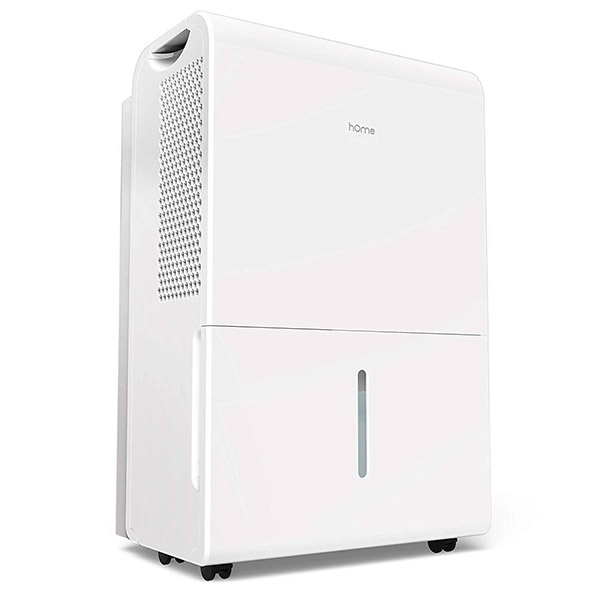
The hOmeLabs 4500 provides the most bang for your buck, including a 1.8 gallon reservoir, an easy-access side filter, touch-panel controls, and an auto-defrost mechanism. Even with a 50 pint daily capacity, this model can aerate even the dampest basement with precision.
With 4,500 sq. ft. of effective coverage, this model is able to draw out up to 50 pints of water from your basement’s air each day, allowing it to comfortably remain at the 35% relative humidity threshold. You’ll hardly even need to mess with this unit once it is running, either, thanks to its use of an easy-access side filter panel and its hefty 1.8 gallon reservoir.
Dehumidifiers Comparison Table
Quickly compare important stats with this handy comparison table.
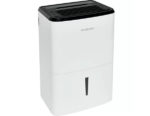
Best Dehumidifier For A Basement Reviews
As noted above, the hOmeLabs 4500 has earned top billing in this collection of reviews. This may leave some folks scratching their head, wondering how a dehumidifier from a fairly unknown brand has come out on top. But once you see this model in action, you won’t question its ability to efficiently collect 50 pints of moisture each day in its spacious 1.8 gallon reservoir.
Let’s get one thing out of the way – the hOmeLabs 4500’s Turbo Mode made a major impact during this model’s review process. When engaged, this feature allows the hOmeLabs 4500 to maximize its moisture removal and odor reduction capabilities by speeding up its intake and dispersion processes. As a result, this model has no trouble converting a 4,500 sq. ft., 85% RH basement into a 35% RH basement in just a few days’ time.
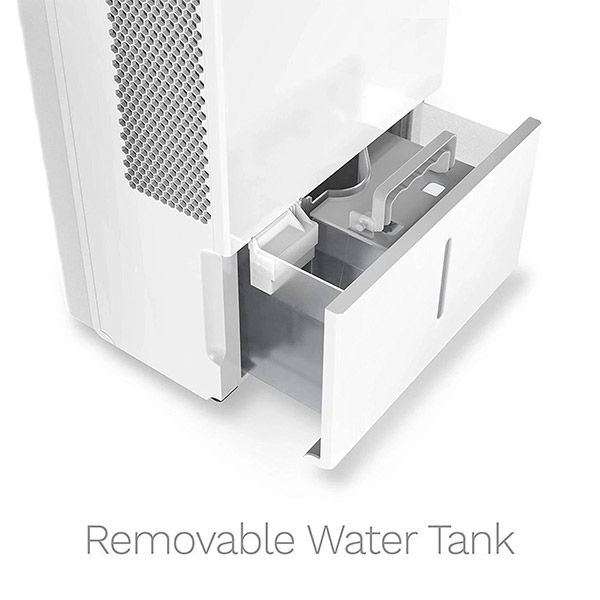
To access this phenomenal Turbo Mode, you’ll have the pleasure of using this model’s user-friendly touch-panel controls. While you’re at it, you’ll be able to easily access the hOmeLabs 4500’s removable filter through its side-mounted access hatch. Simply put, you’re going to have to work hard to find another affordably-priced dehumidifier that can work as efficiently as the hOmeLabs 4500.
The hOmeLabs 4500 Dehumidifier is available directly from the manufacturer.
Waykar 34 Pint Dehumidifier

- 34 pints a day across spaces up to 2,000 sq ft, Energy Star certified
- Humidity target adjustable down to 30%, below the 40% floor most units stop at
- Dual drainage – 0.66 gallon tank or a continuous hose – plus a 90° manual airflow swing
We may earn a commission if you buy through this link — it costs you nothing extra.
Key Specifications
- Up to 2,000 sq. ft. coverage
- 34 pints per day (95°F, 90% RH)
- 30%–80% humidity control
- Energy Star certified
- 90° manual swing airflow
- Dual drainage: 0.66 gallon tank or continuous hose
- Built-in timer
Second on our list is the Waykar 34 Pint, and it is the one to reach for when the basement is a normal basement rather than a swimming pool.
It pulls 34 pints a day and is rated to 2,000 sq ft. The number that matters more is the humidity floor: you can set it to 30%, where most units refuse to go below 40%. In a basement that stores anything you care about, that lower setting is the whole point.
Waykar 34 Pint Dehumidifier
- Rated for spaces up to 3,000 sq ft, with a turbo mode for fast moisture removal
- 35 pints a day under current ratings — 50 pints by the older 2012 standard
- Quite loud, which matters less in a basement; filter washes out about monthly
We may earn a commission if you buy through this link — it costs you nothing extra.
Drainage is the usual pair – a 0.66 gallon tank you empty by hand, or a hose for continuous run-off. The 90° swing is manual on this model, so you aim it once and leave it.
It is Energy Star certified, which matters on a unit that will run most of the year.
Waykar 80 Pint Dehumidifier

- 80 pints a day across spaces up to 5,000 sq ft, Energy Star certified
- Powered 90° swing spreads dry air across the room instead of one corner
- Runs at 42 dB, with both tank and continuous-hose drainage
We may earn a commission if you buy through this link — it costs you nothing extra.
Key Specifications
- Up to 5,000 sq. ft. coverage
- 80 pints per day
- 42 dB operation
- 30%–80% humidity control
- Energy Star certified
- 90° powered swing airflow
- Tank or continuous hose drainage
Third on our list, the Waykar 80 Pint is the big one. 80 pints a day and a 5,000 sq ft rating put it in genuine whole-basement territory.
The feature that earns its place is the powered 90° swing. A dehumidifier parked in a corner tends to dry that corner; this one pushes the dry air out across the floor, which is what you want in a long basement.
Waykar 80 Pint Dehumidifier
- 70 pints a day over 4,500 sq ft, Energy Star rated at a 1.85 L/kWh energy factor
- Auto-defrost and direct-drain compatible
- Uses R410A refrigerant, so it can be safely recycled at end of life
We may earn a commission if you buy through this link — it costs you nothing extra.
It runs at 42 dB, which is quiet for this capacity class, and it takes the humidity target down to 30% like its smaller sibling.
Both drainage options are there, and at this size you will want the hose.
Midea 50 Pint Dehumidifier
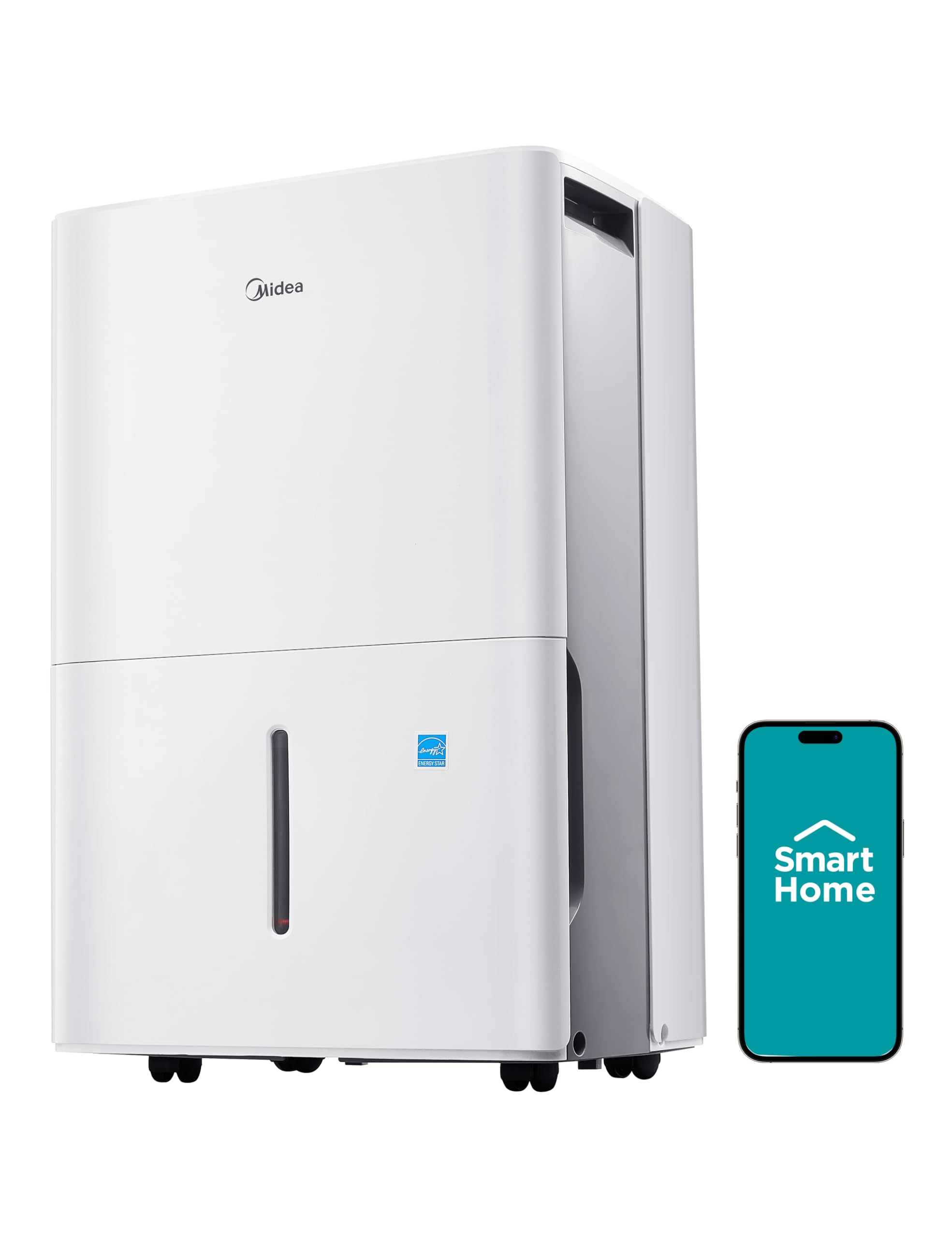
- 50 pints a day across 4,500 sq ft, Energy Star rated
- 49 dBA on low, quiet enough to leave running under a living room
- Wi-Fi control from the app, and a reusable filter rather than a consumable one
We may earn a commission if you buy through this link — it costs you nothing extra.
Key Specifications
- 4,500 sq. ft. coverage
- Up to 50 pints per day
- 49 dBA on low
- Wi-Fi enabled, app control
- Reusable air filter
- Tank or continuous hose (hose not included)
- Energy Star rated
The Midea 50 Pint is the direct replacement for the older Midea that held this spot, and it keeps the two things that made that unit worth recommending.
The first is noise. 49 dBA on low is quiet enough that a basement unit does not announce itself through the floor of the room above.
Midea 50 Pint Dehumidifier
- Pulls up to 70 pints a day across 4,500 sq ft at a quiet 49 dB
- 1.6 gallon reservoir, or continuous drainage through a 0.75in female garden hose
- Reusable filter with a cleaning alert, Energy Star rated, auto-restart after an outage
We may earn a commission if you buy through this link — it costs you nothing extra.
The second is the reusable filter. You wash it instead of buying a new one, which over the life of the unit is the difference between a running cost and no running cost.
It covers 4,500 sq ft at up to 50 pints a day, and it is Wi-Fi enabled, so the humidity target can be changed without going down the stairs. Note that the drain hose is not included.
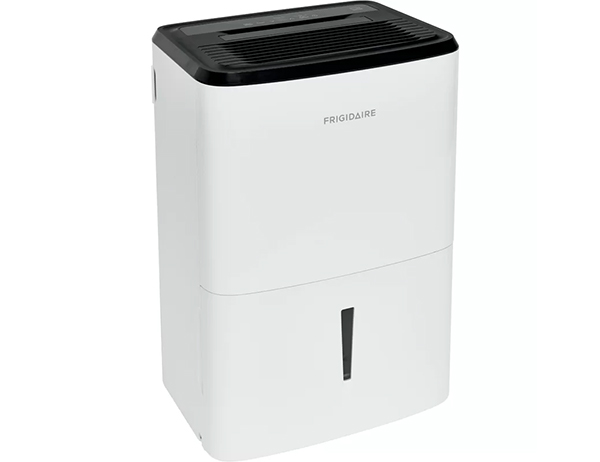
FRIGIDAIRE has long been a well-known name in the air conditioning industry, so it’s only appropriate that one of their prime offerings in the dehumidification market – the FRIGIDAIRE 50 Pint Dehumidifier – lives up to their lofty performance standards. Not only that, but this particular model makes use of the latest and greatest dehumidification technologies developed in-house.
From the moment you plug in the FRIGIDAIRE unit, for example, you’ll be setting the unit’s temperature controls and humidity range using the “Ready-Select” control panel. Then, once your FRIGIDAIRE 70 is up and running according to your schedule, you’ll find that it leaves your home’s air fresher and most moisture-free than ever before due to its excellent implementation of the proprietary “Effortless” clean filter system.
This unit is also able to self-regulate with precision, ensuring that it can reliably complete its job 24 hours a day. This is fully apparent in this model’s implementation of both full tank alerts and a full tank auto-shut-off switch. When either of those components engage, you’ll know it’s time to quickly pull out this model’s hassle-free pull-out bucket reservoir.
GE 50 Pint Energy Star Dehumidifier
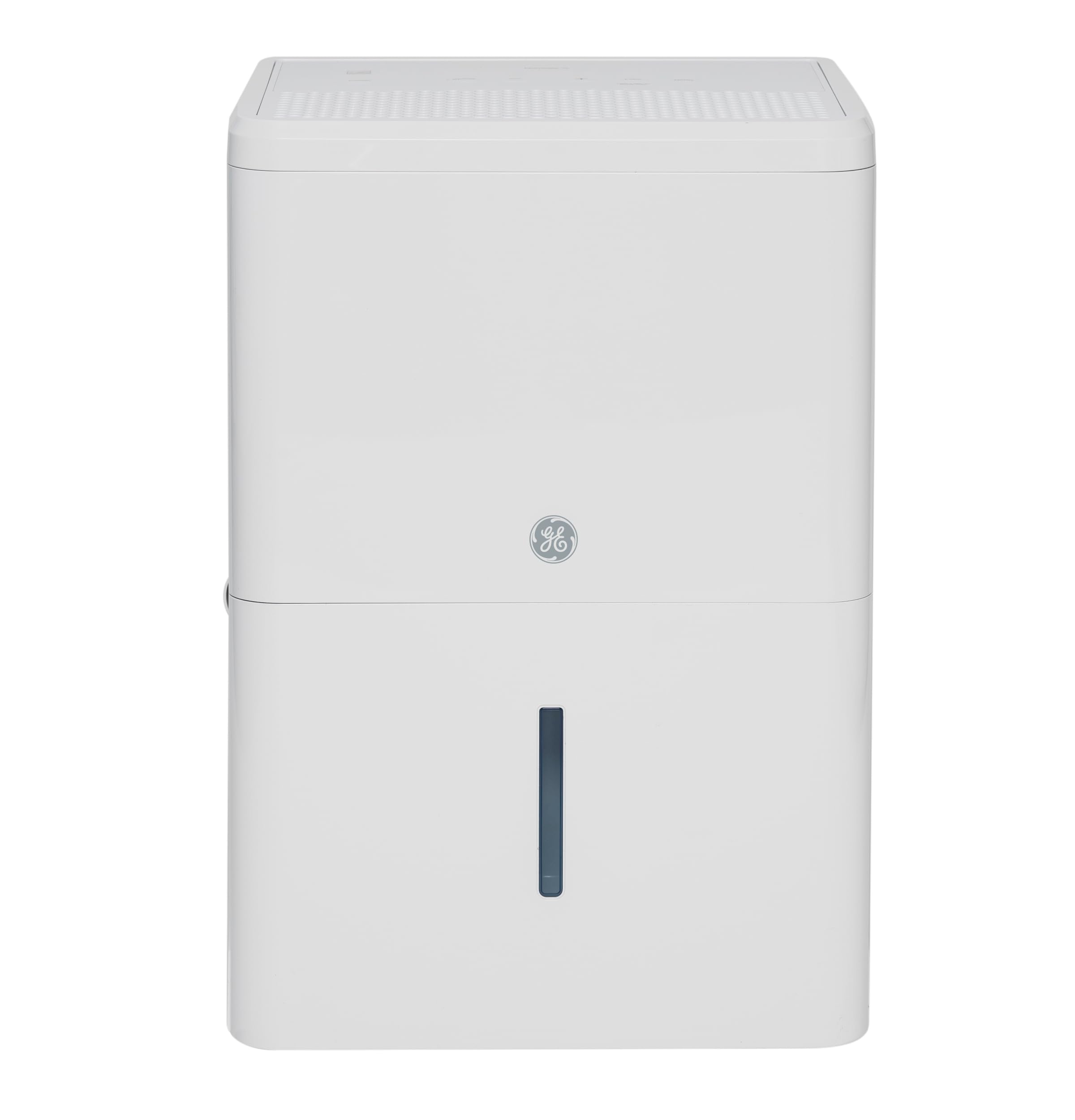
- 50 pints a day across 5,000 sq ft, with Smart Dry adjusting fan speed to the room
- Humidistat adjustable from 30% to 70%
- Continuous drain connection, plus a bucket-full alarm and a filter reminder
We may earn a commission if you buy through this link — it costs you nothing extra.
Key Specifications
- Up to 5,000 sq. ft. coverage
- 50 pints per day
- 30%–70% adjustable humidistat
- Smart Dry automatic fan speed
- Continuous drain hose connection
- Full-bucket alarm and filter alert
- Caster wheels and pocket handles
GE 50 Pint Energy Star Dehumidifier
- Built-in 16 W condensate pump lifts water up to 16.4 feet vertically — no auxiliary pump
- Programmable humidistat on an LCD panel, plus auto-defrost
- Front pull-out bucket with full-tank alerts and automatic shut-off
We may earn a commission if you buy through this link — it costs you nothing extra.
The GE 50 Pint covers 5,000 sq ft, which is more floor area than its pint rating suggests, and it is the most hands-off unit here.
Smart Dry is the reason. It reads the room and moves the fan speed itself, instead of running flat out until it hits the target and then cycling.
The humidistat goes from 30% to 70%, and the unit tells you when the bucket is full and when the filter needs attention, so it is hard to neglect by accident.
One thing to be clear about: this model has a continuous drain connection but no built-in pump, so the hose has to run downhill to a drain.
Midea Cube 20 Pint Dehumidifier
Key Specifications
- 1,500 sq. ft. coverage
- 20 pints per day (about 30 pint by the older 2012 standard)
- Extendable tank, up to 3x conventional capacity
- Continuous drain option with hose
- Wi-Fi enabled, SmartHome app control
- Washable filter
- Auto-restart after power loss
- 1 year parts and labour warranty
Not every basement is 5,000 sq ft. The Midea Cube is here for the small ones, and for crawlspaces and utility rooms where a full-size unit is overkill.
The Cube’s trick is its shape. It extends and nests, and in extended form the tank holds up to three times what a conventional unit of this size holds. That is the difference between emptying it daily and emptying it twice a week.
It is rated at 20 pints a day over 1,500 sq ft, Wi-Fi enabled, and the filter washes rather than gets replaced.
Auto-restart matters more in a basement than anywhere else: after a power cut it comes back on its own settings, rather than sitting idle until someone notices.
Basement Dehumidifier Buying Guide
Purchasing the appropriate dehumidifier is easier said than done for many, though. Dehumidifiers today come in a variety of different sizes, each of which come with differentiated capacities to draw in ambient air vapors and capture the same in an appropriately-sized tank. That aside, the proper dehumidifier unit for your basement may well depend on outstanding factors, such as the size and temperature of the intended use room.
In order to take these factors fully into account, this concise buyer’s guide will provide you with industry-specific details about the kinds of features that typically show up in contemporary basement dehumidifier listings.
Each of these critical criteria may impact your final dehumidifier selection, so be sure to read through this entire buyer’s guide before finalizing your online purchase.
Important Features
First up, let’s crack into the kinds of features you should look for in a high-quality basement dehumidifier. While all of these features need not show up in every model on your list, your final selection should include at least a few if you’re planning to rely on that dehumidifier unit for an extended period of time. Many of the following features directly affect their unit’s performance as well, making it all the more imperative that they appear in your next dehumidifier.
Hose Drain Outlet
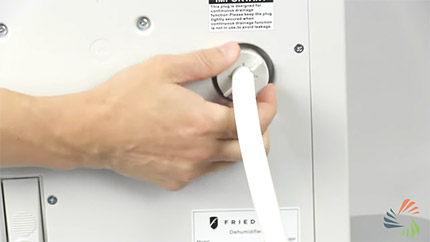
If you’re intending to use your dehumidifier continuously (either year-round or seasonally), then you might consider looking for a model with a hose drain outlet. Though a minor component, this type of outlet allows you to forgo the need to constantly empty your unit’s condensation tank by installing a continuously-active hose drain.
When installed properly, this type of hose drain allows for gravity to do the heavy lifting when it comes to clearing your dehumidifier of its collected moisture. Whether with a common garden hose or a piece of devoted tubing, these hose drains can be set up to empty into a nearby floor-level sewer drain, thus eliminating the need to empty the unit’s tank often during high use scenarios.
Auto-Humidistat
Smart devices are all the rage these days, so it is only appropriate that you purchase a dehumidifier that is “smart” enough to know when it needs to turn on and off. That’s precisely what you’ll get in a unit with an auto-humidistat, which is a programable component that can communicate your desired level of humidity directly to the unit’s operating computer.
When you activate auto-humidistat functionality, you’ll set a high maximum and minimum level of moisture that is accessible within the use space. Then, your dehumidifier uses its onboard sensors to continuously analyze the air quality content in its area. Once it senses humidity over the top threshold, the unit will turn itself on and remain active until the ambient humidity in the area drops below a bottom threshold.
Condensate Pump
Basements with crawl spaces and other unusual areas where humidity congregates will likely need to make use of a condensate pump system. In essence, these pumps allow for water collected by a dehumidifier unit to be driven upward against gravity and into an off-site collection or disposal point (such as a floor-level sewer drain).
If you find yourself in a situation where this kind of auxiliary set up is necessary to properly aerate your basement, you may need to do extra research to find a condensate pump that is compatible with your current dehumidifier. That being said, some premium-grade dehumidifiers come with a condensate pump built in, allowing for more flexible usage over the lifespan of the unit.
Auto Defrost
Many dehumidifier units make use of a cold condensation unit in order to convert ambient humidity back into common water. As a result, these units can run internally cold and are susceptible to freezing up under the right environmental conditions. In these situations, an auto defrost feature can really help preserve your unit’s ability to operate reliably.
Much like in a freezer, an excessive amount of internal moisture can cause ice crystals to seed in unusual places, leading to a noticeable drop in efficiency. Dehumidifiers with a built-in auto defrost module prevent these ice crystals from propagating in the first place, thus making the unit safe to use in spaces with a sub-65° F average temperature.
Low Temperature Setting
As a supplement to the aforementioned auto defrost module, a dehumidifier with a wide range of low temperature settings can really come in handy if you intend to use your new unit in a frigid environment. In fact, these settings can typically allow a dehumidifier to safely operate in rooms that are colder than 41° F – below freezing, in other words.
The majority of dehumidifier users may not find these settings productive because they use their unit during the warmer, more environmentally humid months of the year. However, folks working in regions such as the Pacific Northwest, where the winter months come with an extra serving of humidity, will really relish the ability to relinquish humidity from their basement as the weather outside cools down.
Timer
The unfortunate truth is that many dehumidifiers produce a noticeable amount of noise while in operation. This can make it more challenging to use your unit, especially if needs to be placed in a part of your basement adjacent to a family member’s personal room or office. In these cases, a built-in dehumidifier timer can really come in handy.
Through programmable settings or an analog dial, these timers allow users to decide precisely when their unit will operate. This, in turn, may allow particular homeowners to set their dehumidifier in motion only when they are not present to hear it. These timers can also be useful for collecting ambient humidity only when a direct source of moisture (such as wet laundry) is present.
Learn more: How to use a dehumidifier properly
Factors to Consider before Purchasing a Basement Dehumidifier
There are numerous factors that you’ll need to take into consideration before purchasing a particular basement dehumidifier model.
Room Size and Average Humidity
Naturally, dehumidifiers are designed such that only a single unit is needed to eliminate moisture in a single room in your basement. However, your chosen model cannot accomplish this core task if it is underpowered or simply too low capacity to meet the demands of the room it is placed in. As such, it is always important to take into account your target room size before settling on a particular dehumidifier model.
In order to quantify a unit’s capability in this domain, you’ll first need to calculate your room’s size in square feet. This can be accomplished by multiplying its width by its length (including any unusual side rooms or outcroppings).
Then, you’ll need to compare this sum to the average amount of moisture experienced in that particular room.
For example, a moderately damp area of less than 2,000 sq. ft. in size may only need a 25 pint dehumidifier. Conversely, a 3,500 sq. ft. space with regular floor sweat may need to opt for a model with twice the dehumidifying capacity at 50 pints.
Noise Level
Due to their operational requirements, dehumidifier units can land on the noisy side of the home appliance spectrum. As a result, you should take time to consider where you intend to place your new unit and whether or not that location will be affected by the dehumidifier’s output noise. If so, then your best bet would be to find a model that has been routinely described as quiet by its current users (as indicated in the product’s online reviews).
However, if you are unconcerned about noise emitting from your dehumidifier, then you can place this consideration to the side. Just keep in mind that a noisy dehumidifier can be a real bother if you end up needing to use your unit in a location other than your basement.
Room Temperature
Room temperature can come into play immediately when it comes to dehumidifier operation. Specifically, some units are only designed to operate efficiently within the average range of indoor temperatures. In almost all industry-standard models, this temperature range starts as low as 41° F and can top out as high as 95° F.
That being said, a room temperature within this range can still create problems for your dehumidifier (especially if you intend to use it continuously). Due to their cold internal compression units, dehumidifiers can begin to form internal ice at temperatures as low as 55° F. If you intend to use your dehumidifier in a room at or around that temperature, then you’ll need to opt for a unit with low temperature settings that include an auto-defrost mechanism.
How a Dehumidifier Works
Modern dehumidifier units collect ambient moisture from the space around them using either a refrigerant or desiccant method. Each of these methods comes with varying extraction efficiency rates, not to mention a noticeably different internal operating temperature.
As such, you should pay attention to the types offered at your preferred retailer to ensure that you are obtaining all the necessary features needed to efficiently dehumidify your basement.
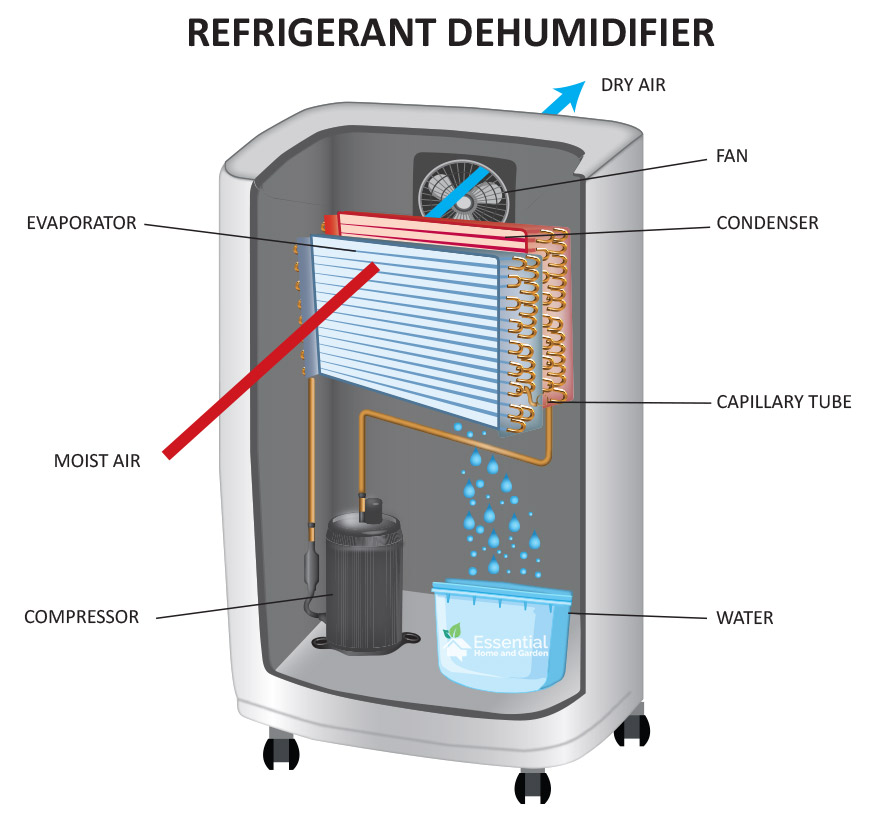
Refrigerant dehumidifiers are the most common overall and carry an average extraction efficiency rating. These units collect water by drawing humid air over a cold internal coil, causing the water to condense out and drop into the collection tank.
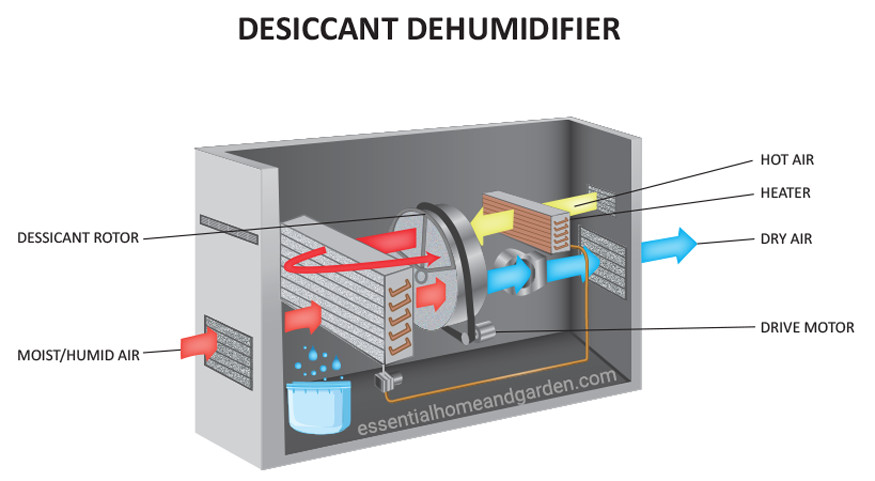
Desiccant dehumidifiers, on the other hand, make use of an internal rotor covered in absorbent material (often made of silica gel) in order to directly capture ambient water vapor.
These units have the added advantage of outputting dry air, thus encouraging drying in and around the moisture-afflicted space.
Learn More: Read our in depth guide on how dehumidifiers work.
How Often Will You Need to Empty the Tank?
For the most part, dehumidifiers operate independently without routine user interaction…with one key exception. Most dehumidifiers make use of an internal collection tank that must be occasionally emptied, which can become a chore of its own in basements with a steady volume of moisture. If you foresee this task becoming a problem for you, then it would be in your best interest to identify a dehumidifier model with as large a collection tank as possible.
Also, many dehumidifier listings include a specification describing the unit’s capacity.
While this appears to reference the amount of water that the unit can hold (and thus, how often it will need to be emptied), capacity in dehumidifiers actually refers to how much ambient moisture the unit can draw out of the air in a 24 hour period. All the same, this metric is still very important for gauging how capable a given unit be when it comes to keeping up with your basement’s dehumidifying needs.
What Size Dehumidifier Do You Need for Your Basement?
“Size”, when describing a dehumidifier, can describe both a unit’s physical dimensions as well as its capacity to extract a certain volume of humidity from the air in a 24 hour period.
When talking about moisture removal capability, precise dehumidifier size will depend primarily on the physical dimensions of your basement as well as the amount of moisture regularly trapped within that space.
Oversized Dehumidifiers Are Ok!
regardless of the dehumidification needs of your basement, remember that you are always safe to use a “larger” model than your circumstances call for.
In fact, larger and stronger dehumidifiers are often more able to tackle small jobs in a tighter time frame, often without the need to empty their larger containment tanks as often.
Sizing up rather than down?
Sylvane carries basement specific models from 35 to 130 pints, including sealed crawl space units built to run in cold, unfinished spaces.
Use the chart below to quickly get a quick idea as to what size dehumidifier you need.
| Conditions | 300 sq ft | 500 sq ft | 800 sq ft | 1200 sq ft |
| Under 60% humidity | 20 pint | 25 pint | 35 pint | 50 pint |
| 60% – 70% humidity | 20 pint | 30 pint | 40 pint | 50 pint |
| 70% – 80% humidity | 30 pint | 35 pint | 45 pint | 55 pint |
| Over 80% humidity | 35 pint | 40 pint | 50 pint | 60 pint |
Do You Need a Basement Dehumidifier?
If you’ve found this guide, then chances are that you are looking at purchasing a dehumidifier for use in your home’s basement. Such a course of action, even as a preventative measure, can be beneficial to the well-being of your home’s residents. This is because excessive in-home moisture can allow mold and mildew to propagate (not to mention the risk for slippery floors where humidity is allowed to settle).
Despite these dangers, not every humid basement calls for a dehumidifier outright.
For example, a dehumidifier unit is best suited to homeowners who experience routine or ongoing moisture in one or more sections of their basement. This can range from slightly mugginess in the air to floor sweat to residual water left over from a major influx of water in the basement (such as after a flood).
If you are performing an in-home moisture test, you should be shooting for an RH (relative humidity) rating of 30% or lower in order to avoid the worst risks posed by basement moisture. Any amount over 50% is bound to cause problems though and should be addressed with a dehumidifier immediately. Any humidity response plan should additionally feature an attempt to resolve the source of the moisture (if possible).
If you really don’t want to spend the money on a humidifier right now, then there are ways you can get rid of humidity in your basement without one.
FAQ – Frequently Asked Questions about Basement Dehumidifiers
How do I clean my Dehumidifier?
Cleaning your dehumidifier need not be an onerous task, so long as you follow proper procedures and initiate a full unit cleaning on a regular basis. This is especially important because dehumidifiers are prone to encourage undesirable bacterial growth if they are not regularly sanitized.
To do this, first unplug your dehumidifier unit. Next, whip down your unit’s exterior with a damp cloth, making sure to apply slight pressure as you pass over any vents. With the exterior properly cleaned, you’ll next need to remove (and empty, if necessary) the reservoir tank. This tank should be cleaned both inside and out with a mild liquid soap.
While you have the soap solution available, remove and wash any air or water filters included in your unit. Once these components have all been rinsed and dried, they may be returned to the unit for regular use.
How Much Electricity Does a Dehumidifier Use?
Precise electrical demands will differ from one dehumidifier model to another. However, most dehumidifiers (like air conditioners) tend to require a greater level of energy consumption when they are working harder.
As such, dehumidifiers (regardless of size) will consume more electricity if they are left on for a majority of the day or are persistently combating an ongoing influx of in-home moisture.
What Level Should I Set My Dehumidifier To?
Your settings come down to personal preference, especially when it comes to measuring your basement’s environment against the relative humidity standard (30%). In most cases, a dehumidifier’s default settings are fully capable of handling most jobs with relative ease and efficiency.
However, if you are looking to save electricity or combat a larger influx of basement humidity, you may choose to lower or raise your unit’s settings accordingly
Where in My Basement Should I Place my Dehumidifier?
Dehumidifier placement is an important but often overlooked factor that can directly impact a unit’s ability to operate efficiently. As a rule of thumb, all dehumidifiers (regardless of size) should be placed six inches or further from a wall in order to promote intra-unit airflow.
Also, your unit’s active face should be positioned towards the source of the humidity or, if the direct source is unclear, towards the broadest portion of the room.
How Long Should a Dehumidifier Run Per Day?
Most homeowners who are looking to combat moisture in their basement run their dehumidifiers for around 12 hours a day.
In many cases, though, modern dehumidifiers are designed to startup automatically when they detect an abundance of moisture, making the act of continuous usage unnecessary.
The Final Word
At the end of the day, you probably didn’t expect there to be this much information to consider before purchasing the best dehumidifier for your basement. But indeed, each of the factors explained in this guide may impact your dehumidifier’s ability to properly aerate your basement, making it essential that you take every feature and specification into account before finagling your purchase.
From here on out, you’ll poses the knowledge necessary to differentiate a high quality dehumidifier from a cheap knockoff. So, using what you’ve learned, you should return to our reviews of this year’s top basement dehumidifiers and select the model that not only meets your dehumidifying needs but also fits your in-home maintenance budget.
