
There are four main categories of fireplaces that branch into 14 distinct variations for your home.
Wood-burning options include traditional open-hearth, closed-hearth, inserts, and prefabricated units, while gas fireplaces offer direct vent, ventless, and B-vent configurations.
Electric choices feature wall-mounted, inset, and freestanding designs, and alternative fuel options encompass ethanol, pellet, and gel installations.
They vary a lot in efficiency (from about 5% for an open fireplace to nearly 100% for electric), heat output and installation needs. The table below puts all 14 side by side.
Updated October 2026: corrected efficiency and heat output figures, 2026 install costs, and safety rules for ventless gas and ethanol fireplaces.
Understanding the technical specifications and requirements of each option will help you select the ideal fireplace solution.
Fireplace Types Compared: Cost, Heat Output and Efficiency
| Type | Efficiency | Heat output (BTU/hr) | Installed cost (2026) | Venting |
|---|---|---|---|---|
| Open-hearth (masonry) | About 5-15% | Not meaningfully rated | $8,500-$15,000+ with a brick chimney | Masonry chimney |
| Closed-hearth (glass doors) | About 10-20% | As open-hearth | Doors $600-$2,000 installed | Masonry chimney |
| Wood insert (EPA-certified) | About 65-80% | About 25,000-75,000 | $3,000-$8,000 with chimney work | Chimney with a liner |
| Prefabricated (wood) | About 10-20% (standard models) | Not meaningfully rated | $1,900-$3,300 | Metal chimney |
| Direct-vent gas | About 70-85% | About 15,000-60,000 | $2,300-$10,000 | Sealed direct vent |
| Ventless gas | Nearly 100% (fumes stay in the room) | Up to 40,000 | $700-$2,500 for the unit | None, oxygen sensor required |
| B-vent gas | About 40-60% | About 20,000-40,000 | $2,000-$5,000 as an insert | Chimney or B-vent pipe |
| Wall-mounted electric | 100% at the outlet | Up to about 5,100 (120V) | $500-$2,500+ | None |
| Inset electric | 100% at the outlet | 5,100 (120V), about 8,500 (240V) | $1,500-$3,000+ | None |
| Freestanding electric | 100% at the outlet | Up to about 5,100 | $200-$1,500 | None |
| Electric TV stand | 100% at the outlet | Up to about 5,100 | Unit price only, no install | None |
| Ethanol | Nearly 100% (fumes stay in the room) | About 5,000-15,000 per burner | Tabletop models to built-in burners | None, minimum room size applies |
| Pellet stove | About 70-83% | About 8,000-50,000 | $1,600-$4,100 ($2,500-$7,000 as an insert) | Pellet vent pipe |
| Gel fuel | Nearly 100% (fumes stay in the room) | About 3,000 per can | Unit price only | None |
Electric looks the most efficient on paper, but electricity usually costs more per BTU than gas or pellets. For a cost comparison, see our guide to the cheapest ways to heat a house.
Want the look of a real fire without a chimney, a gas line, or the yearly cleanup?
That’s where electric has closed the gap. MagikFlame’s HoloFlame units project actual filmed flames onto solid logs, so they read as real from across the room while plugging into a standard outlet.
Most fireplaces need an installer. These are the types you can order online and set up yourself, plus a pellet stove that still needs a vent.

- Type Wall-mounted or recessed
- Size 50 in wide, 3.86 in deep
- Heat 750W and 1,500W modes

PuraFlame Western Electric Fireplace Insert, 33 Inch
- Type Insert for an existing opening
- Size 35 1/16 in W x 26 31/32 in H overall
- Power 120V plug-in, 750/1,500W

duraflame Freestanding Electric Fireplace Stove
- Type Freestanding electric stove
- Heat Infrared, rooms up to 1,000 sq ft
- Controls Thermostat and flame dial
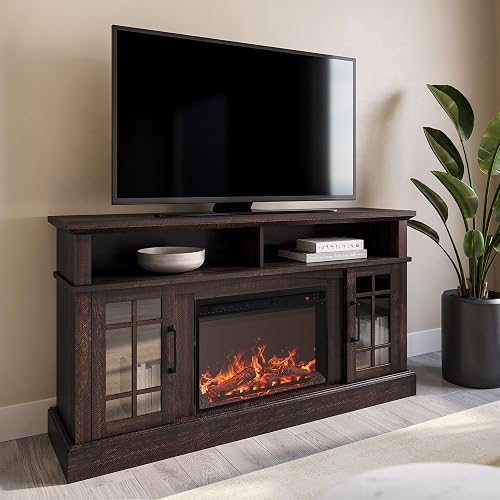
BELLEZE Astorga 58 Inch TV Stand with Electric Fireplace
- Type TV stand, 23 in fireplace
- Heat 1,400W, rooms up to 400 sq ft
- Finish Espresso

ComfortBilt HP22 Pellet Stove
- Type Pellet stove
- Heat Up to 41,000 BTU per hour
- Hopper 55 lb, up to 20 hours

Real Flame Gel Fuel Cans, 12-Pack
- Type Fuel for gel fireplaces
- Heat Up to 3,000 BTU per can
- Burn time 2.5 to 3 hours per can
We may earn a commission if you buy through this link. It costs you nothing extra.
Wood-Burning Fireplaces

When considering wood-burning fireplaces, you’ll find four main types to choose from: traditional open-hearth designs, closed-hearth systems, fireplace inserts, and prefabricated units.
While open-hearth fireplaces offer that classic, wide-open design with natural ambiance, they’re typically less efficient than their closed-hearth counterparts, which focus heat output more effectively into your living space.
You can boost an existing fireplace with an insert, or choose a prefabricated unit that’s easier and cheaper to install. A new masonry fireplace and chimney costs the most.
Open-Hearth Fireplaces

For centuries, open-hearth fireplaces have been the classic choice. A large, open fire chamber gives you the full crackle and glow of a real fire.
The trade-off is heat. The EPA notes that most of an open fireplace’s heat goes up the chimney, and they typically run at only about 5-15% efficiency. Some even pull warm room air out of the house.
Building one new is expensive. HomeGuide puts a masonry fireplace at $3,500-$5,600, plus $5,000-$10,000 for a brick or stone chimney. You’ll also need yearly chimney sweeping.
Despite their relatively low efficiency, these fireplaces continue to be valued for their timeless appeal and ability to serve as a striking design focal point.
Closed-Hearth Fireplaces

Closed-hearth fireplaces add glass doors to an open fireplace. The doors cut down on warm room air escaping up the chimney, especially as the fire dies down.
They don’t turn it into a real heater, though. Expect about 10-20% efficiency.
While you’ll still need a complete chimney system for proper ventilation, the glass enclosure helps regulate the burning process and minimize heat loss.
Glass doors cost about $600 to $2,000 installed, according to HomeGuide.
The sealed glass doors create a safer barrier between your living space and the fire while maintaining ideal burning conditions.
Glass doors are sold by firebox size, so measure the opening first. This Pleasant Hearth Alpine door in the small size fits openings 30 to 37 inches wide and 22.5 to 29.5 inches high, and has clear tempered glass with a mesh panel behind it.
Fireplace Inserts

Transform your existing fireplace into a high-performance heating system with a wood-burning fireplace insert.
These specialized units, designed to fit seamlessly into your current fireplace opening, can dramatically enhance heating efficiency from typical fireplace levels to an impressive 65-80% while considerably increasing heat output throughout your living space.
Installing a wood stove or insert typically costs $3,000 to $8,000, including chimney work. A stainless chimney liner on its own runs $1,500 to $4,000.
Look for an EPA-certified model. Since 2020, new wood stoves and inserts have had to meet the EPA limit of 2.0 grams of smoke per hour, and certified models average about 71% (non-catalytic) to 78% (catalytic) efficiency.
During the installation process, your chimney may require professional relining to guarantee proper venting and meeting safety standards.
If you would rather not burn wood, an electric insert sits in the same opening and plugs into a 120V outlet. This PuraFlame is 35 1/16 inches wide and 26 31/32 inches high overall, and its listing says it gives supplemental heat for up to 400 square feet.
Prefabricated Fireplaces

Prefabricated fireplaces offer a practical alternative to traditional masonry units, combining modern engineering with easy installation.
These factory-built systems cost about $1,900 to $3,300 installed for a 36-inch wood-burning unit with a metal chimney, according to HomeGuide.
These units are particularly versatile due to their lightweight construction, which allows for installation in locations where traditional masonry fireplaces aren’t feasible.
Standard prefab fireplaces are mostly decorative, at about 10-20% efficiency, much like a masonry open hearth. EPA-certified high-efficiency models do much better, so check the label if you want real heat.
Key advantages of prefabricated fireplaces include:
- Metal chimney systems that are easier to install than masonry
- Various sizes and styles to match your home’s design
- Lower installation costs compared to traditional brick fireplaces
Gas Fireplaces

When considering gas fireplaces for your home, you’ll encounter three main types: direct vent systems that offer sealed, efficient operation, ventless units that don’t require chimneys, and natural vent (B-vent) options that use traditional chimney systems.
Gas fireplaces provide excellent heat transfer efficiency while requiring minimal maintenance, making them a practical choice for modern homes.
Installing a gas fireplace costs $2,300 to $10,000 on average, according to HomeGuide, and a gas insert for an existing fireplace costs $2,000 to $5,000. You get heat at the push of a button, but less of the crackle of a wood fire.
Direct Vent Gas Fireplaces

Direct vent gas fireplaces represent one of the most efficient and versatile heating options for modern homes.
With efficiency ratings of 70-85%, these systems employ sealed combustion technology and dual-wall venting to maximize heat output while maintaining indoor air quality.
Installed, they typically fall within HomeGuide’s $2,300 to $10,000 range for gas fireplaces.
These advanced heating systems offer several key advantages:
- Heat output of roughly 15,000-60,000 BTUs, depending on size
- Flexible installation options with both horizontal and vertical venting configurations
- Sealed combustion system greatly reduces indoor air quality concerns
The dual-wall venting system enables you to place your fireplace in various locations throughout your home, as it doesn’t require a traditional chimney setup.
Another advantage is the combination of safety features and installation flexibility that direct vent technology provides.
Ventless (Vent-Free) Gas Fireplaces

Ventless gas fireplaces offer a unique blend of high efficiency and simplified installation, operating without the need for external venting or chimneys.
These units are nearly 100% efficient because all the heat stays in the room. So do the combustion gases and water vapor. Ventless units cost about $700 to $2,500 before installation.
You’ll need to evaluate several important factors before choosing a ventless system.
Due to safety regulations, these fireplaces are limited to 40,000 BTUs maximum heat output, and they’re not permitted in all jurisdictions.
Where they’re allowed, the gas code (NFPA 54) limits them to 10,000 BTUs in a bedroom and 6,000 BTUs in a bathroom, and requires an oxygen-depletion sensor. The room also needs at least 50 cubic feet per 1,000 BTUs.
Some places don’t allow them in homes at all. California bans them, Minnesota prohibits them in dwellings, and some cities, including New York City, restrict them. Check with your local building department first.
Because they vent into the room, ventless fireplaces add moisture and combustion gases to your air. Keep a carbon monoxide alarm nearby and follow the maker’s limits on running time.
It’s essential to weigh these considerations against the benefits of high efficiency and lower installation costs when making your decision.
Natural Vent (B-Vent) Gas Fireplaces

Through a combination of traditional venting and modern convenience, natural vent gas fireplaces offer homeowners a practical option for converting existing wood-burning fireplaces.
These units use your existing chimney or a B-vent pipe for exhaust. They put out about 20,000-40,000 BTUs, at roughly 40-60% efficiency, because they draw room air and lose heat up the vent.
As an insert in an existing fireplace, expect about $2,000 to $5,000 installed.
Key considerations for B-vent fireplaces include:
- Annual inspection requirements to guarantee proper venting system function
- Limited placement options due to the need for vertical venting
- Higher efficiency than wood fireplaces but lower than direct vent models
While these systems aren’t as efficient as direct vent options, they’re often the most practical choice when you’re looking to retrofit an existing fireplace, providing reliable heat with modern gas convenience.
Electric Fireplaces

When it comes to electric fireplaces, you’ll find several versatile options to match your home’s style and space requirements, including wall-mounted units that create a modern focal point, and inset models that offer a clean, built-in look.
You can also consider freestanding electric stoves that provide portability and traditional charm, or electric fireplace TV stands that combine entertainment functionality with supplemental heating.
These electric options come with realistic flame effects and convenient features, making them particularly appealing if you’re looking for a low-maintenance heating solution that doesn’t require venting or complex installation.
Wall-Mounted Electric Fireplaces

Many homeowners are turning to wall-mounted electric fireplaces as a stylish and practical heating solution. These modern units, which install similarly to mounting a flat-screen TV, can generate between 4,000 and 5,000 BTUs of supplemental heat while offering customizable flame effects and colors to enhance your room’s ambiance.
Premium manufacturers like MagikFlame have revolutionized the market with their HoloFlame technology, which projects filmed flames onto a screen and logs for a realistic look.
- Installation is typically DIY-friendly, requiring basic tools and wall-mounting hardware.
- Prices run from about $500 to $2,500+ installed (HomeGuide) for premium units with advanced features, with MagikFlame models offering exceptional realism in the mid to upper range.
- Heat output can effectively warm small spaces while maintaining energy efficiency.
When you’re considering a wall-mounted electric fireplace, you’ll appreciate its space-saving design and versatility, as it doesn’t require ventilation or complex installation procedures. Companies like MagikFlame offer comprehensive installation guides and customer support to ensure proper setup.
These units serve as both functional heating appliances and sophisticated wall decorations, making them particularly suitable for apartments, condos, or rooms where traditional fireplaces aren’t feasible.
MagikFlame’s collection, for instance, features various styles from contemporary to transitional, allowing homeowners to match their existing décor while enjoying the benefits of modern electric fireplace technology.
R.W.FLAME 50 Inch Recessed and Wall Mounted Electric Fireplace
A wall-mounted unit that is 3.86 inches deep, so it sits close to the wall. It can also be recessed.
- 12 flame and flame bed color modes, 5 flame speeds
- 750W and 1,500W heat modes, for up to 400 square feet
- Touch screen and remote control
We may earn a commission if you buy through this link. It costs you nothing extra.
Inset (Recessed) Electric Fireplaces

For homeowners seeking an even more integrated appearance than wall-mounted options, inset electric fireplaces offer the ultimate built-in solution.
Built-in units cost about $1,500 to $3,000 or more installed, according to HomeGuide, because the wall has to be framed and usually needs its own circuit.
A standard 120V plug-in model tops out at about 5,100 BTUs, because a household outlet supplies 1,500 watts. Hardwired 240V models put out more, about 8,500 BTUs on Dimplex’s larger IgniteXL units.
The design possibilities allow you to recreate the look of a traditional fireplace opening, creating a seamless, sophisticated focal point in any room.
Since they’re built directly into the wall, you’ll achieve a clean, contemporary aesthetic that doesn’t sacrifice any floor space or protrude into your living area.
Freestanding Electric Fireplaces

Selecting a freestanding electric fireplace offers unmatched flexibility for your heating and décor needs. These portable units, which typically generate between 4,000-5,000 BTUs of heat output, can be easily relocated throughout your living space without requiring professional installation or permanent modifications to your home’s structure.
- Available in various styles, including traditional stove designs that complement both modern and classic décor schemes.
- Installation-free operation requires only a standard electrical outlet, making these units ideal for renters or homeowners seeking portable heating solutions.
- Price points ranging from about $200 to $1,500 let you choose a model that aligns with both your budget and specific heating requirements.
These units are particularly practical when you need supplemental heat in different rooms throughout the day, as their portable nature allows for efficient space heating wherever it’s needed most.
duraflame Freestanding Electric Fireplace Stove
A stove-style electric fireplace that plugs in and can be carried from room to room. The listing says its infrared heat suits rooms up to 1,000 square feet.
- Glass door that opens, with side viewing windows
- Flame and heat work independently
- Adjustable thermostat and flame dial
We may earn a commission if you buy through this link. It costs you nothing extra.
Electric Fireplace TV Stands
Electric fireplace TV stands deliver space-saving innovation by merging entertainment storage with supplemental heating. These dual-purpose units, which require no complex installation beyond basic assembly, provide convenient media organization while producing 4,000-5,000 BTUs of warmth through their integrated electric fireplaces.
These versatile pieces are available across a wide price range, from $300 entry-level models to premium options reaching $2,000, with costs typically reflecting size differences and construction quality.
The built-in fireplaces come with adjustable settings, allowing you to control both heat output and flame display intensity to match your comfort needs and aesthetic preferences.
For smaller living spaces where you’re looking to maximize functionality without sacrificing style, these combination units offer an efficient solution that doesn’t compromise on either entertainment storage or supplemental heating capabilities.
BELLEZE Astorga 58 Inch TV Stand with Electric Fireplace
A TV stand with a 23 inch electric fireplace built in. The listing says the 1,400W heater can warm rooms up to 400 square feet.
- Two adjustable shelves, with open and closed storage
- Fire crackling sound
- Espresso finish
We may earn a commission if you buy through this link. It costs you nothing extra.
Alternative Fuel Fireplaces

If you’re exploring alternatives to wood, you’ll find several options, including ethanol fireplaces, which need no chimney but still need fresh air.
Pellet stove fireplaces efficiently burn compressed wood or biomass materials, and gel fuel fireplaces are another option. These alternative fuel solutions offer environmentally conscious heating choices while providing the ambiance of real flames.
Many can be installed in locations where traditional fireplaces aren’t feasible. You’ll appreciate that these modern alternatives typically produce fewer emissions than conventional fireplaces, with pellet stoves being particularly efficient and ethanol units offering the most flexibility regarding placement and installation requirements.
Ethanol Fireplaces
For homeowners seeking an eco-friendly and versatile fireplace option, ethanol fireplaces offer a modern alternative to traditional heating solutions.
These ventless units burn bioethanol, so you don’t need a chimney or a gas line. They do need a room at least as big as the maker specifies, plus some ventilation, because the exhaust stays indoors.
Prices run from small tabletop models to large built-in burners.
Key features of ethanol fireplaces include:
- Heat output of about 5,000-15,000 BTUs per burner, depending on size
- No chimney needed, but check the minimum room size in the manual
- Clean-burning renewable fuel that produces no smoke or ash
While you’ll enjoy the convenience and eco-friendly aspects, it’s important to take into account that ethanol fireplaces typically generate less heat than conventional units, and fuel costs may be higher.
⚠ Ethanol Fireplace Safety Warning
- Never refill a burner while it’s lit or still warm. The flame can be nearly invisible, and refilling can cause flame jetting.
- The CPSC has warned about tabletop ethanol fireplaces after serious burns and deaths.
- Keep them away from curtains and furniture, and out of reach of children and pets.
Pellet Stove Fireplaces
Modern pellet stove fireplaces combine the traditional appeal of wood-burning units with advanced technology to deliver exceptional heating efficiency.
They run at about 70-83% efficiency with far less smoke than an open wood fire. A freestanding pellet stove costs $1,600 to $4,100 installed and a pellet insert $2,500 to $7,000, according to HomeGuide. They need electricity to run the auger and blowers.
| Feature | Specification |
|---|---|
| Heat Output | About 8,000-50,000 BTUs |
| Fuel Type | Wood/Biomass Pellets |
| Efficiency | 70-83% |
| Power Source | Electric |
| Maintenance | Regular Cleaning |
Most pellet stoves put out about 8,000 to 50,000 BTUs, and a few large models reach about 60,000. You’ll need somewhere dry to store pellets and a routine for cleaning.
The automated feeding system guarantees consistent heat output, but you’ll need a reliable power source to maintain operation.
Already own one that is playing up? See our pellet stove troubleshooting guide.
Gel Fuel Fireplaces
Unlike their pellet-burning counterparts, gel fuel fireplaces offer a uniquely portable and flexible heating solution for your home.
They burn alcohol-based gel fuel cans that give about 3,000 BTUs each, so they’re for ambiance, not heating a room.
- You’ll find installation requirements are nonexistent, allowing you to place the unit anywhere in your living space.
- Expect to invest between $300-$1,500 for the fireplace unit itself, though you’ll need to factor in ongoing fuel costs.
- Each fuel canister provides 2-3 hours of burn time, requiring replacement for extended use.
These fireplaces combine convenience with modern design, though they’re limited in their heating capacity.
When selecting a gel fuel fireplace, you’ll want to take into account the trade-off between portability and heat output for your specific needs.
Real Flame sells the gel fuel on its own. Each 13 ounce can gives up to 3,000 BTUs and burns for 2.5 to 3 hours, and the listing says to use the cans only in Real Flame approved fireplaces.
Fireplace Styles and Designs

Beyond the fuel, there are plenty of design options to match your home’s layout and style. If you burn wood, the type of firewood you use matters too.
Masonry fireplaces, constructed with brick or stone, are permanently integrated into your home’s design, while prefabricated models offer easier installation and flexibility.
If you’re looking to maximize viewing angles, consider a two-sided fireplace that’s visible from adjacent rooms, or opt for a space-efficient corner design that fits seamlessly into room intersections.
Freestanding stoves can sit out in the room for more heat, though wood, pellet and gas stoves still need a vent and safe clearances. Only electric models are truly portable.
Wall-mounted electric units need no chimney at all, while wall-mounted gas units still need a direct vent unless they’re vent-free.
If you’re interested in outdoor entertaining, exterior fireplaces can create an inviting atmosphere for your outdoor living spaces, combining functionality with design appeal.
On a small patio, a tabletop fire pit is the simplest way to start. This Cuisinart Cleanburn is a 2 lb, outdoor-only fire pit that burns wood pellets or mini logs up to 5.5 inches long. For bigger builds, see our fire pit ideas.
Efficiency and Heat Output Comparison
All 14 types are compared side by side in the table at the top of this guide.
Understanding fireplace efficiency can greatly impact your heating costs and environmental footprint.
When comparing heat output and efficiency across different types, you’ll find that electric fireplaces convert 100% of electricity into heat, making them highly efficient for indoor warming.
Open wood fireplaces are the least efficient, at about 5-15%. But an EPA-certified wood insert (about 65-80%) can match or beat many gas fireplaces for heat output.
- Electric fireplaces turn all their electricity into heat in the room, but electricity usually costs more per BTU than gas.
- Gas units offer excellent heat distribution and controlled temperature management.
- Pellet stoves combine high efficiency with environmental responsibility, using compressed wood waste as fuel.
Your choice will depend on balancing factors like fuel availability, operating costs, and heating requirements.
An open wood fireplace gives the most authentic fire but the least heat. An EPA-certified insert gives you both.
Installation Considerations
The right fireplace means little without proper installation planning. You’ll need to evaluate whether you’re working with an existing chimney or starting fresh, as this greatly impacts your options and costs.
Before you start, check your local building codes and get any permits you need. In the US, fireplaces and chimneys fall under the International Residential Code (Chapter 10), NFPA 211 for chimneys and vents, and NFPA 54 for gas lines. Your local building department can tell you which apply.
| Installation Factor | Existing Home | New Construction |
|---|---|---|
| Chimney Requirements | Inspection needed | Fresh installation |
| Venting Options | Limited by structure | Fully customizable |
| Cost Considerations | Higher for retrofits | Lower for integration |
Professional installation is essential, particularly for gas fireplaces, where venting and gas line connections need specialist knowledge.
Your installer should check clearances, ventilation and that all materials meet safety standards. When retrofitting an existing chimney, they’ll also need to inspect its condition first.
Maintenance and Safety
Proper maintenance guarantees your fireplace delivers safe, efficient warmth year after year. Each type requires specific care – wood-burning units need regular cleaning of the firebox and chimney to prevent dangerous creosote buildup, while gas fireplaces require periodic inspection of connections and valves, along with gentle cleaning of decorative elements. Here’s how to clean fireplace glass doors.
Electric models are the most low-maintenance, typically needing only occasional dusting.
Essential safety equipment for your fireplace includes:
- A complete set of fireplace tools, including a shovel and brush for ash management
- A metal ash bucket with a tight-fitting lid for safe disposal of hot ashes
- Working smoke and carbon monoxide alarms on every level of your home
Have wood-burning chimneys and vents inspected once a year, as NFPA 211 recommends, and sweep them when needed.
For essential safety tips regarding wood-burning fireplaces and stoves, visit Chimney Solutions.
Choosing the Right Fireplace for Your Home
After ensuring your fireplace maintenance routine is in order, selecting the ideal fireplace becomes your next important decision.
When choosing your fireplace, you’ll need to evaluate several critical factors that will impact your long-term satisfaction and comfort.
Begin by evaluating your home’s structural capabilities and existing ventilation system, as these elements will determine which fireplace types are feasible for your space.
You’ll want to calculate your heating requirements based on your local climate and the size of the area you’re planning to warm.
Consider your access to different fuel sources, as this will influence your options between wood, gas, or electric models.
Finally, weigh the installation costs against long-term operational expenses, while factoring in how much maintenance you’re willing to perform to keep your fireplace functioning at its best.
Still torn between the 14 options? If realism is the sticking point, that’s the one MagikFlame set out to fix.
Its HoloFlame projection uses real filmed fire with adjustable flame color and speed, plus a built-in heater for supplemental warmth. No venting, no gas line, no annual chimney sweep. Measure your wall or mantel opening first, since the inserts come in fixed 28, 30, and 40 inch widths.
