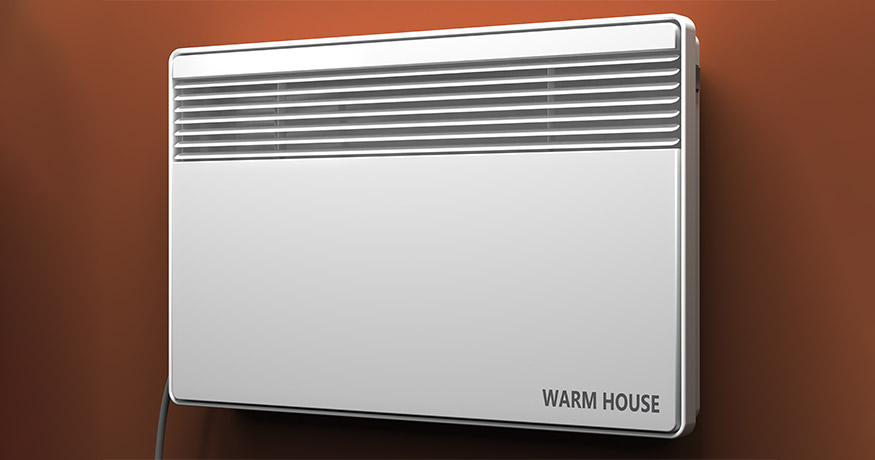
The best electric wall heater depends on your wall. If you can wire one in, a fan-forced in-wall heater like the Cadet Com-Pak is quiet, safe and out of the way.
If you rent or can’t cut into drywall, a plug-in wall panel or surface-mount heater does the job without an electrician.
Below are our 10 picks by job, with the voltage, wattage and room size each one suits, plus what an install involves and what it costs to run.
Updated October 2026: all-new picks, 2026 running costs and a 120V vs 240V guide.
Which Electric Wall Heater Do You Need?
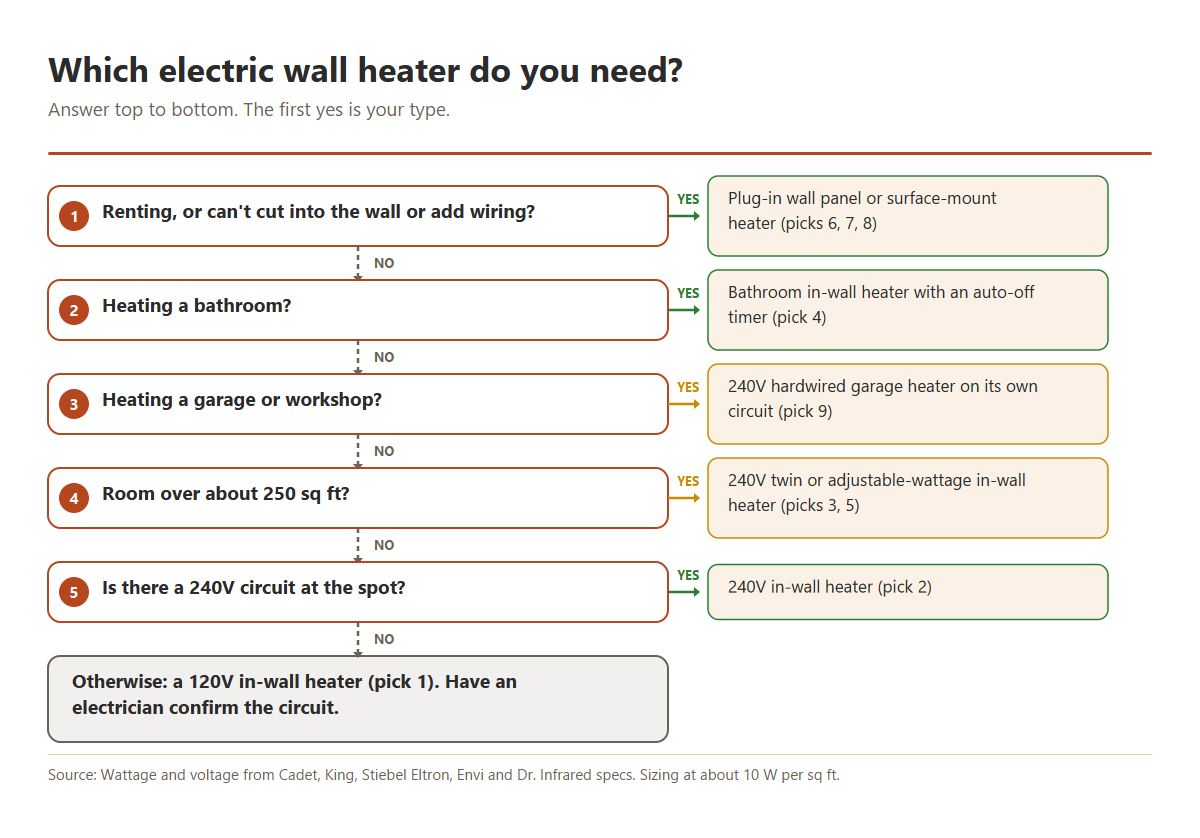
There are four kinds of electric wall heater, and the right one is mostly decided by your house, not by features.
In-wall heaters sit in a metal can between the studs and blow warm air through a grille. They are hardwired to their own circuit.
Surface-mount and panel heaters screw or hang onto the wall and usually plug into an outlet. Garage heaters are big 240V units on a bracket.
Best Electric Wall Heaters Compared

- Power 1,500W, 120V
- Room Up to about 150 sq ft
- Install Hardwired, in-wall
- Thermostat Built in
- Power 2,000W at 240V
- Room Up to about 200 sq ft
- Install Hardwired, in-wall
- Thermostat Built in

- Power 3,000W at 240V
- Room Up to about 300 sq ft
- Install Hardwired, in-wall
- Thermostat Built in

- Power 1,000W, 120V or 240V
- Room Up to about 100 sq ft
- Install Hardwired, in-wall
- Thermostat Built in + 60-min timer

- Power 500 to 2,250W, 240V
- Room Up to about 225 sq ft
- Install Hardwired, in-wall
- Thermostat Sold separately

- Power 1,500W, 120V
- Room Up to about 150 sq ft
- Install Plug-in, screws to wall
- Thermostat Built in

- Power 500W, 120V
- Room Up to 150 sq ft (Envi)
- Install Plug-in panel
- Thermostat Built in

- Power 750 or 1,500W, 120V
- Room Up to about 150 sq ft
- Install Plug-in, wall or feet
- Thermostat Wi-Fi app

- Power Up to 7,500W, 240V
- Room Garage or shop
- Install Hardwired, wall or ceiling
- Thermostat Remote control

- Power Standard 120V outlet
- Room Supplemental heat
- Install Stands against a wall
- Flames HoloFlame filmed fire
We may earn a commission if you buy through this link. It costs you nothing extra.
Electric Wall Heater Reviews
1. Cadet Com-Pak CSC151TW: Best Overall
The Com-Pak is the in-wall heater most electricians reach for, and this complete unit is the easy way to buy it.
The box includes the heater, the steel wall can, the grille and a built-in thermostat (40 to 85°F), so there’s nothing else to order.
It runs on a standard 120V circuit at 1,500W, enough for a room of about 150 sq ft. A fan pushes the heat out, so it warms a bedroom or office quickly.
The simplest in-wall heater to get right
Complete 120V unit with the can, grille and thermostat in one box.
The same Com-Pak Plus line is also sold at Wayfair.
Pros:
- Everything in one box
- Runs on 120V
- Fits Cadet’s standard wall can
Cons:
- Needs its own hardwired circuit
- The fan makes a soft hum
2. Cadet Com-Pak CSC202TW: Best 240V
If there’s a 240V circuit where the heater will go, this is the better buy.
It gives 2,000W at 240V (1,500W at 208V), about a third more heat than the 120V model in the same size wall can.
At 240V the same heat also draws half the current, which makes the wiring easier on your electrician.
More heat from the same small grille
2,000W complete unit for 240V circuits, thermostat included.
Pros:
- More heat than the 120V version
- Lower current on the circuit
- Complete unit
Cons:
- 240V only
- Needs an electrician
3. Cadet Com-Pak Twin CSTC302TW: Best for Large Rooms
The Twin puts two heater elements behind one grille for up to 3,000W at 240V.
That’s about 10,200 BTU, enough for a family room or open entry where a single heater falls short.
It’s a complete unit with its own wall can and thermostat.
Two heaters, one grille
Up to 3,000W at 240V for big rooms and entryways.
Pros:
- Heats larger rooms
- Complete unit
- Still fits between studs
Cons:
- 240V only
- Bigger circuit than a single heater
4. Cadet Com-Pak Bath CBC103TW: Best for Bathrooms
Bathroom heaters face steam and wet hands, and this one is built for it.
It has a corrosion-resistant element and a 60-minute auto-off timer, so it can’t be left running all day.
At 1,000W it suits a typical bathroom of up to about 100 sq ft, and it can be wired for 120V or 240V.
Made for steamy bathrooms
Built-in thermostat plus a timer that switches it off after an hour.
For more options, including ceiling heaters, see our best bathroom heater guide.
Pros:
- Timer stops it running all day
- Corrosion-resistant element
- Wires for 120V or 240V
Cons:
- Only 1,000W
- Hardwired install
5. King PAW2422-W Pic-A-Watt: Best Adjustable Wattage
King’s Pic-A-Watt lets the installer choose the wattage, from 500 to 2,250W at 240V.
That makes it easy to match the heater to the room, and it comes with a five-year warranty, longer than most.
The wall can is included but the thermostat is not, so add a King or line-voltage smart thermostat.
Set the wattage to fit the room
500 to 2,250W at 240V, with a five-year warranty.
Pros:
- Wattage set at install
- 5-year warranty
- Sturdy commercial-grade build
Cons:
- Thermostat sold separately
- 240V only
6. Stiebel Eltron CK Trend: Best No-Cut Surface Mount
The CK Trend screws onto the wall surface and plugs into a regular outlet, so there’s no wall cutting at all.
It’s a 1,500W fan heater with a ceramic element and a built-in thermostat, and Stiebel rates it at 49 dB.
Stiebel lists bathrooms, basements and offices as typical uses. Keep the cord well clear of water.
Wall-mounted heat without cutting drywall
1,500W plug-in fan heater that screws to the wall surface.
Pros:
- No wall cutting or wiring
- Built-in thermostat
- Quiet for a fan heater
Cons:
- Visible cord to the outlet
- Uses a full 15A outlet circuit
7. Envi Plug-In Wall Panel: Best for Renters
The Envi is a slim panel that hangs on the wall and plugs in, with no fan, so it’s silent.
It only draws 500W, so it’s cheap to run (about 9 cents an hour) and it’s rated for up to 150 sq ft.
It warms a bedroom or office slowly and evenly rather than blasting heat.
Silent heat that hangs on the wall
500W fan-less panel. Plug it in, no electrician.
Pros:
- Completely silent
- Very low running cost
- Renter-friendly
Cons:
- Too small for big rooms
- Slow to warm a cold room
8. Heat Storm HS-1500-PHX-WIFI: Best Smart Plug-In
The Heat Storm mounts on the wall or stands on feet, and you control it from a phone app.
It runs at 750 or 1,500W from a regular outlet and has close to 14,000 Amazon reviews.
Smart scheduling is handy for warming a bathroom or bedroom before you get up.
Turn it on from bed
Wi-Fi controlled 1,500W heater for the wall or the floor.
Pros:
- App control and scheduling
- Wall or floor use
- Huge review base
Cons:
- Bulkier than a panel
- 1-year warranty
9. Dr. Infrared DR-975: Best for Garages
Garages need far more heat than a living room, and the DR-975 delivers up to 7,500W at 240V.
It mounts on a wall or ceiling bracket and comes with a remote control thermostat.
It draws about 31 amps, so it needs its own large 240V circuit, and the power cord is not included.
Pros:
- Big heat output
- Remote control
- Wall or ceiling mount
Cons:
- Needs a dedicated large circuit
- Cord sold separately
10. MagikFlame Athena: Best With a Fireplace Look
If you want the heater to be the focal point, the Athena is a white mantel unit that stands flat against a wall and heats like a plug-in heater.
Its HoloFlame insert shows filmed footage of real fire, the most convincing electric flame we’ve covered. It runs from a standard outlet, so there’s no wiring.
For more flame-first options, see our guide to the most realistic electric fireplaces.
A wall heater that looks like a real fire
MagikFlame’s HoloFlame mantel. Plugs into a standard outlet.
Pros:
- Looks like a real fireplace
- No wiring needed
- A focal point, not just a heater
Cons:
- Takes up floor space
- Costs more than a plain heater
How To Size an Electric Wall Heater
A good rule is about 10 watts per square foot of floor in a well-insulated room.
Use about 12 watts in an average room and 15 in an old or drafty one. Add about 25% for ceilings above 8 feet.
So a 12 x 12 ft bedroom (144 sq ft) needs about 1,500W, the most a standard 120V heater gives.
120V vs 240V Wall Heaters
A 120V heater can run on a regular household circuit, which is why plug-in heaters top out at 1,500W.
A 240V heater gives the same heat at half the current. A 1,500W heater draws 12.5 amps at 120V but only 6.25 amps at 240V, so 240V is the better choice for bigger rooms.
The electrical code treats fixed heaters as a continuous load, so the circuit has to be rated for 125% of the heater’s draw. That’s why a 1,500W 120V heater often needs a 20A circuit; your electrician sizes it.
⚠ Before you wire a wall heater
- Turn the breaker off and confirm the power is dead with a tester.
- Match the heater’s voltage to the circuit. A 240V heater on 120V gives a quarter of the heat; a 120V heater on 240V is a fire risk.
- Follow the manual’s clearances. Cadet asks for at least 4.5 inches from the floor and 3 feet of space in front.
- Never mount it behind a door, furniture or curtains.
If you’re adding a new circuit, hire a licensed electrician. Many areas require a permit.
How Much Does It Cost To Install a Wall Heater?
Expect about $400 to $1,200 for an installed in-wall heater, including the unit, according to Angi and HomeGuide estimates.
Electricians charge about $60 to $150 an hour. A new dedicated circuit adds roughly $570 to $1,000, so a spot with existing wiring saves the most.

How Much Does an Electric Wall Heater Cost To Run?
At the U.S. average of 18.31 cents per kWh (July 2026), a 1,500W wall heater costs about 27 cents an hour on full power.
| Heater | Per hour | 8 hours | Month (8 h a day) |
|---|---|---|---|
| 500W | $0.09 | $0.73 | $21.97 |
| 1,000W | $0.18 | $1.46 | $43.94 |
| 1,500W | $0.27 | $2.20 | $65.92 |
| 2,000W | $0.37 | $2.93 | $87.89 |
| 3,000W | $0.55 | $4.39 | $131.83 |
Plug in your own wattage and state rate with our space heater cost calculator.
Are Electric Wall Heaters Safe?
Yes, when they’re installed correctly and kept clear. They burn no fuel, so there’s no carbon monoxide, and they can’t be knocked over like a portable heater.
Buy a UL or ETL listed heater from a known brand, and keep fabric and furniture away from the grille.
Older heaters are worth a check. In 2000, Cadet and Encore recalled more than 1.9 million in-wall heaters (CPSC), and in 2024 Atomi recalled its smart wall heaters for turning on by themselves (CPSC).
Electric Wall Heater FAQs
Can I install an electric wall heater myself?
A plug-in or surface-mount heater, yes. A hardwired in-wall heater means working on a live circuit, and many areas need a licensed electrician and a permit for a new circuit.
Are electric wall heaters cheaper to run than space heaters?
No. Every electric resistance heater turns about 100% of its power into heat, so the same wattage costs the same per hour.
The savings come from heating only the room you’re in. A heat pump is the only electric heat that’s cheaper per unit; see our guide to the cheapest heating options.
How long do electric wall heaters last?
Often 10 years or more. Vacuum the grille and fan once or twice a season to keep dust from building up on the element.
Do electric wall heaters need a dedicated circuit?
Hardwired heaters usually do, and the circuit is sized at 125% of the heater’s draw. Plug-in models should go straight into a wall outlet, never an extension cord or power strip.
What size wall heater do I need for a bedroom?
For a typical 10 x 12 ft bedroom, 1,000 to 1,500W is plenty. Use the 10 watts per square foot rule and adjust for insulation.
The Wrap Up
For most homes with wiring in place, the Cadet Com-Pak is the safe, quiet pick: the 120V CSC151TW or the 240V CSC202TW.
Renters should start with the Envi panel or the Stiebel CK Trend, and garages need a 240V unit like the DR-975.
